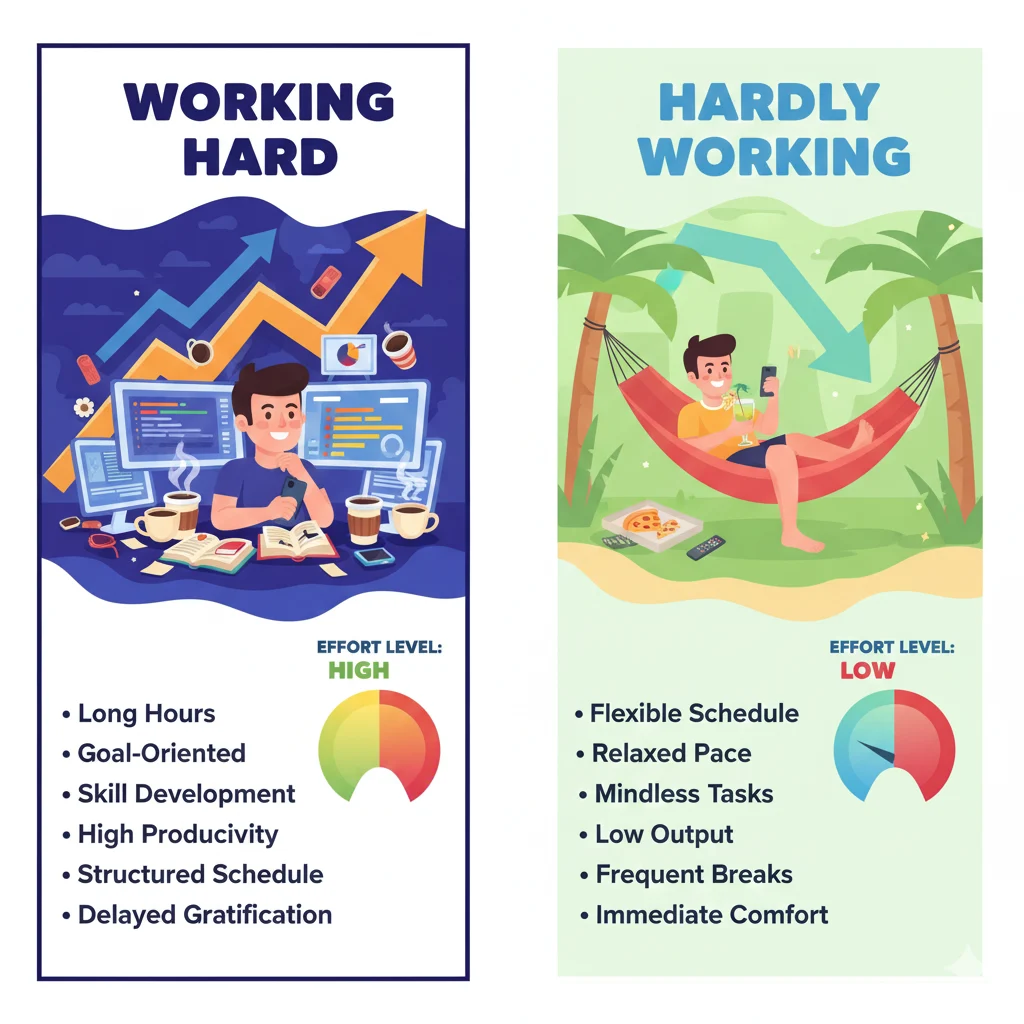
“Working hard” means putting in a lot of effort.
“Hardly working” means doing very little or almost nothing.
👉 They sound similar, but their meanings are completely opposite. Mixing them up can change your message or even make it sound funny.
People often hear the phrase “working hard or hardly working?” as a joke at school, in offices, or on social media. Because the words hard and hardly look similar, many learners think they mean the same thing. They don’t.
This confusion is very common, even for adults who speak English well. One small word can flip the meaning of a whole sentence.
In this simple guide, you’ll learn:
- The meaning of working hard and hardly working
- The key difference between them
- How to use each phrase correctly in real life
- Common mistakes and how to avoid them
This lesson is written in very easy English, so even a class 4 student can understand it clearly.
What Does “Working Hard” Mean?

Meaning (Simple Explanation)
Working hard means putting in a lot of effort. It means you are busy, focused, and trying your best.
Part of Speech
- Working → verb (action)
- Hard → adverb (tells how you work)
Easy Examples
- She is working hard to pass her exams.
- My father is working hard to support our family.
- The team is working hard on the school project.
Simple Story
Ali studies every day after school. He finishes his homework and practices math. His teacher says,
👉 “Ali is working hard.”
Remember:
If someone is busy and trying their best, they are working hard.
What Does “Hardly Working” Mean?
Meaning (Simple Explanation)
Hardly working means almost not working at all. It shows very little effort.
Part of Speech
- Hardly → adverb (means “almost not”)
- Working → verb
Easy Examples
- He is hardly working and keeps checking his phone.
- The student was hardly working during class.
- She sat at her desk but was hardly working.
Simple Story
Sara sits at her desk all day but plays games on her phone. Her friend laughs and says,
👉 “You’re hardly working!”
Important:
“Hardly” does NOT mean “hard.”
It means almost not.
The Key Difference Between Working Hard and Hardly Working
| Phrase | Meaning | Effort Level | Example Sentence |
|---|---|---|---|
| Working hard | Doing a lot of work | High effort | He is working hard for his exams. |
| Hardly working | Doing almost no work | Very low effort | He is hardly working at his desk. |
Quick Tip to Remember
- Hard = strong effort
- Hardly = almost none
If you see -ly, think “little or none.”
Common Mistakes and How to Avoid Them
❌ Common Mistake 1
Wrong: He is hardly working to finish the project.
Right: He is working hard to finish the project.
➡ Why? Because finishing a project needs effort.
❌ Common Mistake 2
Wrong: She is working hard and watching videos all day.
Right: She is hardly working and watching videos all day.
➡ Why? Watching videos shows little effort.
❌ Common Mistake 3
Wrong: I am hardly working for my exams.
Right: I am working hard for my exams.
➡ Tip: Exams need effort → use working hard.
When to Use “Working Hard”
Use working hard when someone is:
- Busy
- Focused
- Making strong effort
- Trying their best
Real-Life Examples
- I am working hard on my homework.
- She is working hard to learn English.
- The farmers are working hard in the fields.
- He is working hard to save money.
- We are working hard as a team.
Memory Trick
🧠 Hard work = strong effort = success
Picture someone sweating and smiling after finishing work.
When to Use “Hardly Working”
Use hardly working when someone is:
- Lazy
- Distracted
- Doing almost nothing
- Pretending to work
Real-Life Examples
- He is hardly working and talking all the time.
- The kids were hardly working in class.
- She looks busy but is hardly working.
- I was tired and hardly working today.
- He sat at his desk but was hardly working.
Memory Hack
🧠 Hardly = barely
Picture someone sitting, yawning, and doing nothing.
Quick Recap: Working Hard vs Hardly Working
- Working hard
- Means strong effort
- Positive meaning
- Shows dedication
- Hardly working
- Means almost no effort
- Often negative or joking
- Shows laziness
👉 Same words, opposite meanings.
Advanced Tips (For Extra Confidence)
Word Origin (Simple)
- Hard comes from Old English meaning “strong” or “firm.”
- Hardly developed to mean “barely” or “almost not.”
In Exams and Formal Writing
- Teachers expect working hard when praising effort.
- Using hardly working by mistake can lose marks.
In Texting and Online Writing
- “LOL, working hard or hardly working?” is often used as a joke.
- Be careful in serious writing—wrong use can sound rude or lazy.
Mini Quiz: Test Yourself
Fill in the blanks with working hard or hardly working.
- She is ________ to improve her grades.
- He was ________ and playing games all day.
- My parents are ________ for our future.
- The worker looked busy but was ________.
- I am ________ on my English skills.
- They were tired and ________ at work.
Quiz Answers
- working hard
- hardly working
- working hard
- hardly working
- working hard
- hardly working
FAQs
1. What does “working hard” mean?
It means putting in a lot of effort and trying your best.
2. What does “hardly working” mean?
It means doing very little or almost no work.
3. Are “working hard” and “hardly working” the same?
No. They have opposite meanings.
4. Why do people confuse working hard and hardly working?
Because the words sound similar, but “hardly” changes the meaning.
5. Is “hardly working” rude?
It can sound joking or critical, depending on the situation.
Conclusion
Now you clearly understand the difference between working hard or hardly working. One phrase shows effort and dedication. The other shows little or no effort. A small word makes a big difference in meaning.
Practice using both phrases in daily sentences. The more you use them, the more confident you’ll become. English gets easier when you notice these small details. Keep learning, keep practicing, and keep improving every day.

Isla Merrin is a language and writing expert at Definevs.com, creating simple, engaging guides to help readers master words, grammar, and modern English usage.