Have you ever paused mid-sentence, wondering whether to say “Who” or “Whom”? 🤔
You’re not alone! Many English learners (and even native speakers!) mix these two words. They look similar, sound similar, and both talk about people — but their roles in a sentence are different.
In this friendly guide, you’ll learn the difference between who and whom, their meanings, correct usage, and simple tricks to remember which one fits where. By the end, you’ll be using both words like a pro! 🌟
📘 What Does Each Word Mean?
Let’s start by understanding what “who” and “whom” actually mean in English.
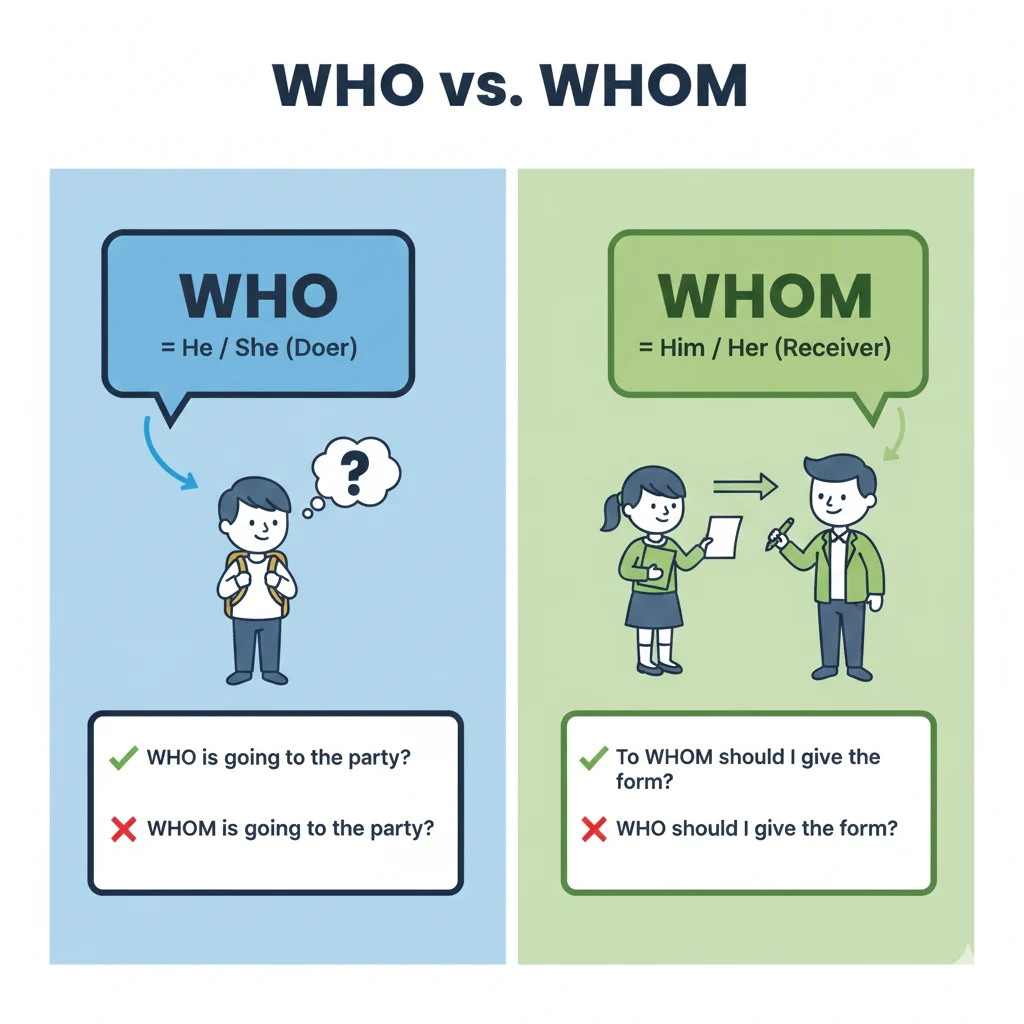
🟦 WHO
Part of speech: Pronoun (used as the subject of a sentence).
“Who” refers to the person doing the action.
✅ Examples:
- Who is calling me?
- Who opened the door?
- Do you know who made this cake?
Think of “who” as the doer — the one performing the action.
🟪 WHOM
Part of speech: Pronoun (used as the object of a sentence).
“Whom” refers to the person receiving the action.
✅ Examples:
- Whom did you call?
- To whom should I send this letter?
- Whom are you waiting for?
If someone does something to them, we use whom.
⚖️ The Key Difference Between “Who” and “Whom”
Here’s a simple way to remember it:
👉 “Who” = they (subject)
👉 “Whom” = Him/Her (object)
| Usage | Who | Whom |
|---|---|---|
| Role | Subject (does the action) | Object (receives the action) |
| Replaces | He / She / They | Him / Her / Them |
| Example | Who called you? (He called) | Whom did you call? (You called him) |
| Used In | Questions & statements about doers | Questions & statements about receivers |
💡 Quick Tip to Remember:
If you can replace the word with they, use who.
If you can replace it with him/her, use whom.
✅ Example:
- “Who/Whom did you meet?” → You met him, so use whom.
- “Who/Whom is coming to the party?” → He is coming, so use who.

🚫 Common Mistakes and How to Avoid Them
Even advanced learners sometimes get this wrong! Let’s fix that:
❌ Incorrect: Who did you give the gift to?
✅ Correct: Whom did you give the gift to?
(You gave it to him/her → use whom)
❌ Incorrect: Whom is knocking at the door?
✅ Correct: Who is knocking at the door?
they is knocking → use who)
❌ Incorrect: Do you know whom is calling?
✅ Correct: Do you know who is calling?
(Who is doing the calling → subject)
👉 Why these mistakes happen:
Because “whom” sounds formal and rare, people often overuse “who” instead. But remembering the subject-object rule makes it simple!
👩🏫 When to Use “Who”
Use who when you’re talking about someone doing an action — the subject of a verb.
✅ Examples:
- Who is going to school today?
- Do you know who won the race?
- Who made this delicious cake?
- Tell me who called you.
- Who is sitting in your chair?
📘 Memory Hack:
If you can replace the word with “he” or “she,” it’s who!
(He made the cake → Who made the cake?)
💌 When to Use “Whom”
Use whom when the person is receiving the action — the object of a verb or preposition.
✅ Examples:
- Whom did you see at the park?
- To whom should I address this letter?
- Whom are you talking to?
- Whom did the teacher praise?
- For whom are these flowers?
📘 Memory Hack:
If you can replace it with “him” or “her,” it’s whom!
(I saw him → Whom did you see?)
🧩 Quick Recap: Who vs Whom
- Who = Subject = He/She/They = Does the action.
- Whom = Object = Him/Her/Them = Receives the action.
- Tip: He → Who. Him → Whom.
🔹 Who: Who ate the cookie? (He did.)
🔹 Whom: Whom did you invite? (You invited him.)
✨ Simple Trick:
If you can answer the question with they, use who.
If you can answer with him/her/them, use whom.
📚 Advanced Tips for Learners
⭐ 1. Origin:
“Who” comes from Old English hwā, and “whom” is its old-fashioned object form hwām.
⭐ 2. Modern Use:
In modern English, especially in everyday speech, “whom” is often replaced by “who” — and that’s okay in casual conversations!
But in formal writing, essays, and exams, using whom correctly shows strong grammar skills. 💪
⭐ 3. Texting & Online Writing:
Most people say “Who are you talking to?” instead of “Whom are you talking to?” — both are understood, but the second is grammatically correct.
⭐ 4. Academic Use:
Use “whom” in professional letters, formal emails, or school essays when you want to sound polished and correct.
⭐ 5. Fun Trick:
If you feel unsure, use “who” in casual talk and “whom” when writing formally — you’ll always sound natural!
🧠 Mini Quiz: Test Yourself!
Fill in the blanks with who or whom 👇
- _______ is knocking on the door?
- To _______ should I give this message?
- Do you know _______ painted this picture?
- _______ did you invite to the wedding?
- I wonder _______ will lead the team this year.
- For _______ did you buy this present?
- _______ wants to come with me?
✅ Answers: 1. Who 2. Whom 3. Who 4. Whom 5. Who 6. Whom 7. Who
💬 FAQs
1. What is the main difference between who and whom?
“Who” is used for the subject (the doer), while “whom” is used for the object (the receiver).
2. Is “whom” still used in modern English?
Yes, mostly in formal writing, but “who” is common in casual conversation.
3. How can I easily remember when to use whom?
If you can replace it with him or her, it’s whom.
4. Can I always use “who” instead of “whom”?
In everyday speech, yes — but for formal or academic writing, use “whom” correctly.
5. Is it wrong to say “Who are you talking to?”
Not really. It’s widely accepted, though “Whom are you talking to?” is the traditional form.
🌟 Conclusion
Now you know the real difference between who and whom — and it’s simpler than it seemed! 🎉
Use who for the doer of the action and whom for the receiver. With practice, you’ll start choosing the right one naturally. Remember, grammar isn’t scary — it’s a fun puzzle that helps you speak and write clearly. 💬
Keep learning, keep practicing, and soon your English will sound smooth, smart, and confident! 🌈

Arwen Blythe is a passionate language and culture enthusiast, crafting clear, engaging guides on words, phrases, and modern English for Definevs.com readers.