Have you ever paused while writing a sentence and thought, “Should I say who or whom?” 🤔
Don’t worry — you’re not alone! Even native English speakers get confused about when to use who and whom.
Both words are pronouns, but they’re used in different grammatical roles.
This simple guide will help you understand:
- The meaning of who and whom
- The difference between them
- Easy examples and memory tricks to remember which one fits
- Plus, a quick quiz to test what you learned
By the end, you’ll never mix up who vs whom again — promise! ✨
🧐 What Does Each Word Mean?
Let’s start simple. Both who and whom refer to people — not things.
But their jobs in a sentence are different.
✅ What Does “Who” Mean?
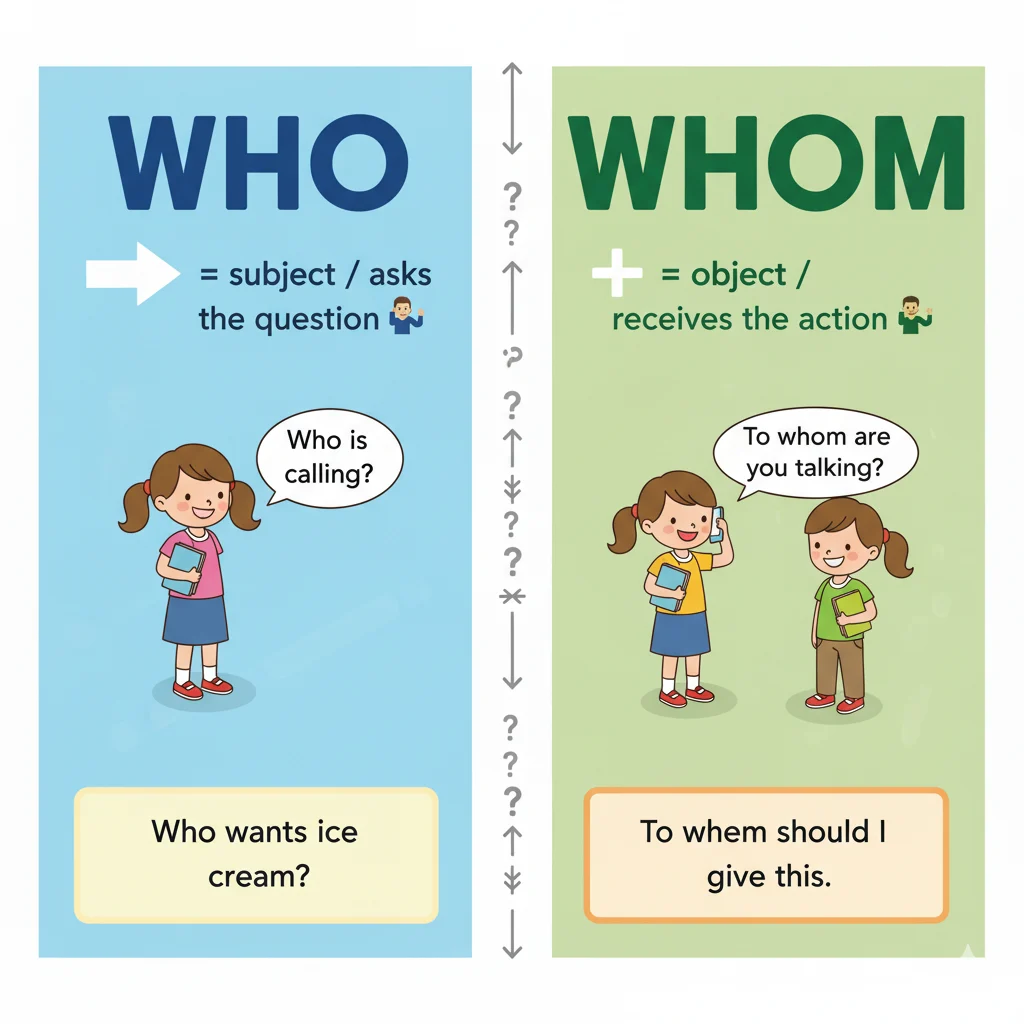
Who is used when referring to the subject of a sentence — the person doing the action.
Part of speech: Pronoun (subject)
Examples:
- Who is calling me?
- I wonder who broke the glass.
- Who wants to play football?
Quick Tip:
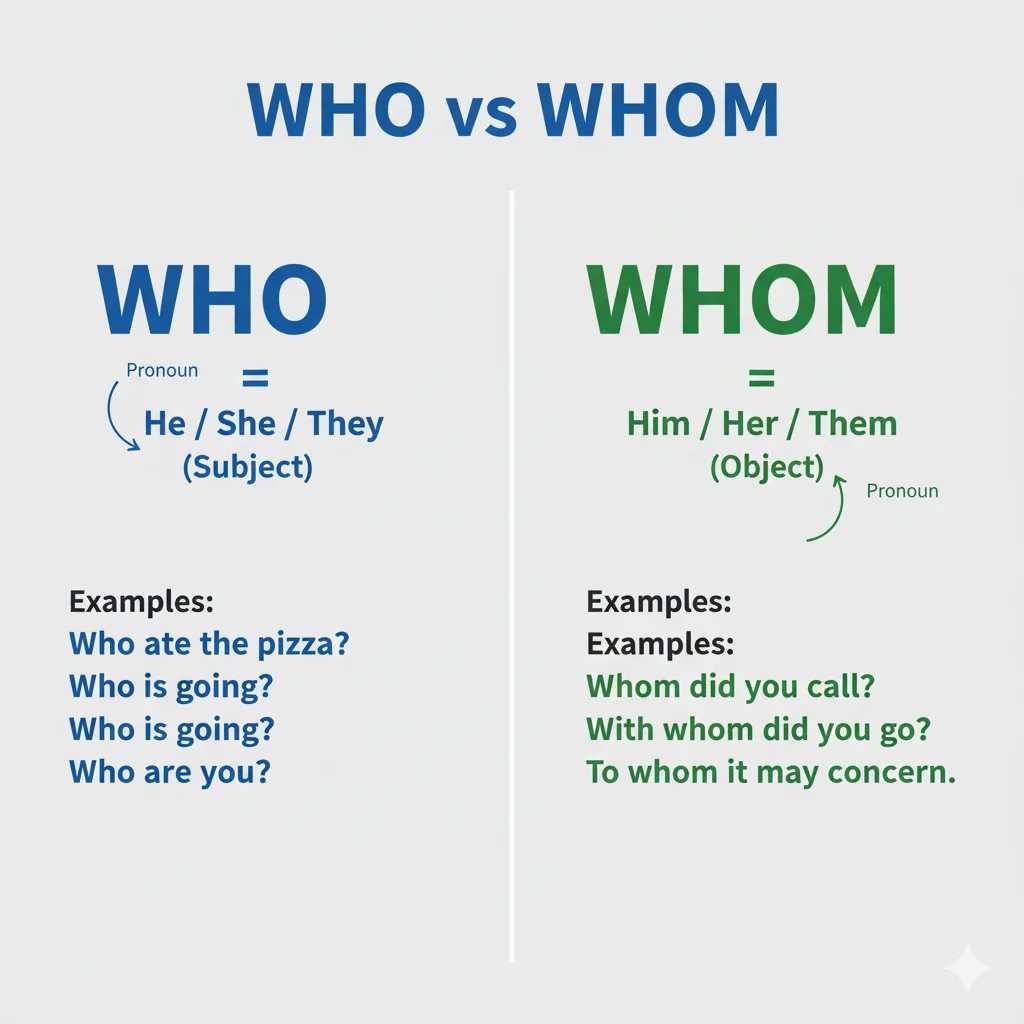
If you can replace it with they/they, use who.
👉 Example: Who is there? → He is there. ✅
✅ What Does “Whom” Mean?
Whom is used when referring to the object of a sentence — the person receiving the action.
Part of speech: Pronoun (object)
Examples:
- To whom did you give the gift?
- I don’t know whom to invite.
- Whom are you talking about?
Quick Tip:
If you can replace it with him/her/them, use whom.
👉 Example: You invited whom? → You invited him. ✅
⚖️ The Key Difference Between “Who” and “Whom”
The difference comes down to who is doing the action and who is receiving it.
| Aspect | Who | Whom |
|---|---|---|
| Grammatical Role | Subject (does the action) | Object (receives the action) |
| Replace With | He / She / They | Him / Her / Them |
| Example Sentence | Who ate the cake? | To whom was the cake given? |
| Common Use | Everyday speech | Formal writing or polite speech |
Quick Trick to Remember:
👉 If you can answer with “he,” use who.
👉 If you can answer with “him,” use whom.
(Hint: “M” in whom matches with “M” in him.)
🚫 Common Mistakes and How to Avoid Them
Let’s look at some typical mix-ups:
❌ Incorrect: Who did you give the pen to?
✅ Correct: Whom did you give the pen to?
🧩 Why: The person is receiving the pen → use whom.
❌ Incorrect: Whom is knocking at the door?
✅ Correct: Who is knocking at the door?
🧩 Why: The person is doing the action → use who.
❌ Incorrect: I don’t know who to trust.
✅ Correct (formal): I don’t know whom to trust.
🧩 Note: In casual English, “who” is often used instead of “whom,” and that’s okay in informal settings!
✍️ When to Use “Who”
Use who when you are talking about someone doing something.
Examples:
- Who wants to go first?
- Do you know who wrote this book?
- Tell me who called you last night.
- Who is the new teacher?
- Who helped you with your homework?
Memory Hack:
Think of a superhero 🦸♂️ — Who saves the day!
That’s because “who” is the doer (subject) of the action.
🗣️ When to Use “Whom”
Use whom when someone is receiving an action — often after a preposition like to, with, by, or for.
Examples:
- To whom should I send the email?
- Whom are you waiting for?
- With whom are you going to the party?
- I met a writer whom I really admire.
- She is someone whom I respect deeply.
Memory Hack:
If you can put “to,” “for,” or “with” before it, whom is probably correct!
👉 “To whom,” “for whom,” “with whom,” etc.
🧩 Quick Recap: Who vs Whom
- Who = Subject (they/they) → The person doing the action.
- Whom = Object (him/her/them) → The person receiving the action.
- Trick: If you can replace it with “he,” use who; if “him,” use whom.
- Common rule: “Whom” is more formal; “who” is used more in everyday speech.
🌍 Advanced Tips and Grammar Insights
- In modern English, “whom” is less common in casual speech. Most people say “who” even when “whom” is technically correct.
Example: “Who are you talking to?” instead of “To whom are you talking?” - However, in formal writing, “whom” still appears — in essays, letters, and official communication.
Example: “The person to whom this letter is addressed…” - Historically, “whom” comes from Old English grammar rules that distinguished between subjects and objects (like “he” vs “him”).
- Using “whom” correctly can make your writing sound polished and professional.
🧠 Mini Quiz: Test Yourself!
Fill in the blanks with who or whom.
- _______ is going to the store?
- To _______ should I send this invitation?
- _______ made this delicious cake?
- With _______ did you go to the concert?
- Do you know _______ won the prize?
- I’m not sure _______ she invited.
- _______ is calling my name?
✅ Answers: 1. Who 2. Whom 3. Who 4. Whom 5. Who 6. Whom 7. Who
❓ FAQ Section
1. What is the difference between who and whom?
Who is used for the person doing the action; whom is used for the person receiving it.
2. Is it okay to use “who” instead of “whom”?
Yes, in casual conversation it’s fine. But in formal writing, use whom when it’s the object of the sentence.
3. How can I easily remember the rule?
Think: he = who and him = whom. The “M” in “whom” matches the “M” in “him.”
4. Do native speakers use “whom”?
Not very often in speech — but they still use it in writing, especially in professional or academic contexts.
5. Can I start a question with “whom”?
Yes! Example: “Whom did you see?” But it may sound formal. Most people would say “Who did you see?”
🏁 Conclusion
And there you have it! 🎉
The difference between who and whom is simple once you know the rule:
👉 Who = subject (they), Whom = object (him/her).
Now that you know when to use each word, try practicing with your own sentences. The more you use them, the more natural it’ll feel — for real! 💪
Keep learning, stay curious, and soon you’ll be the “grammar pro” in your group chats and classrooms. 📚✨

Mira Loxley is a passionate language and writing expert at Definevs.com, turning tricky words and grammar into clear, engaging guides for every reader.