Have you ever stopped mid-sentence wondering, “Should I say who or whom?”
You’re not alone — even native English speakers mix them up all the time!
Both “who” and “whom” are used to talk about people, but they play different grammar roles in a sentence. The confusion happens because “whom” sounds formal, and in everyday talk, most people just say “who.”
In this simple guide, you’ll learn:
- What who and whom mean
- The difference between them
- When to use each correctly
- Real-life examples, quick tips, and a memory hack to make it easy forever
By the end, you’ll confidently know when to use whom or who in any sentence — for real!
🧩 What Does Each Word Mean?
Let’s start with the basics — their meanings and roles in a sentence.
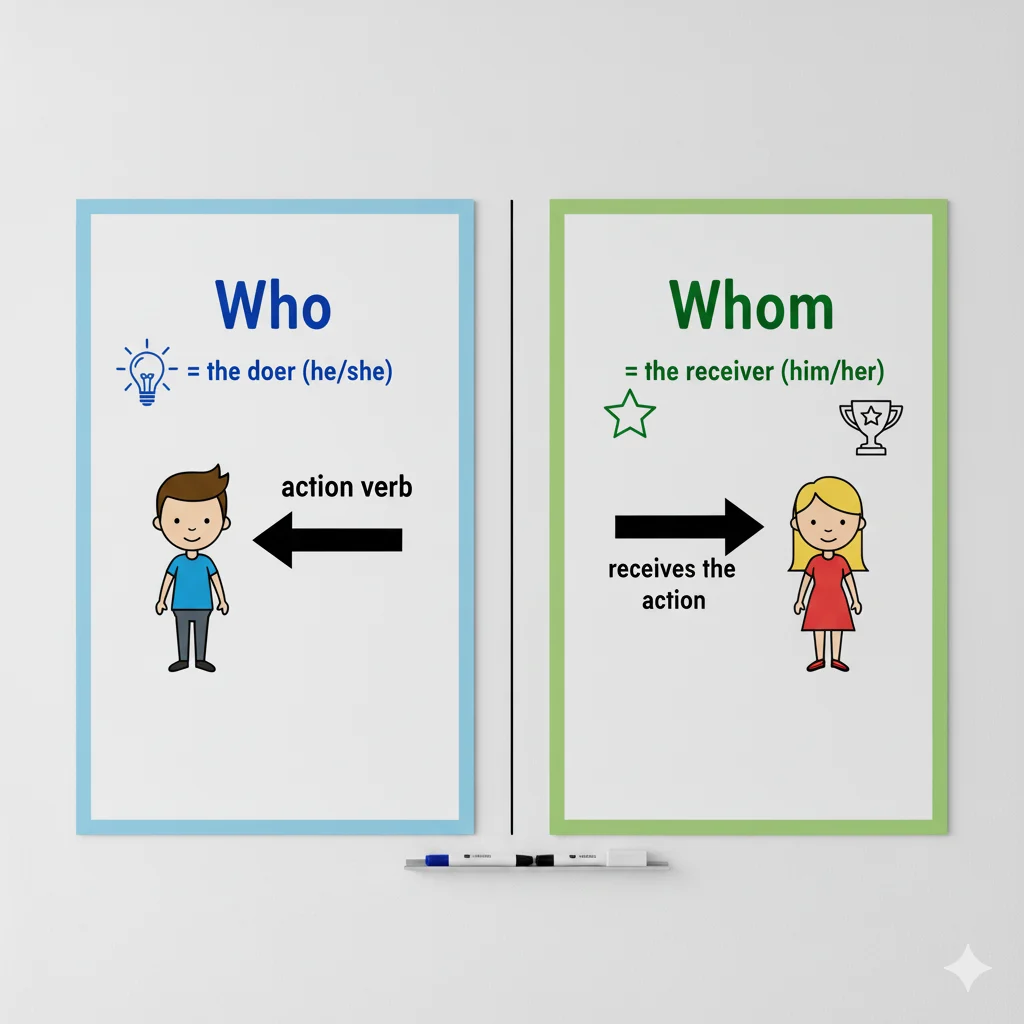
Who
- Part of speech: Pronoun
- Used for: The person doing the action (the subject)
Examples:
- Who is calling me?
- Who made this cake?
- Do you know who won the race?
👉 Think of “who” as the doer of the action — the person performing something.
Whom
- Part of speech: Pronoun
- Used for: The person receiving the action (the object)
Examples:
- Whom did you invite to the party?
- With whom are you going?
- To whom should I send this letter?
👉 Think of “whom” as the receiver — the person the action is done to.
⚖️ The Key Difference Between Who and Whom
The main difference lies in what role the word plays in a sentence:
| Function | Word to Use | Simple Rule | Example Sentence |
|---|---|---|---|
| When the person does the action | Who | Use “who” as the subject | “Who ate the last cookie?” |
| When the person receives the action | Whom | Use “whom” as the object | “Whom did you see at school?” |
💡 Quick Tip to Remember:
👉 If you can replace the word with he/she, use who.
👉 If you can replace it with him/her, use whom.
Example:
- “Who/Whom called you?” → He called me → ✅ Who
- “Who/Whom did you call?” → You called him → ✅ Whom
🚫 Common Mistakes and How to Avoid Them
Even advanced speakers make these mistakes — let’s fix them easily.
❌ Mistake 1: “Whom is coming to the party?”
✅ Correct: “Who is coming to the party?”
(“Who” is doing the action → attending the party.)
❌ Mistake 2: “Who did you give the book to?”
✅ Correct: “Whom did you give the book to?”
(“Whom” receives the action → the book is given to whom.)
❌ Mistake 3: “Whom made the cake?”
✅ Correct: “Who made the cake?”
(“Who” is the doer → the one baking.)
👉 Why it happens:
People use “whom” when trying to sound formal but forget its grammatical role. Remember: if they do the action, it’s “who.”
🧠 When to Use “Who”
Use who when referring to the subject — the one performing the action.
✅ Examples of Correct Usage:
- Who opened the door?
- Who wants pizza for lunch?
- Who told you that secret?
- Who is responsible for this project?
- Do you know who called earlier?
💡 Memory Hack:
Think of “who” as a superhero — the one taking action, saving the day, or doing something.
📬 When to Use “Whom”
Use whom when referring to the object — the person receiving the action.
✅ Examples of Correct Usage:
- Whom did you see at the mall?
- With whom are you studying?
- Whom should I contact about this form?
- The teacher asked whom we chose as class leader.
- To whom should the package be delivered?
💡 Memory Trick:
If you can replace it with “him” or “her,” it’s whom.
For example:
“You saw him.” → “Whom did you see?”
🔍 Quick Recap: Who vs Whom
Let’s summarize everything in simple bullet points:
- Who = the subject → does the action
- Whom = the object → receives the action
- Who = he/she, Whom = him/her
- Use “who” when asking who is doing something
- Use “whom” when asking to or for whom something is done
📘 Advanced Tips (For Grammar Lovers)
- History: “Whom” comes from Old English and used to be common in formal writing. But in modern English, “whom” is slowly disappearing in everyday speech.
- Formal vs Informal Use:
- Formal: “To whom it may concern.”
- Informal: “Who are you talking to?”
- Exams or Academic Writing: Always use whom correctly — it still matters in essays, tests, and professional writing.
- In Texting or Social Media: Most people say “who,” even when “whom” is correct — and that’s okay in casual settings!
📝 Mini Quiz: Test Yourself!
Fill in the blanks with who or whom 👇
- _______ is your best friend?
- To _______ did you send the email?
- _______ called you yesterday?
- With _______ are you going to the concert?
- _______ wants to join the club?
- For _______ should I save a seat?
- Do you know _______ made this cake?
(Answers: 1. Who, 2. Whom, 3. Who, 4. Whom, 5. Who, 6. Whom, 7. Who)
🙌 Conclusion
Now you know exactly when to use whom or who!
Remember:
- “Who” does the action.
- “Whom” receives the action.
With a little practice, you’ll never hesitate again while writing or speaking.
Keep learning small grammar tips like this — and your English will get stronger every single day! 🌟

Kael Donovan is a language enthusiast and writer at Definevs.com, simplifying complex words and grammar rules into fun, easy-to-understand guides for readers.