Have you ever stopped mid-sentence wondering if you should say “who” or “whom”? You’re not alone! Even native English speakers often mix these two words up.
Both “who” and “whom” are common in English, but they’re used in different grammatical situations. Knowing which one to use can make your writing sound clear and confident.
In this guide, you’ll learn:
- The meaning of “who” and “whom”
- The difference between them
- Simple grammar tips to know which one fits best
- Examples, common mistakes, and a quick quiz to test yourself
Bachelor’s Degree / Bachelors Degree: The Tiny Detail You’re Getting Wrong 😮
📘 What Does Each Word Mean?
Let’s start by understanding what “who” and “whom” actually mean.
🧍 What Does “Who” Mean?
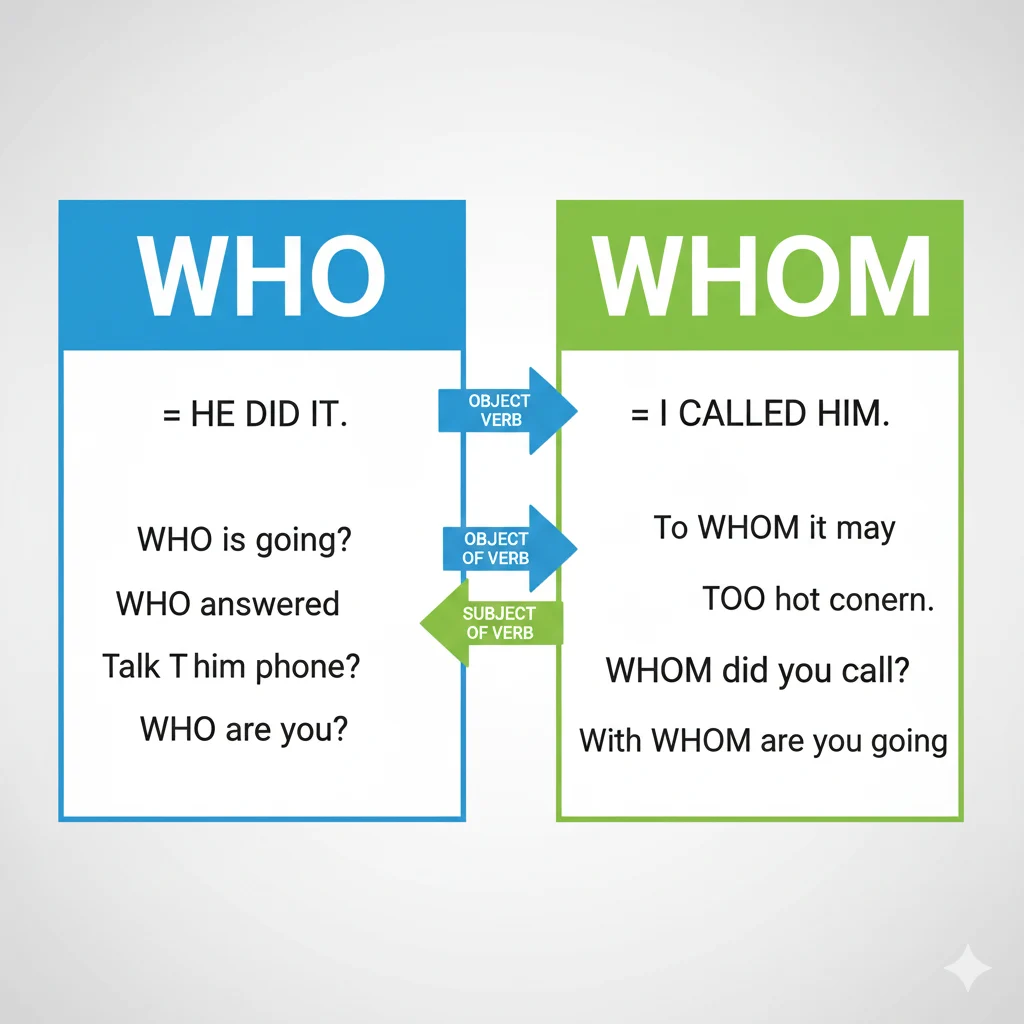
“Who” is a subject pronoun — it’s used when the person is doing the action in a sentence.
Think of “who” = he/she/they.
✅ Examples:
- Who called you last night? (→ He called you.)
- Do you know who won the game? (→ She won the game.)
- Who made this cake? It’s delicious!
🧑🏫 What Does “Whom” Mean?
“Whom” is an object pronoun — it’s used when the person is receiving the action.
Think of “whom” = him/her/them.
✅ Examples:
- To whom should I address the letter? (→ Address it to him.)
- Whom did you invite to the party? (→ You invited her.)
- With whom are you going? (→ I’m going with them.)
💡 Quick Trick:
👉 If you can replace the word with they, use who.
👉 If you can replace it with him/her, use whom.
⚖️ The Key Difference Between “Who” and “Whom”
Here’s a simple comparison to make it crystal clear 👇
| Feature | Who | Whom |
|---|---|---|
| Part of Speech | Subject pronoun | Object pronoun |
| Used for | The person doing the action | The person receiving the action |
| Test Word | He / She | Him / Her |
| Example Sentence | Who made the call? → He did. | Whom did you call? → You called him. |
📌 Quick Tip to Remember:
If you can answer the question with they, use who.
If you can answer with him/her, use whom.
(Hint: “m” in “whom” matches the “m” in “him.” Easy, right?)
❌ Common Mistakes and How to Avoid Them
Even advanced speakers slip up on this one. Let’s fix the most common errors.
❌ Wrong: Who should I talk to?
✅ Correct: Whom should I talk to?
👉 Because you’re talking to someone (object).
❌ Wrong: Whom made this?
✅ Correct: Who made this?
👉 Because “who” is the one doing the action (subject).
❌ Wrong: I don’t know whom is coming.
✅ Correct: I don’t know who is coming.
👉 Because “who” is the subject of “is coming.”
🧠 Memory Tip:
If you can swap the word for they, it’s “who.”
If you can swap for him/her, it’s “whom.”
🕵️ When to Use “Who”
Use “who” when you’re talking about the doer — the person performing the action.
✅ Examples:
- Who broke the vase?
- Who is at the door?
- Do you know who likes pizza the most?
- Who helped you with your homework?
- Who told you that secret?
🎓 In simple words:
“Who” = the person doing something.
It’s like saying “He did it.”
🎯 When to Use “Whom”
Use “whom” when the person is affected by or receiving the action.
✅ Examples:
- Whom did you call after the game?
- To whom was the package sent?
- Whom are you thinking about?
- With whom did you go to the concert?
- Whom should we choose for the team?
💡 Memory Hack:
If the sentence already has a preposition (to, with, for, by, from), it’s usually whom.
- “To whom,” “with whom,” “for whom,” “by whom” → all correct.
🧾 Quick Recap: Who vs Whom
Let’s summarize everything in one place:
- Who = subject (the doer) → they
- Whom = object (the receiver) → Him/her
- Test Rule:
- If you can replace it with they, use who.
- If you can replace it with him/her, use whom.
- Prepositions (to, for, with, by) often mean you’ll need whom.
Example Recap:
- Who made the cake? → She did.
- Whom did you invite? → I invited him.
💡 Advanced Tips
- In everyday English, many people now use “who” even when “whom” is technically correct. Example:
- “Who are you talking to?” (Technically “whom,” but “who” is fine in casual speech.)
- In formal writing or exams, always use “whom” when it’s the object.
- Historically, “whom” comes from Old English and has been fading from daily speech — but it remains correct in professional or academic writing.
✏️ Mini Quiz: Test Yourself!
Choose the correct word (who/whom):
- _______ is your favorite teacher?
- To _______ did you send the message?
- _______ wants to join us for lunch?
- _______ are you waiting for?
- The man _______ fixed the car is my uncle.
- I don’t know _______ she invited to the wedding.
- _______ can help me with this math problem?
✅ Answers:
- Who
- Whom
- Who
- Whom
- Who
- Whom
- Who
❓ FAQs
1. What is the difference between “who” and “whom”?
“Who” is used for the subject (the doer), and “whom” is used for the object (the receiver of the action).
2. How can I easily remember when to use “whom”?
If you can replace it with him or her, use “whom.” The “m” in “whom” matches the “m” in “him.”
3. Can I use “who” instead of “whom” in conversation?
Yes! Most people do. “Whom” sounds formal, so it’s mainly used in writing or polite speech.
4. Is “whom” still grammatically correct?
Absolutely! It’s less common in speech but still correct — especially in essays, emails, and formal English.
5. Why is “to whom it may concern” correct?
Because “whom” is the object of the preposition “to.” That’s the traditional, formal phrasing.
🏁 Conclusion
Now you know exactly when to use “who” and “whom.”
Remember:
- Who = the doer (they)
- Whom = the receiver (him/her)
With these simple tricks, you’ll never mix them up again.
Keep practicing, and soon it’ll feel natural — for real!

Kael Donovan is a language enthusiast and writer at Definevs.com, simplifying complex words and grammar rules into fun, easy-to-understand guides for readers.