Ever stopped mid-sentence wondering if you should write “to” or “too”? 🤔
You’re not alone — these two tiny words are among the most confusing in English! Both sound exactly the same but have different meanings and uses.
In this easy guide, you’ll learn:
- The simple meanings of to and too
- The difference between to and too
- When to use each word (with examples)
- Common mistakes and how to fix them
By the end, you’ll never mix them up again — even in school essays, texts, or emails!
📚 What Does Each Word Mean?
Let’s start by understanding what each word really means.
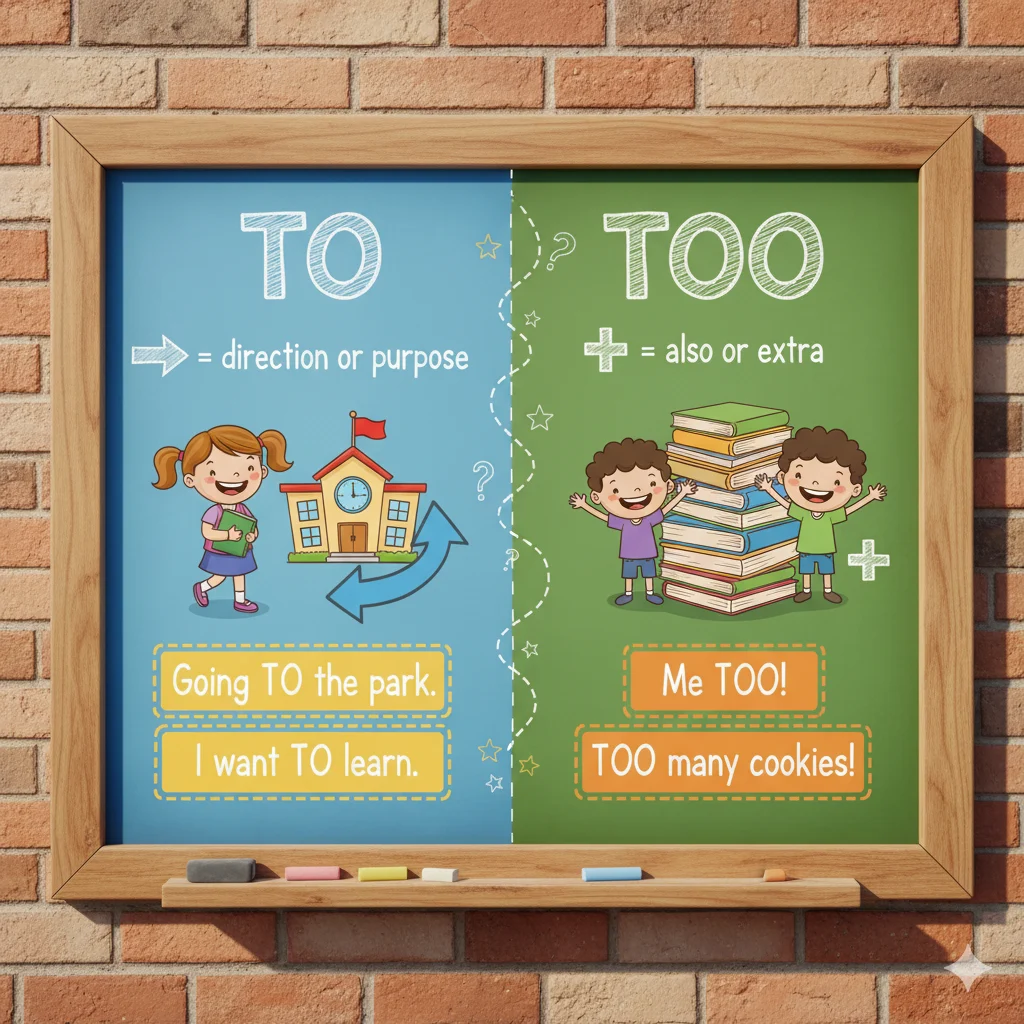
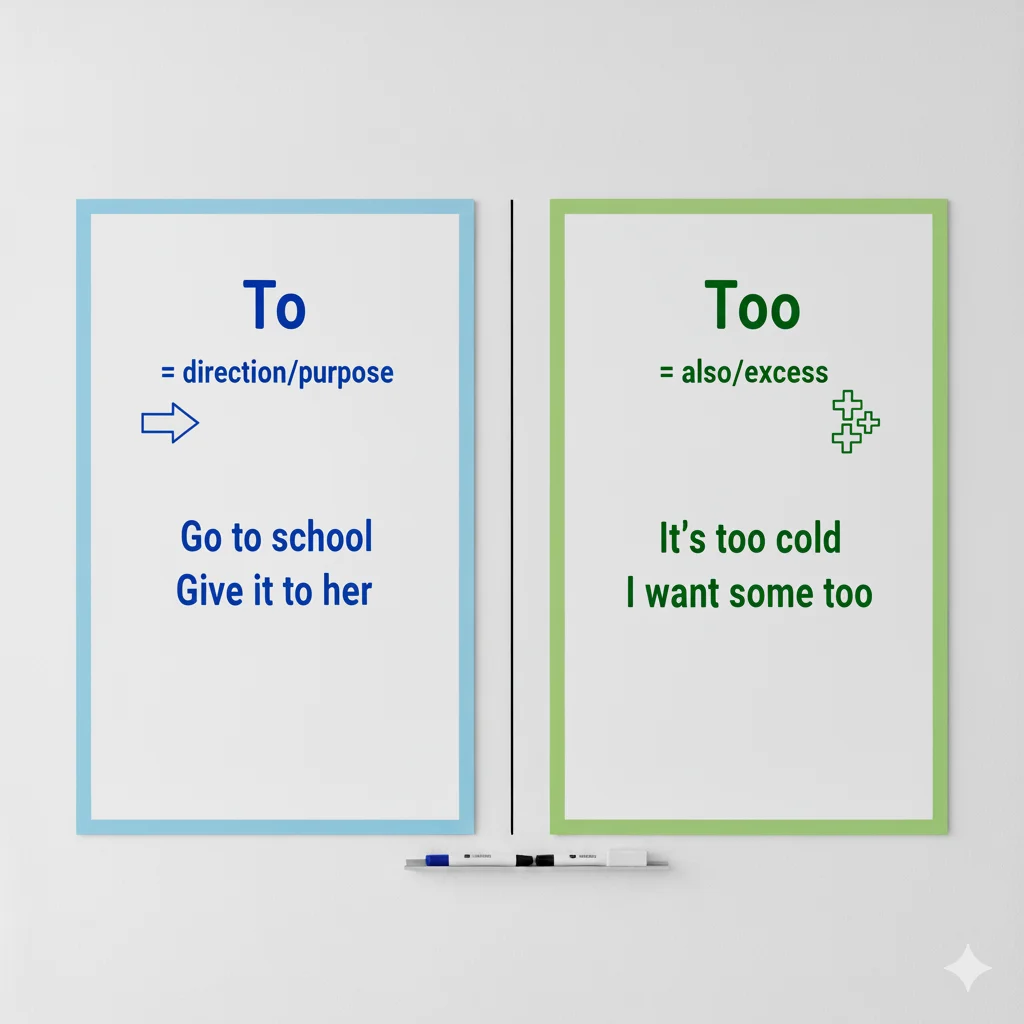
🟦 “To” – The Direction or Purpose Word
“To” is a preposition. It usually shows direction, purpose, or connection between words.
👉 It tells us where something is going, what someone wants to do, or who is involved.
Examples of “to”:
- I’m going to school. (shows direction)
- She wants to dance. (shows purpose)
- Give the book to Ali. (shows who receives it)
Think of “to” like a little arrow ➡️ that points toward a place, person, or goal.
🟩 “Too” – The Extra or Also Word
“Too” is an adverb. It means “also,” “in addition,” or “more than enough.”
Examples of “too”:
- Can I come too? (means “also”)
- It’s too hot outside. (means “very” or “excessively”)
- You’re driving too fast! (means “more than is good”)
Think of “too” as something extra — like when you pour too much syrup on pancakes 🍯.
⚖️ The Key Difference Between To and Too
Here’s a quick comparison to help you remember the difference between to and too.
| Feature | To | Too |
|---|---|---|
| Part of Speech | Preposition | Adverb |
| Main Meaning | Direction, purpose, or relation | Also, or more than enough |
| Example 1 | I’m going to the park. | I want to come too. |
| Example 2 | Give it to him. | It’s too cold today. |
| Quick Tip | Think of “to” as an arrow → (movement or goal) | Think of “too” as “extra o” = extra or also |
✅ Memory Hack: “Too” has two o’s — meaning “too much” or “also.”
❌ Common Mistakes and How to Avoid Them
Even native speakers mix these up! Let’s look at a few common mistakes and how to fix them.
❌ Mistake 1:
I want to go too the park.
✅ Correct: I want to go to the park.
(We use “to” because it shows direction.)
❌ Mistake 2:
That’s to funny!
✅ Correct: That’s too funny!
(We use “too” because it means “very” or “excessively.”)
❌ Mistake 3:
Can I come to?
✅ Correct: Can I come too?
(We use “too” when it means “also.”)
👉 Tip: If you can replace the word with “also” or “very,” use too.
If it shows movement or purpose, use to.
🧭 When to Use “To”
Use “to” when showing:
- Direction → going to school, walking to the park
- Purpose → want to learn, need to study
- Recipient → give it to him, say hi to her
- Infinitive verbs → to eat, to run, to dance
Examples:
- I’m going to the mall.
- He wants to sleep early.
- We gave the keys to Mom.
- Let’s go to the zoo tomorrow.
- She’s learning to play guitar.
👉 Quick Trick: If it connects one thing to another, use to.
🌟 When to Use “Too”
Use “too” when it means:
- Also / As well
- Very / Excessively
Examples:
- I love pizza too. (means “also”)
- It’s too loud in here. (means “very”)
- She talks too fast for me.
- Can we go too? (means “as well”)
- That shirt is too expensive.
🧠 Memory Hack:
Think of “too” as “too much” — it always adds something extra.
📝 Quick Recap: To vs Too
Here’s a short and simple summary:
- To = shows direction, purpose, or goal
→ “I’m going to the park.” - Too = means also or very
→ “It’s too hot.” / “I’m coming too.”
Quick Trick:
If you can replace it with also, use too.
If it connects two things (like a person or place), use to.
💡 Advanced Tips for Learners
- Origin:
“To” comes from Old English tō, meaning movement toward something.
“Too” came from tō as well, but later added an extra “o” to show excess or addition. - Formal Writing:
Always use the correct one — mixing them up can look careless in essays or emails. - In Texting:
You might see people skip one “o” in casual chats (“me to” instead of “me too”). That’s fine informally, but avoid it in school or work writing.
🧩 Mini Quiz — Test Yourself!
Fill in the blanks with to or too:
- I want ___ go to the movies.
- That cake is ___ sweet for me.
- Give this letter ___ your teacher.
- Can I join you guys ___?
- She’s going ___ buy a new phone.
- It’s never ___ late to learn!
Answers: 1️⃣ to 2️⃣ too 3️⃣ to 4️⃣ too 5️⃣ to 6️⃣ too ✅
❓ FAQs
1. What’s the difference between “to” and “too”?
“To” shows direction or purpose, while “too” means “also” or “very.”
2. When do I use “too” in a sentence?
Use “too” when you mean “also” or “more than enough.” Example: “I’m hungry too” or “It’s too cold.”
3. Can I use “to” at the end of a sentence?
Yes, if it’s part of a phrase. Example: “Where are you going to?”
4. Is “to” a preposition or an adverb?
“To” is a preposition, and sometimes it’s part of a verb phrase (like “to eat,” “to run”).
5. Why does “too” have two o’s?
Because it means something extra — the second “o” reminds you of “too much” or “also.”
🏁 Conclusion
Now you know exactly when to use “to” or “too.”
Remember:
- To = direction or purpose (go to the park)
- Too = also or very (me too, too cold)
Keep practicing by noticing these words in books, texts, or TV shows — and soon you’ll use them correctly without even thinking about it! 🌟

Arwen Blythe is a passionate language and culture enthusiast, crafting clear, engaging guides on words, phrases, and modern English for Definevs.com readers.