Ever stopped mid-sentence wondering if you should write “to” or “too”? You’re not alone! These two tiny words confuse even native English speakers.
Both sound the same but have different meanings and uses — one helps connect words (like “go to school”), while the other means “also” or “very” (like “I want to go too” or “That’s too hot”).
In this simple guide, you’ll learn:
- The meanings of “to” and “too”
- The key difference between them
- Examples and common mistakes
- When to use each word confidently
By the end, you’ll never hesitate again when typing or writing them.
📘 What Does Each Word Mean?
🔹 “To” — Meaning and Usage
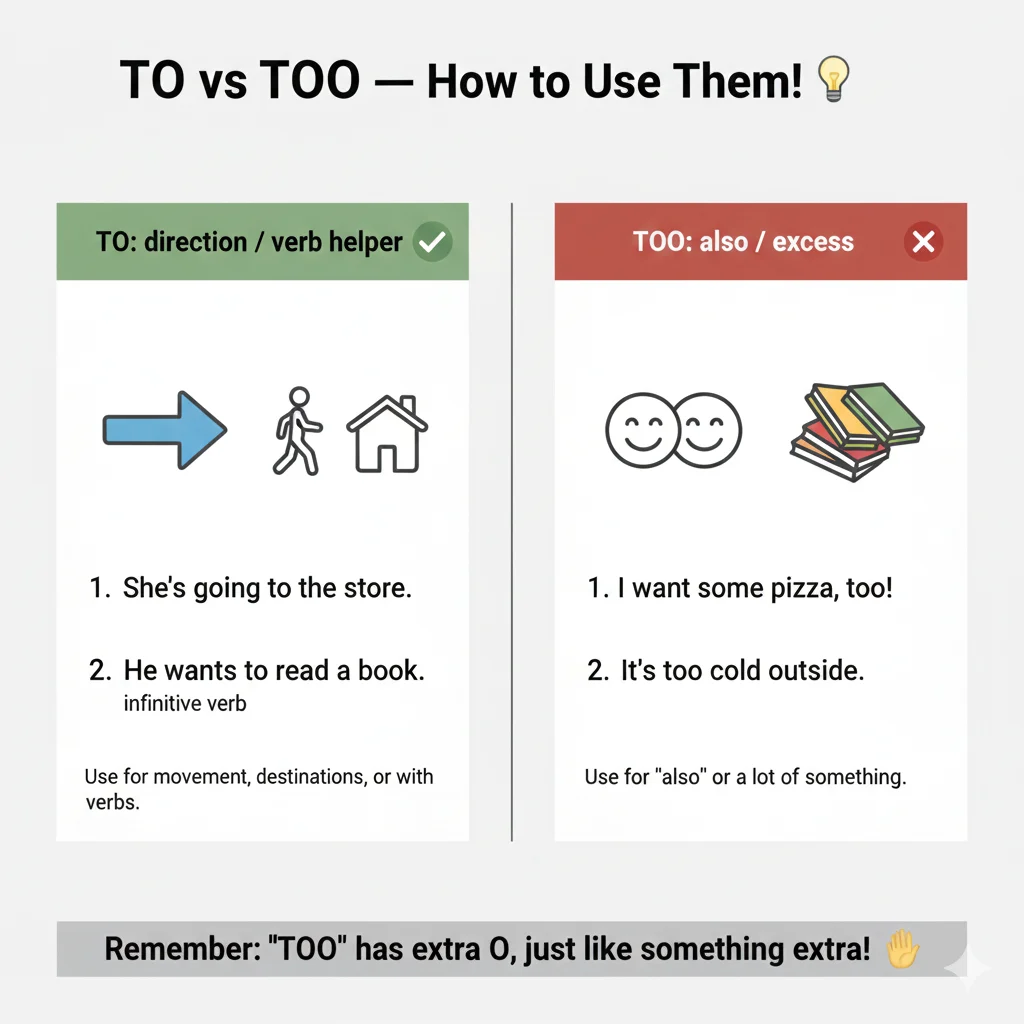
“To” is a preposition or a part of an infinitive verb. It usually shows direction, purpose, or connection.
Simple meaning: It tells where, why, or who something is related to.
Examples:
- I’m going to the park. (direction)
- She gave the book to her friend. (receiver)
- I want to eat ice cream. (before a verb = infinitive form)
🧠 Think of “to” as a little arrow ➜ showing movement or purpose.
🔹 “Too” — Meaning and Usage
“Too” is an adverb. It means “also,” “as well,” or “more than enough.”
Simple meaning: It shows addition or excess.
Examples:
- I like chocolate too. (also)
- That movie was too long. (more than enough)
- She’s too tired to walk. (excessive amount)
🧠 Think of “too” as meaning “extra” — it has an extra “o”!
⚖️ The Key Difference Between “To” and “Too”
Here’s a quick comparison to make it crystal clear:
| Feature | To | Too |
|---|---|---|
| Part of Speech | Preposition / part of verb | Adverb |
| Meaning | Shows direction, purpose, or relationship | Means “also” or “more than enough” |
| Examples | I’m going to school. | I’m coming too. |
| Quick Tip | Think of an arrow → (movement) | Think of “extra o” → extra meaning |
💡 Quick Tip to Remember:
If you can replace it with “also” or “very,” use “too.”
If it shows movement or connects a verb, use “to.”
❌ Common Mistakes and How to Avoid Them
Mistake 1:
❌ I’m going too school.
✅ I’m going to school.
Why: “To” shows direction or movement. “Too” doesn’t fit here.
Mistake 2:
❌ I want to go to.
✅ I want to go too.
Why: The last “too” means “also.”
Mistake 3:
❌ She’s to nice to everyone.
✅ She’s too nice to everyone.
Why: “Too” here means “very.”
🧠 Memory Hack: If the sentence sounds like “also” or “very,” it’s too.
If it’s pointing or connecting ideas, it’s to.
📍 When to Use “To”
Use “to” in these cases:
1. Showing direction or place
- I’m going to the beach.
- She walked to the door.
- We traveled to Paris last summer.
2. Indicating a relationship or purpose
- This gift is to you.
- I need this to finish my homework.
3. Before a verb (infinitive form)
- I want to learn Spanish.
- He loves to play football.
4. Showing a range or limit
- The store is open from 9 to 5.
- Count to ten before speaking.
🧠 Mini Tip:
“To” = motion or purpose.
If something or someone is moving or connecting → use to.
💡 When to Use “Too”
Use “too” in these cases:
1. To mean “also” or “as well”
- Can I come too?
- She likes pizza too.
- I want ice cream too!
2. To mean “more than enough” or “excessive”
- It’s too hot outside.
- This box is too heavy.
- He’s too young to drive.
3. To show intensity
- That was too funny!
- She’s too excited to sleep.
🧠 Memory Trick:
“Too” has two o’s — think of it as “too much” or “me too.”
🔄 Quick Recap: “To” vs “Too”
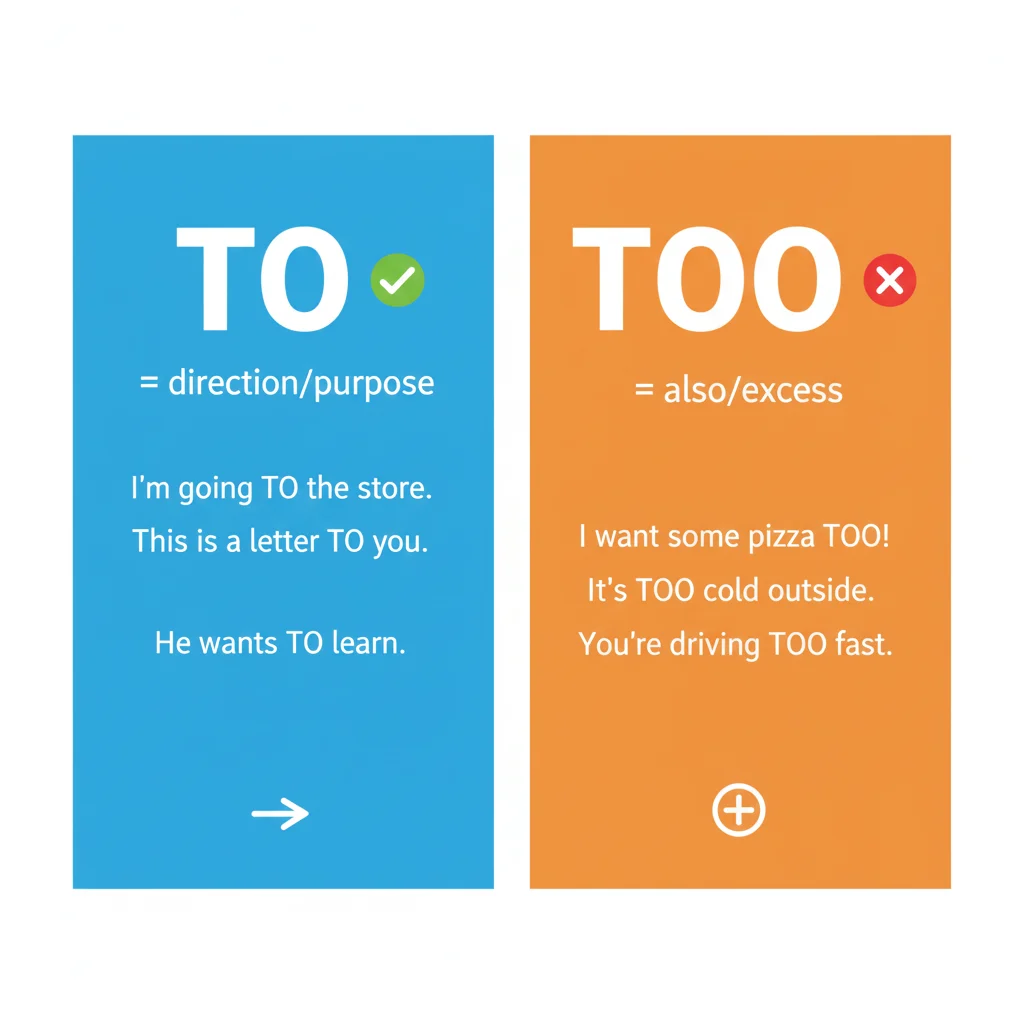
- To = direction, purpose, or connection.
- Too = also, very, or more than enough.
- Trick: If you can replace it with “also” or “very,” it’s too. Otherwise, it’s to.
Examples:
- I want to dance.
- I want to dance too.
- That’s too loud!
📸 Visual Suggestion: A quick recap chart with 3 example sentences showing the difference clearly.
🧠 Advanced Tips: Origins & Grammar Insight
- The word “to” comes from Old English tō, used to show direction or purpose for centuries.
- “Too” developed later from “to” but gained an extra “o” to show “in addition” or “excess.”
- In formal writing (like essays or letters), always check if your “too” adds meaning — if not, it might be “to.”
- In texting or social media, people sometimes write “to” instead of “too” (like “me to”), but that’s still a grammar mistake.
🧾 Pro Tip: Before hitting send, reread your sentence out loud. If it sounds like “also,” choose too. If it shows direction or connects a verb, choose to.
🧩 Mini Quiz: Test Yourself
Fill in the blanks with to or too.
- I’m going ___ the store.
- It’s ___ cold to go outside.
- Can I join you ___?
- She wants ___ become a doctor.
- He’s ___ busy to talk right now.
✅ Answers: 1. to, 2. too, 3. too, 4. to, 5. too
Bachelor’s Degree / Bachelors Degree: The Tiny Detail You’re Getting Wrong 😮
🏁 Conclusion
Now you know exactly when to use “to” or “too.” 🎉
- To = shows movement, purpose, or connection.
- Too = means “also” or “excess.”
Keep practicing by noticing how writers and speakers use them. The more you read and write, the easier it becomes — for real!
✨ Remember: “Too” has an extra “o” because it means extra or more.
Keep learning a little every day — your English will thank you for it.
🧩 FAQs
1. What is the difference between “to” and “too”?
“To” shows direction or purpose, while “too” means “also” or “more than enough.”
2. How do I know when to use “too”?
If you can replace the word with “also” or “very,” use “too.”
3. Can “to” be used before verbs?
Yes! Use “to” before verbs like “to eat,” “to run,” or “to go.”
4. What’s an easy trick to remember “too”?
“Too” has two o’s — think of it as meaning too much or me too.
5. Is it okay to use “to” instead of “too” in texting?
It’s common, but still incorrect in proper English. Always write “too” when you mean “also” or “very.”

Mira Loxley is a passionate language and writing expert at Definevs.com, turning tricky words and grammar into clear, engaging guides for every reader.