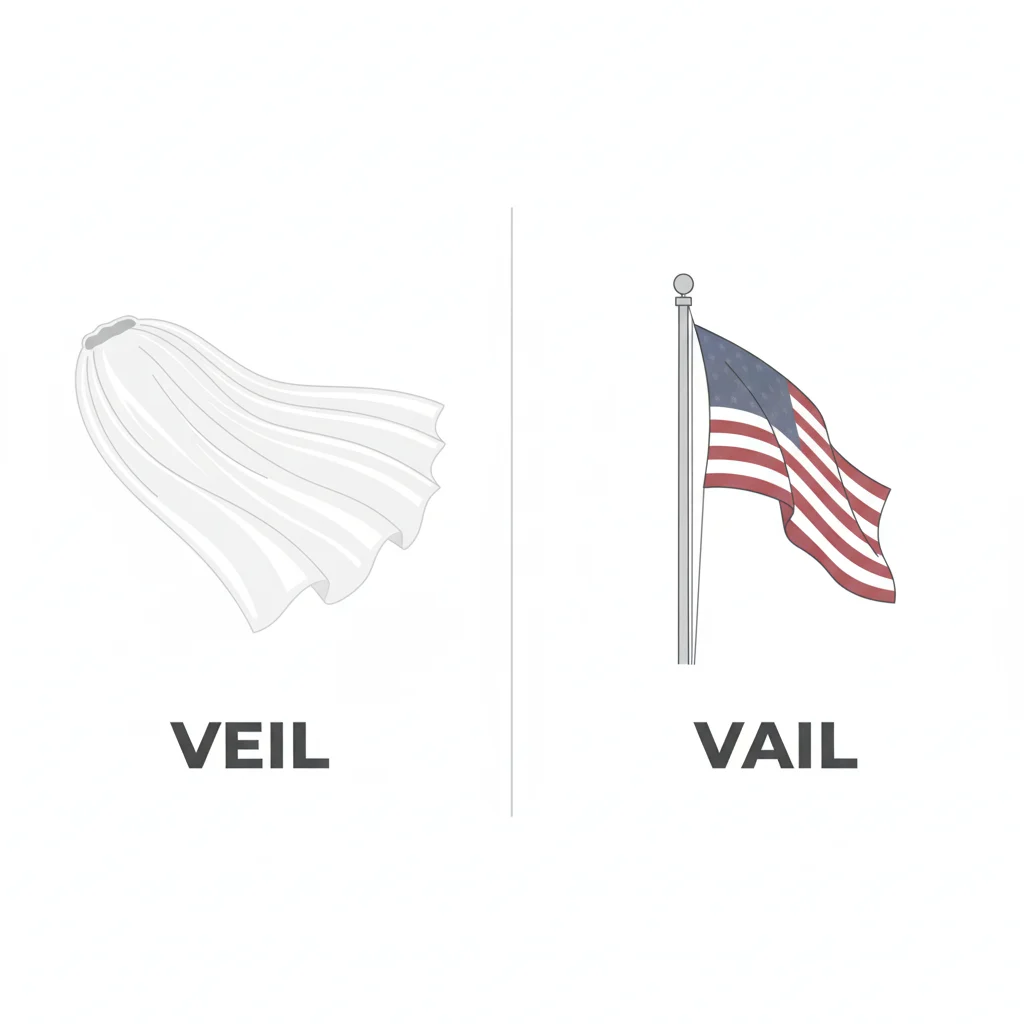
Veil is a noun or verb meaning to cover, hide, or conceal, often used for clothing, secrecy, or symbolism.
Vail is a verb meaning to lower, bow, or give way, and it is also a proper noun (like Vail, a place name).
Examples:
- She wore a white wedding veil.
- He chose to vail his pride and apologize.
If you mean covering or hiding, use veil. If you mean lowering or yielding, use vail.
English can be tricky, and vail vs veil is a perfect example of why so many people feel confused. These two words look almost identical, sound the same, and often appear in similar contexts—yet their meanings are completely different. Many writers pause mid-sentence wondering: Should I write vail or veil? This confusion shows up in everyday writing, Bible studies, wedding articles, legal texts, and even place names like Vail, Colorado. People search for this keyword because using the wrong word can change the meaning of a sentence or make it look unprofessional.
This article solves that problem with a clear, simple explanation. You’ll get a quick answer first, followed by detailed guidance, real-life examples, spelling tips for British and American English, and professional advice on which word to use. By the end, you’ll never mix up vail vs veil again.
The Origin of Vail vs Veil
The confusion between vail vs veil comes from their shared pronunciation but very different histories.
Veil comes from the Latin word vela, meaning “sail” or “covering.” Over time, it came to mean a piece of fabric worn over the face or something that hides or obscures. This is why we talk about a wedding veil, a veil of secrecy, or even veiling the truth.
Vail, on the other hand, comes from the Old French avaler, meaning “to lower.” Historically, it was used to describe lowering a flag, lowering one’s eyes, or yielding power or control. In modern English, vail is less common and often appears in formal, literary, or religious contexts, including older Bible translations.
The spelling difference exists because these words evolved separately, even though they now sound the same.
British English vs American English Spelling
Unlike many spelling debates, vail vs veil is not a British vs American spelling issue. Both spellings exist in both varieties of English, but they serve different purposes.
| Aspect | Veil | Vail |
|---|---|---|
| Used in US English | Yes | Yes |
| Used in UK English | Yes | Yes |
| Meaning | Cover, conceal | Lower, yield |
| Common usage | Very common | Rare |
| Example | wedding veil | vail one’s pride |
So, whether you write for the US, UK, or Commonwealth audiences, the spelling does not change—only the meaning does.
Scarring vs Scaring 📌 Simple Rule Everyone Should Know
Which Spelling Should You Use?
Choosing between vail or veil depends entirely on meaning, not location.
- Use “veil” if your audience is general, global, or non-technical. It is far more common and widely understood.
- Use “vail” only if you are writing formal, literary, legal, or religious content, or if you are referring to a proper noun like Vail (a place or name).
For global readers, especially online, veil is usually the correct and safest choice. Using vail incorrectly can confuse readers and hurt clarity, credibility, and SEO performance.
Common Mistakes with Vail vs Veil
Many writers make predictable errors with vail vs veil.
- ❌ She lifted her wedding vail.
✅ She lifted her wedding veil. - ❌ He tried to veil his pride.
✅ He tried to vail his pride.
Another mistake is confusing veil with vale. A vale means a valley, not a covering or lowering. Mixing veil vs vale vs vail is common, but each word has a unique meaning and usage.
Vail vs Veil in Everyday Examples
You’ll see veil far more often in daily life.
Emails:
- “Please veil the sensitive data before sharing.”
News:
- “The report was released under a veil of secrecy.”
Social Media:
- “Love this dress and the bridal veil 😍”
Formal Writing:
- “The truth was veiled in ambiguous language.”
Vail, however, appears in more specific contexts:
- “He chose to vail his objections for peace.”
- “The ceremony symbolized the act to vail earthly power.”
Stank vs Stunk 🔥 Which One Is Actually Correct?
Vail vs Veil – Google Trends & Usage Data

Search data shows that veil is significantly more popular worldwide. Queries like wedding veil, veil meaning, and veil vs vale dominate search trends. Vail spikes mainly in geographic searches (such as the town of Vail) or Bible-related questions like vail or veil in the Bible.
In the US, UK, Canada, and Australia, veil appears far more frequently in both spoken and written English. Vail remains niche and context-specific, which explains why many people search to confirm its meaning.
Comparison Table: Vail vs Veil vs Vale
| Word | Meaning | Example |
|---|---|---|
| Veil | Cover or conceal | She wore a veil |
| Vail | Lower or yield | He vails his pride |
| Vale | Valley | A green vale |
This side-by-side comparison helps prevent confusion when writing or editing.
FAQs About Vail vs Veil
1. What is the difference between veil and vail?
Veil means to cover or hide. Vail means to lower or yield.
2. What does vail mean?
Vail means to lower, bow, or give way, often used formally.
3. Is vail used in the Bible?
Yes, older Bible texts use vail to mean lowering or submission.
4. Is a wedding veil spelled veil or vail?
It is always spelled veil.
5. Can veil be a verb?
Yes. You can veil the truth or veil emotions.
6. What is Vail used for today?
Mostly as a proper noun or in formal language.
7. How do I remember the difference?
Think veil = fabric/cover, vail = bow/lower.
Conclusion
Understanding vail vs veil is about mastering meaning, not memorizing spelling rules. Although these words sound identical, they serve very different purposes in English. Veil is the word you’ll use most often, especially when talking about clothing, secrecy, symbolism, or emotional concealment. It appears everywhere—from wedding traditions to journalism and everyday conversation. Vail, by contrast, is rare and formal. It refers to lowering, yielding, or submitting and shows up mainly in literary, historical, or religious contexts, including Bible interpretations.
For most writers, bloggers, students, and professionals, choosing veil will be the correct and reader-friendly option. Knowing when vail is appropriate, however, adds precision and authority to your writing. By learning the origins, common mistakes, and real-world examples, you can write with confidence and clarity. When in doubt, pause and ask what you mean: cover or lower? That single question will guide you to the right word every time.

Isla Merrin is a language and writing expert at Definevs.com, creating simple, engaging guides to help readers master words, grammar, and modern English usage.