Have you ever heard a story and wondered — is it truth or fiction? 🤔 These two words sound simple, but many people use them incorrectly when describing real and imaginary things. In everyday English, truth means something real or factual, while fiction means something made up or imaginary. Yet, they often get mixed up — especially in writing, movies, and storytelling!
In this fun and easy guide, you’ll learn the difference between truth and fiction, their meanings, correct usage, and simple examples. By the end, you’ll never confuse them again! Whether you’re a student, writer, or just curious, this article will help you master when to use truth and when to use fiction. 🌟
📚 What Does Each Word Mean?
Let’s start by understanding both words in simple terms — no fancy grammar words needed!
✅ Truth
Meaning: Truth means something real, correct, or based on facts. It’s what actually happened.
Part of speech: Noun
Examples:
- She always tells the truth.
- The truth is that the Earth goes around the sun.
- It’s hard to face the truth sometimes.
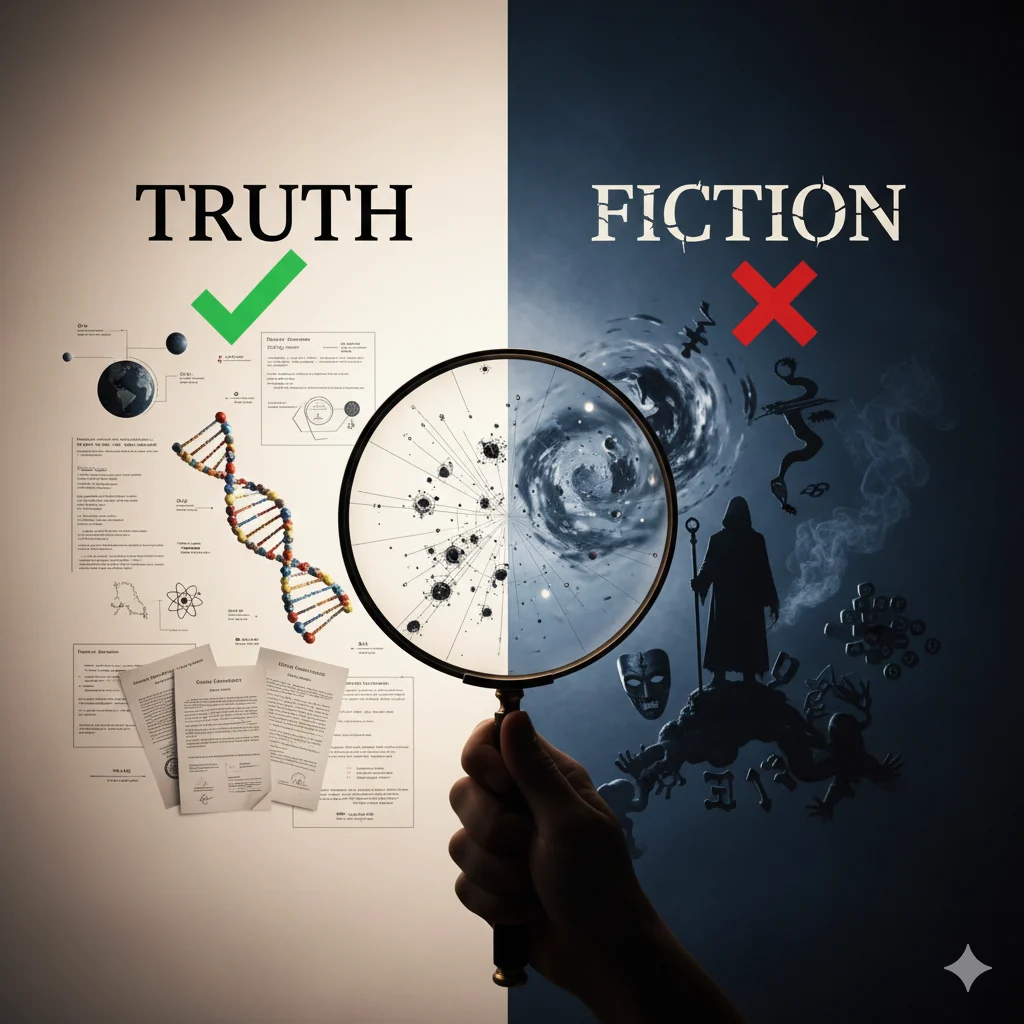
🧩 Think of truth as a mirror — it shows things as they are!
🌈 Fiction
Meaning: Fiction means something imaginary or made-up, not real.
Part of speech: Noun
Examples:
- I love reading fiction books about dragons.
- The movie was pure fiction, not based on real events.
- He mixes fiction with real history to make his stories exciting.
💡 Think of fiction as a dream — it looks real in your mind, but it’s not true.
⚖️ The Key Difference Between Truth and Fiction
Here’s a quick, clear comparison to help you see how they’re different 👇
| Feature | Truth | Fiction |
|---|---|---|
| Meaning | Based on real facts or reality | Made up or imaginary |
| Used For | News, facts, history, science | Stories, novels, movies |
| Example Sentence | “He spoke the truth about the accident.” | “She wrote a fiction about aliens.” |
| Memory Tip | 🪞Truth = mirror of reality | 🌙Fiction = dream world |
✨ Quick Tip:
If it really happened → it’s truth.
If it was invented or imagined → it’s fiction.
❌ Common Mistakes and How to Avoid Them
Even adults mix these up sometimes! Let’s see a few examples 👇
❌ Incorrect: The movie is based on a truth story.
✅ Correct: The movie is based on a true story (truth = fact, true = adjective).
❌ Incorrect: I like reading truths about superheroes.
✅ Correct: I like reading fiction about superheroes.
Why this happens:
People confuse truth with true, and sometimes they think fiction means “a lie.” But fiction isn’t a lie — it’s imagination.
🪞 When to Use “Truth”
Use truth when you talk about facts, honesty, or things that are real.
Examples:
- Always tell the truth, even if it’s hard.
- The truth hurts sometimes, but it helps us grow.
- Scientists look for the truth through experiments.
- My teacher asked us to write about the truth behind myths.
- The truth will always come out in the end.
🎯 Memory Hack:
If it’s real, proven, or factual — it’s truth. Imagine it as something you can see or prove.
🌙 When to Use “Fiction”
Use fiction when you talk about stories, imagination, or creative writing that is not real.
Examples:
- Harry Potter is a famous work of fiction.
- I enjoy watching fictional movies about space.
- The author mixes fiction with reality in her books.
- Children love fiction stories about talking animals.
- This story may sound real, but it’s pure fiction.
🧠 Memory Hack:
If it happens only in your imagination — it’s fiction. Think of movies, novels, or fairy tales!
🧩 Quick Recap: Truth vs Fiction
Here’s a simple way to remember 👇
- Truth = What is real.
- Fiction = What is imagined.
- Truth is found in facts, history, or honesty.
- Fiction lives in stories, movies, or dreams.
- If it can be proven → it’s truth.
- If it can be imagined → it’s fiction.
📘 In short: Truth is what happens. Fiction is what we create.
🧭 Advanced Tips for Curious Learners
Did you know?
- The word truth comes from Old English “triewe,” meaning “faithful” or “real.”
- Fiction comes from Latin fictio, meaning “to shape or create.”
In formal writing or essays, always use truth for facts and fiction for creative content.
Example:
- “The documentary revealed the truth about pollution.”
- “Her novel blends fiction and fantasy beautifully.”
🚫 In texting or social media, people sometimes write “true fiction” — which doesn’t make sense! Something can’t be both truth and fiction at once.
🧩 Mini Quiz — Test Yourself!
Fill in the blanks with truth or fiction 👇
- The movie was based on real ________.
- I prefer reading science ________ novels.
- Always tell the ________, no matter what.
- The story about ghosts is just ________.
- She spoke the plain ________ in court.
- “Harry Potter” is a famous work of ________.
- Finding the ________ sometimes takes time.
(Answers: 1. truth, 2. fiction, 3. truth, 4. fiction, 5. truth, 6. fiction, 7. truth)
🌟 Conclusion
So now you know — truth or fiction aren’t just words; they show the line between reality and imagination. 🌈 Learning how to use them correctly helps you write, speak, and think more clearly. Remember: truth reflects the world as it is, while fiction builds worlds that could be. 💫
Keep practicing! Try writing a paragraph mixing truth and fiction — start with something real, then add your imagination. That’s how the best stories are born!
💬 FAQs
1. What is the main difference between truth and fiction?
Truth is based on real facts, while fiction is made up or imagined.
2. Can something be both truth and fiction?
No — truth is real, and fiction is created. However, a story can be inspired by truth.
3. Is fiction the same as a lie?
No! Fiction is for imagination and storytelling, not lying.
4. What’s the adjective form of truth?
The adjective form is true (example: true story).
5. What’s the adjective form of fiction?
The adjective form is fictional (example: fictional hero).

Kael Donovan is a language enthusiast and writer at Definevs.com, simplifying complex words and grammar rules into fun, easy-to-understand guides for readers.