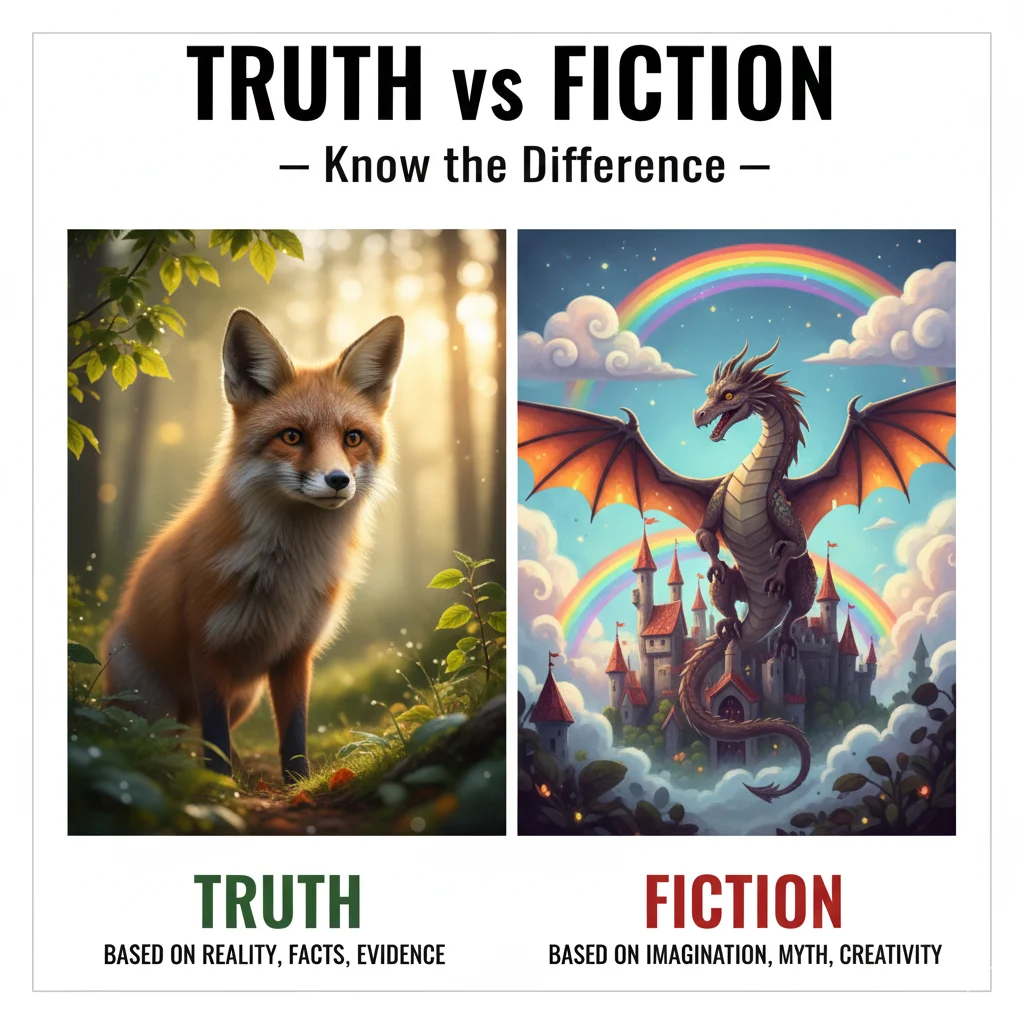
Have you ever read a story and wondered, “Is this truth or fiction?” 🤔
These two words — truth and fiction — often confuse people because they seem similar when talking about stories, movies, or news. But they actually have very different meanings.
In this easy guide, you’ll learn:
- What truth and fiction mean
- The difference between truth and fiction
- When and how to use each word correctly
- Simple examples, memory tips, and a fun quiz to help you remember forever
This article will make it crystal clear — even a fourth grader can understand the difference between truth and fiction in just a few minutes.
🧩 What Does Each Word Mean?
🟦 What Is “Truth”?
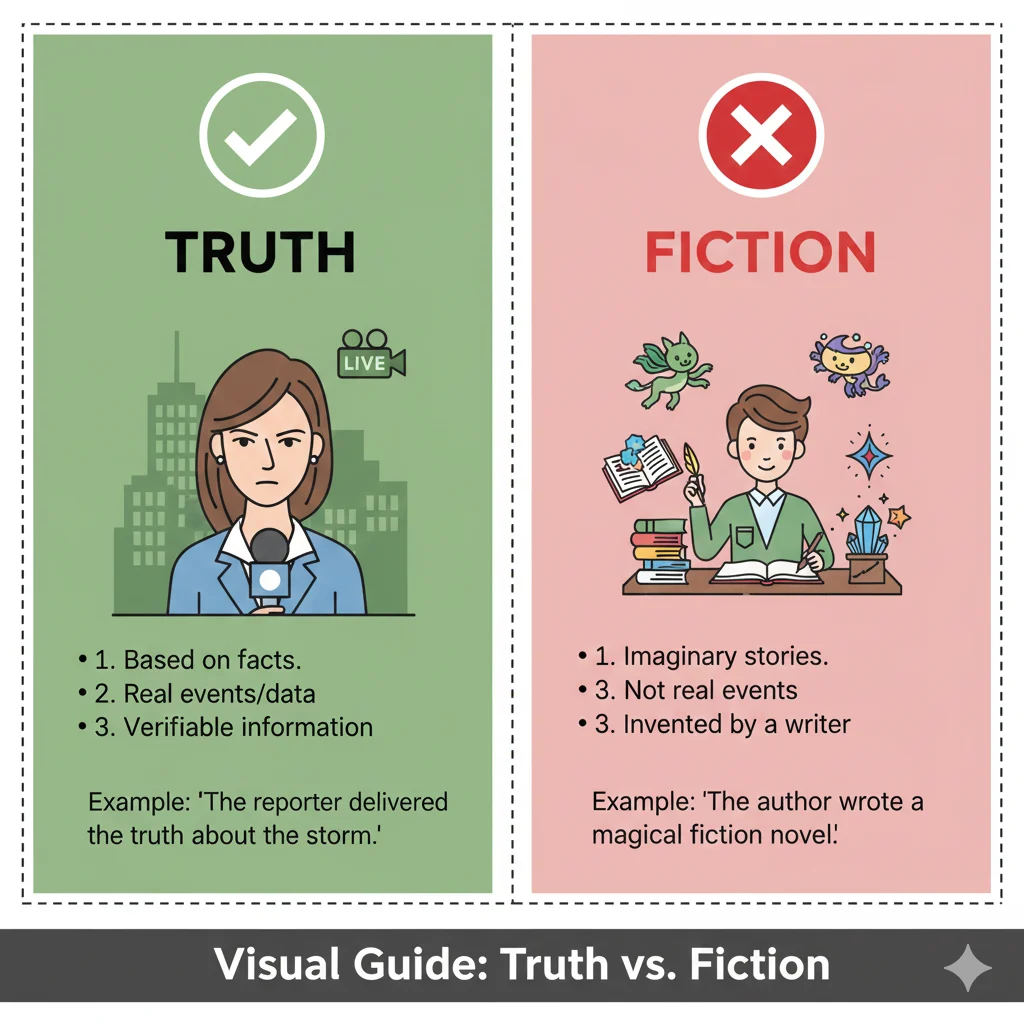
Truth is something real, honest, and based on facts.
It’s what actually happened — not what someone imagined.
- Part of speech: Noun
- Meaning: The real facts about something.
Examples:
- She always tells the truth to her parents.
- The truth is that the sun rises in the east.
- We should accept the truth, even if it’s hard.
🧠 Think of “truth” as something you can prove or see for yourself.
🟥 What Is “Fiction”?
Fiction means something made up, imagined, or not true.
It usually describes stories, movies, or books that come from someone’s imagination.
- Part of speech: Noun
- Meaning: Something invented, not based on real facts.
Examples:
- Harry Potter is a fictional story — it’s not real.
- My brother writes fiction about superheroes.
- Science fiction mixes real science with made-up ideas.
🧠 Think of “fiction” as fun imagination — something that feels real but isn’t!
⚖️ The Key Difference Between Truth and Fiction
Here’s a quick look at the main difference between truth and fiction 👇
| Feature | Truth | Fiction |
|---|---|---|
| Meaning | Something real, factual, or proven | Something made up or imaginary |
| Part of Speech | Noun | Noun |
| Used For | Facts, history, reality | Stories, novels, movies |
| Example | “The truth is he helped his friend.” | “The story is complete fiction.” |
| Reality Check | Can be proven | Created from imagination |
💡 Quick Tip to Remember:
“Truth = Real, Fiction = Fake.”
If you can prove it, it’s truth. If you imagine it, it’s fiction.
❌ Common Mistakes and How to Avoid Them
Here are a few mistakes people make when using truth and fiction — and how to fix them:
| ❌ Incorrect | ✅ Correct | Why It’s Wrong |
|---|---|---|
| “The movie was based on a true fiction.” | “The movie was based on a true story.” | “Fiction” means not true — it can’t be “true fiction.” |
| “He told me a fiction about his job.” | “He told me a lie about his job.” | “Fiction” is used for creative writing, not daily lies. |
| “Truth novels are popular these days.” | “Non-fiction books are popular these days.” | “Truth” isn’t used for book types — the correct term is “non-fiction.” |
✅ Grammar Tip: Use truth for facts and honesty. Use fiction for creative stories and imagination.
🟩 When to Use “Truth”
Use truth when talking about real events, honesty, or proven facts.
Examples:
- Always tell the truth — lying hurts trust.
- The detective searched for the truth behind the mystery.
- Children should learn the truth about kindness.
- “To tell you the truth,” means “Honestly speaking.”
- Truth helps people believe and understand.
💡 Memory Hack:
“Truth” starts with T, just like “True” — both are real!
🟥 When to Use “Fiction”
Use fiction when talking about made-up stories, novels, or creative writing.
Examples:
- I love reading fiction before bed.
- That movie was pure fiction, but it felt real.
- The author mixed fiction with history to make it exciting.
- Her imagination makes her a great fiction writer.
- Many games are based on science fiction stories.
💡 Memory Trick:
“Fiction” and “Fake” both start with F — easy way to remember it’s not real!
🔁 Quick Recap: Truth vs Fiction
Here’s a simple summary of everything you’ve learned:
- Truth = Real, honest, and proven by facts.
- Fiction = Imaginary, made up, and creative.
- Truth shows reality.
- Fiction shows possibility.
- Use truth for facts and fiction for stories.
📚 Advanced Tips
Even though “truth” and “fiction” are opposites, they often connect in literature and media. For example:
- A “true story” can inspire fictional movies.
- Some fiction is based on real events, but with creative twists — this is called “historical fiction.”
In formal writing, use:
- “The truth is…” or “It’s a fact that…” for real information.
- “This story is fictional…” when describing imaginary content.
📘 Tip for Exams or Essays:
When writing about books or movies, always mention whether they’re fiction or non-fiction. Mixing them up changes the entire meaning!
🧠 Mini Quiz — Test Yourself!
Fill in the blanks with Truth or Fiction:
- Superman is a character from _______.
- Always tell the _______ to your teachers.
- This book is based on _______ events from history.
- Harry Potter belongs to the _______ genre.
- It’s hard to find the _______ in that story.
Answers: 1. Fiction | 2. Truth | 3. Truth | 4. Fiction | 5. Truth
❓FAQs About Truth and Fiction
1. What is the main difference between truth and fiction?
Truth means something real or factual, while fiction means something imaginary or made up.
2. Can fiction be partly true?
Yes! Some stories mix facts with imagination — this is called historical fiction or based-on-a-true-story fiction.
3. What’s the opposite of fiction?
The opposite of fiction is non-fiction, which includes real-life stories, facts, and biographies.
4. How do I remember the difference easily?
Remember: “Truth = True,” “Fiction = Fake.” Both start with the same first letter!
5. Can truth and fiction ever overlap?
Yes. Some works of fiction use real facts or lessons from life, blending truth and imagination to teach or entertain.
🏁 Conclusion
Now you know the clear difference between truth and fiction!
Truth is about what’s real and proven. Fiction is about what’s imagined and creative.
When you understand these words, you’ll never confuse reality with imagination again.
Keep practicing by reading both — facts to learn and fiction to dream. 🌟

Isla Merrin is a language and writing expert at Definevs.com, creating simple, engaging guides to help readers master words, grammar, and modern English usage.