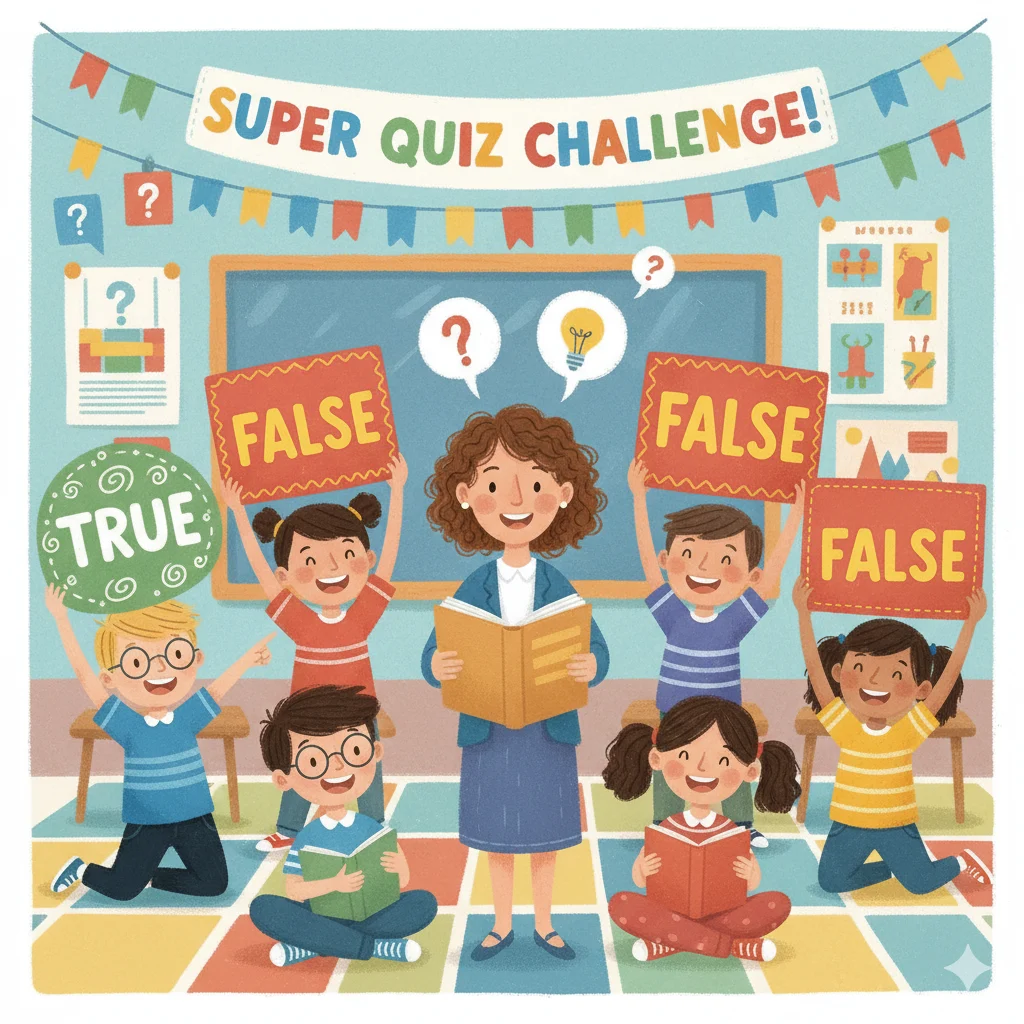
Have you ever tried asking your child a few true or false questions just for fun? Kids love quick, challenging questions that make them think — and true or false questions for kids are one of the best ways to do it!
These simple quiz-style questions help children learn new facts, boost memory, and improve critical thinking in a playful way. Whether you’re a teacher, parent, or homeschooler, these questions make learning both fun and educational.
In this guide, we’ll explain:
- What true or false questions are
- How they help kids learn
- The difference between true and false statements
- 100+ examples for different subjects
- Tips, tricks, and fun ways to play
🧠 What Are True or False Questions?
True or False questions are simple statements that can be either correct (true) or incorrect (false).
Kids read or hear a sentence and decide if it’s factually right or wrong.
For example:
- “The sun rises in the west.” → ❌ False
- “Fish can swim.” → ✅ True
These types of questions are easy for children to understand and perfect for testing basic knowledge in a fun, interactive way.
📚 What Do “True” and “False” Mean?
Let’s break down both words simply:
True – Meaning & Usage
“True” means something that is correct, real, or factually right.
Examples:
- The Earth goes around the Sun. → True
- Ice melts when it’s heated. → True
- Dogs have tails. → True
Think of “true” as something you can prove or see in real life.
False – Meaning & Usage
“False” means something that is not correct, fake, or wrong.
Examples:
- Cats can fly. → False
- The ocean is made of juice. → False
- Two plus two equals five. → False
A “false” statement is one that doesn’t match reality or facts.
⚖️ The Key Difference Between “True” and “False”
| Feature | True | False |
|---|---|---|
| Meaning | Something correct or real | Something incorrect or not real |
| Example | “Water is wet.” | “The sky is green.” |
| Symbol | ✅ | ❌ |
| Use in Quizzes | Marks the right answer | Marks the wrong answer |
| Memory Tip | True = Trust it’s right | False = Fake or wrong |
💡 Quick Tip to Remember:
If you can prove it’s real, it’s true.
If you doubt or laugh at it, it’s false!

💬 Common Mistakes and How to Avoid Them
Even simple words like true and false can confuse kids when questions are tricky. Here are a few examples:
| ❌ Common Mistake | ✅ Correct Version | Explanation |
|---|---|---|
| “All birds can fly.” → True | “All birds can fly.” → False | Penguins and ostriches can’t fly. |
| “The moon is a star.” → True | “The moon is a star.” → False | The moon is not a star — it reflects sunlight. |
| “The number 10 is greater than 100.” → True | “The number 10 is greater than 100.” → False | 10 is smaller, not greater. |
💡 Tip: Always double-check facts before marking an answer as true or false!
📘 When to Use “True”
Use “true” when something is correct, factual, or proven.
Examples:
- Apples are fruits. → ✅ True
- There are seven days in a week. → ✅ True
- 1 + 1 = 2. → ✅ True
- The Earth has one moon. → ✅ True
- Rain comes from clouds. → ✅ True
📖 Memory Hack:
If your teacher or parent says, “That’s right!” — it means your answer is true!
🚫 When to Use “False”
Use “false” when something is wrong, made up, or not possible.
Examples:
- The sun is cold. → ❌ False
- Cats bark. → ❌ False
- Humans have three arms. → ❌ False
- Ice is hot. → ❌ False
- Fish can live without water. → ❌ False
🧩 Memory Trick:
Think of “false” like a fake story — it sounds funny or impossible!
🔍 Quick Recap: True vs False
- True = Real, Correct, Proven
- False = Wrong, Fake, Impossible
- If you can check it in real life → it’s True
- If it sounds silly or untrue → it’s False
✅ True = “Yes, that’s right!”
❌ False = “No, that’s wrong!”
🎯 10 Fun True or False Questions for Kids
Let’s test your knowledge! Can you guess which ones are true and which are false?
- The sun is a star. → ✅
- Fish can talk. → ❌
- There are 24 hours in a day. → ✅
- The moon is made of cheese. → ❌
- Water freezes into ice. → ✅
- 10 comes after 9. → ✅
- Lions live in the ocean. → ❌
- Spiders have eight legs. → ✅
- Bananas grow underground. → ❌
- Fire is hot. → ✅
🧠 Keep going! You can make your own by turning facts into short questions.
🌟 Advanced Tips for Parents and Teachers
- Use them daily: Ask one or two true/false questions during breakfast or before bed.
- Mix subjects: Add science, math, and fun facts.
- Encourage reasoning: Ask kids why they think it’s true or false.
- Create rewards: Use stickers or points for correct answers.
- Promote curiosity: Turn wrong answers into learning moments instead of corrections.
🎓 Bonus Tip: For older kids, make statements slightly tricky to develop critical thinking and logic skills.
🧩 Mini Quiz: Can You Answer These?
- The sky is blue. → ___
- Cars can swim. → ___
- The letter “B” comes before “C.” → ___
- Ice cream is hot. → ___
- We use our eyes to see. → ___
(Answers: 1-True, 2-False, 3-True, 4-False, 5-True)
❓ FAQ Section
1. What are true or false questions for kids?
They are short quiz questions where children decide if a statement is correct (true) or incorrect (false).
2. Why are true or false questions helpful?
They help improve memory, attention, and understanding of facts while making learning fun and interactive.
3. What subjects can I use them for?
You can use them for science, math, English, geography, or even general knowledge.
4. Are true or false questions suitable for all ages?
Yes! Just make the questions simpler for younger kids and more challenging for older students.
5. How can parents make true or false games fun?
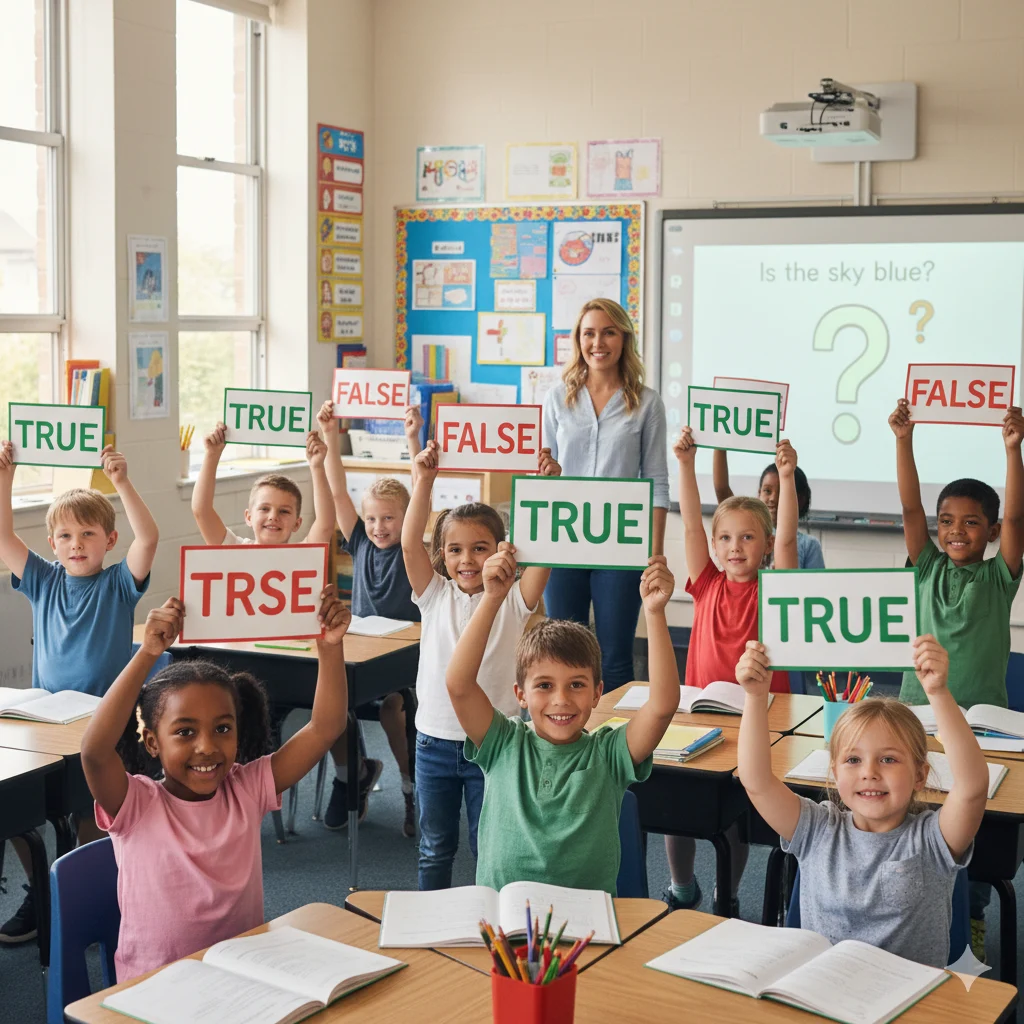
Turn them into mini-competitions, use flashcards, or let kids hold up “True” and “False” signs during play.
🏁 Conclusion
True or false questions for kids are a fun, creative way to make learning exciting. They teach children to think, reason, and remember facts — all while having fun!
So next time you’re spending time with your child, try a few of these quick questions. You’ll be amazed at how fast they learn — and laugh — along the way.

Kael Donovan is a language enthusiast and writer at Definevs.com, simplifying complex words and grammar rules into fun, easy-to-understand guides for readers.