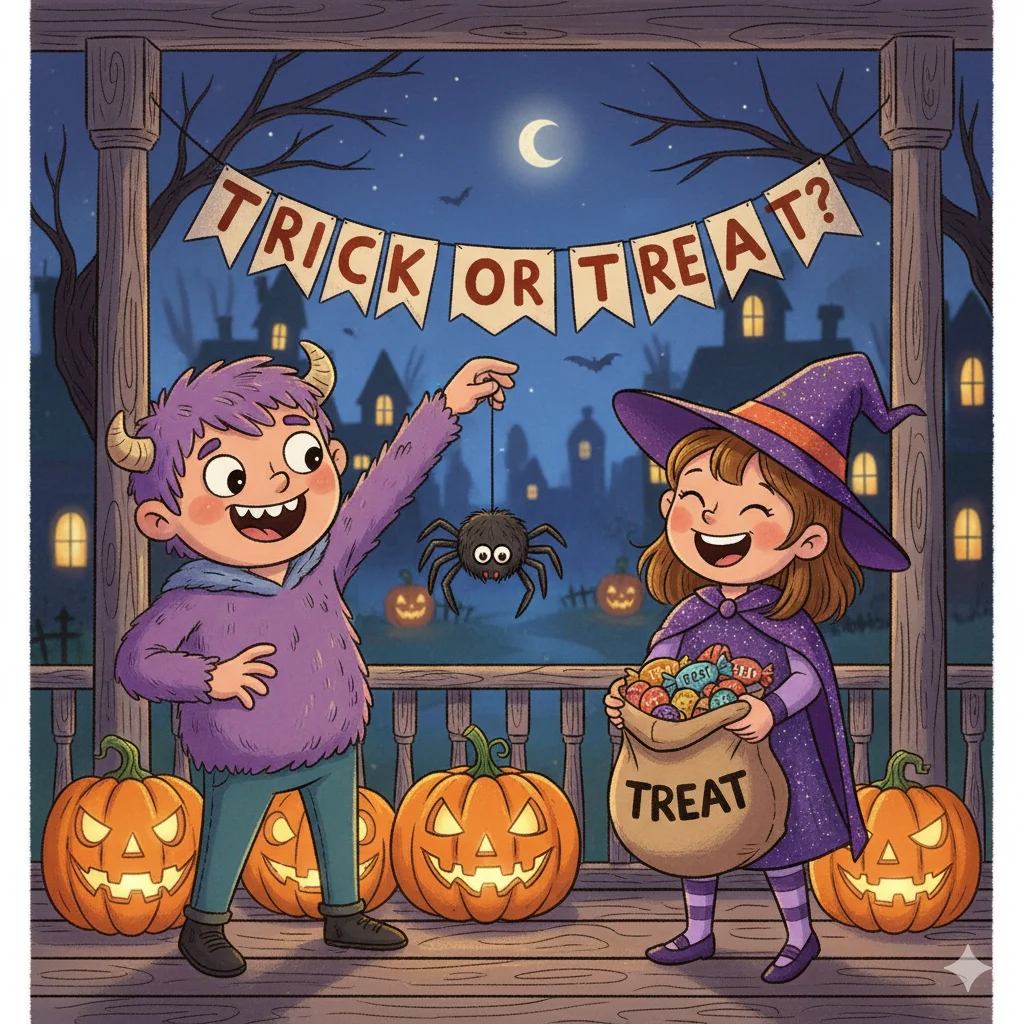
Every Halloween, you’ll hear kids excitedly shout, “Trick or Treat!” while knocking on doors — but have you ever stopped to think about what those words actually mean?
The phrase “trick or treat” is more than just a fun Halloween saying. It combines two very different words — “trick” and “treat” — that each have their own unique meanings and uses in English.
In this easy guide, we’ll explain:
- What “trick” and “treat” mean
- The difference between them
- How to use them correctly in everyday life
- Common mistakes and simple memory hacks
By the end, you’ll understand why this popular phrase makes sense — and how both words work separately in English.
🪄 What Does Each Word Mean?
Let’s look at the meaning of both “trick” and “treat.”
💫 Trick – Meaning and Examples
“Trick” means a clever action or prank meant to surprise, confuse, or amuse someone. It can also mean a skill or method used to do something better.
Part of Speech: Noun or Verb
Examples:
- He played a trick on his brother by hiding his shoes.
- The magician showed us a cool card trick.
- She tricked me into believing it was my birthday gift.
👉 Quick idea: A trick is something you do to surprise someone or get your way.
🍬 Treat – Meaning and Examples
“Treat” means to give something nice or to behave kindly toward someone. It can also mean a delicious snack or a special gift.
Part of Speech: Verb or Noun
Examples:
- Mom treated us to ice cream after school.
- Always treat your friends with respect.
- This chocolate cake is such a treat!
👉 Quick idea: A treat is something good that makes you happy.
🎭 The Key Difference Between “Trick” and “Treat”
| Feature | Trick | Treat |
|---|---|---|
| Meaning | A prank or clever act to fool someone | A gift, favor, or something nice given |
| Part of Speech | Can be a noun or a verb | Can be a noun or a verb |
| Emotion | Usually playful or mischievous | Always positive and kind |
| Example Sentence | “He played a trick on his teacher.” | “She gave us candies as a treat.” |
Quick Tip to Remember:
👉 A trick surprises people. A treat pleases people.

🚫 Common Mistakes and How to Avoid Them
Many English learners mix these up because they sound cheerful together in “trick or treat.” But remember:
❌ Incorrect: “I’ll give you a trick if you win.”
✅ Correct: “I’ll give you a treat if you win.”
(You reward with a treat, not a trick.)
❌ Incorrect: “He treated me by hiding my books.”
✅ Correct: “He tricked me by hiding my books.”
(A trick is when you fool someone.)
Why the Confusion Happens:
Because both words appear together, some people think they mean the same thing — but they’re actually opposites. One is naughty (trick), and the other is nice (treat)!
🎩 When to Use “Trick”
Use “trick” when:
- You are playing a joke or prank
- You are using a clever method
- You are trying to surprise or fool someone
Examples:
- The magician’s trick amazed the crowd.
- My brother loves to trick me every April Fool’s Day.
- The new math trick helped me solve problems faster.
- Don’t trick your teacher — it’s not polite!
- It was just a harmless trick, not something mean.
Memory Hack:
👉 Think “trick” = “tricky.” If it’s tricky, it’s clever or sneaky!
🍭 When to Use “Treat”
Use “treat” when:
- You give or receive something nice
- You talk about food, gifts, or rewards
- You describe kind behavior
Examples:
- Grandma treated us to cookies.
- Always treat your pets with love.
- This movie night is such a treat after exams!
- She was treated with great care at the hospital.
- Dad said, “If you finish your homework, I’ll treat you to pizza.”
Memory Hack:
👉 “Treat” rhymes with “sweet.” Both make people happy!
🧾 Quick Recap: Trick vs Treat
- Trick → To fool or surprise someone (sneaky or funny).
- Treat → To give something nice or behave kindly.
- Trick = Sneaky, Treat = Sweet
- Trick makes others laugh or gasp.
- Treat makes others smile.
📚 Advanced Tips: Origins and Usage in Writing
The phrase “Trick or Treat” began in North America in the 1920s as part of Halloween traditions.
Children would say it while visiting houses — offering adults a choice:
👉 “Give us a treat (like candy), or we might play a harmless trick!”
In formal English writing, both words are common:
- “Trick of the light” means an optical illusion.
- “A real treat” means something enjoyable or special.
⚠️ In texting or social media, “treat” can even mean pampering yourself — like “Self-care day! Time to treat myself!”
✏️ Mini Quiz: Test Your Understanding
Fill in the blanks with trick or treat.
- The magician’s card ____ amazed everyone.
- My parents will ____ us to pizza if we behave.
- It was just a Halloween ____ — don’t worry!
- Always ____ your classmates with respect.
- The movie night was a real ____.
- Don’t ____ your friends just to make a joke.
- I can show you a cool math ____ to remember this formula.
(Answers: 1-trick, 2-treat, 3-trick, 4-treat, 5-treat, 6-trick, 7-trick.)
❓ FAQs About “Trick or Treat”
1. What does “Trick or Treat” mean?
It means “Give me something nice (a treat), or I’ll play a funny prank (a trick).” It’s a fun Halloween saying.
2. What’s the difference between a trick and a treat?
A trick is a playful act to fool someone, while a treat is a reward or gift.
3. Can “treat” mean food?
Yes! In English, a “treat” often means a special food like candy, cake, or ice cream.
4. Is “trick” always bad?
No. A “trick” can be funny or clever, but it can be mean if someone feels hurt or embarrassed.
5. How can I remember the difference easily?
Think: “Trick = Tricky (sneaky)” and “Treat = Sweet (nice).”
🎉 Conclusion
Now you know the real difference between “trick” and “treat.”
A trick is something sneaky or clever, while a treat is something kind or delicious. Both words are fun and full of meaning — especially during Halloween!
Keep practicing these words in everyday sentences, and soon you’ll use them like a pro. Remember — learning English is always a treat, never a trick! 🍬

Isla Merrin is a language and writing expert at Definevs.com, creating simple, engaging guides to help readers master words, grammar, and modern English usage.