Have you ever typed “traveled” and then wondered if it should have two Ls — like “travelled”? Don’t worry — you’re not alone!
This is one of the most common English spelling confusions, especially for learners and even native speakers.
Both words are correct — but their usage depends on where you live or which form of English you’re using.
In this friendly guide, you’ll learn:
- The meaning of both “traveled” and “travelled”
- The key difference between them
- How to use each correctly in writing
- Simple examples and memory tricks to remember the rule
By the end, you’ll know exactly which one to use — and never second-guess yourself again!
🧭 What Does Each Word Mean?
1. Traveled (One L)
“Traveled” is the past tense and past participle of the verb “travel.”
It means someone went from one place to another.
It’s mainly used in American English.
Examples:
- I traveled to New York last summer.
- She has traveled around the world.
- We traveled together for three months.
So, if you’re writing for an audience in the United States, use “traveled.”
2. Travelled (Two Ls)
“Travelled” also means went from one place to another.
It’s the same word — but spelled with two Ls in British, Canadian, and Australian English.
Examples:
- I travelled to London for a business trip.
- They travelled by train across Europe.
- He has travelled far and wide.
So, if your readers are in the UK, Canada, or Australia, use “travelled.”
⚖️ The Key Difference Between “Traveled” and “Travelled”
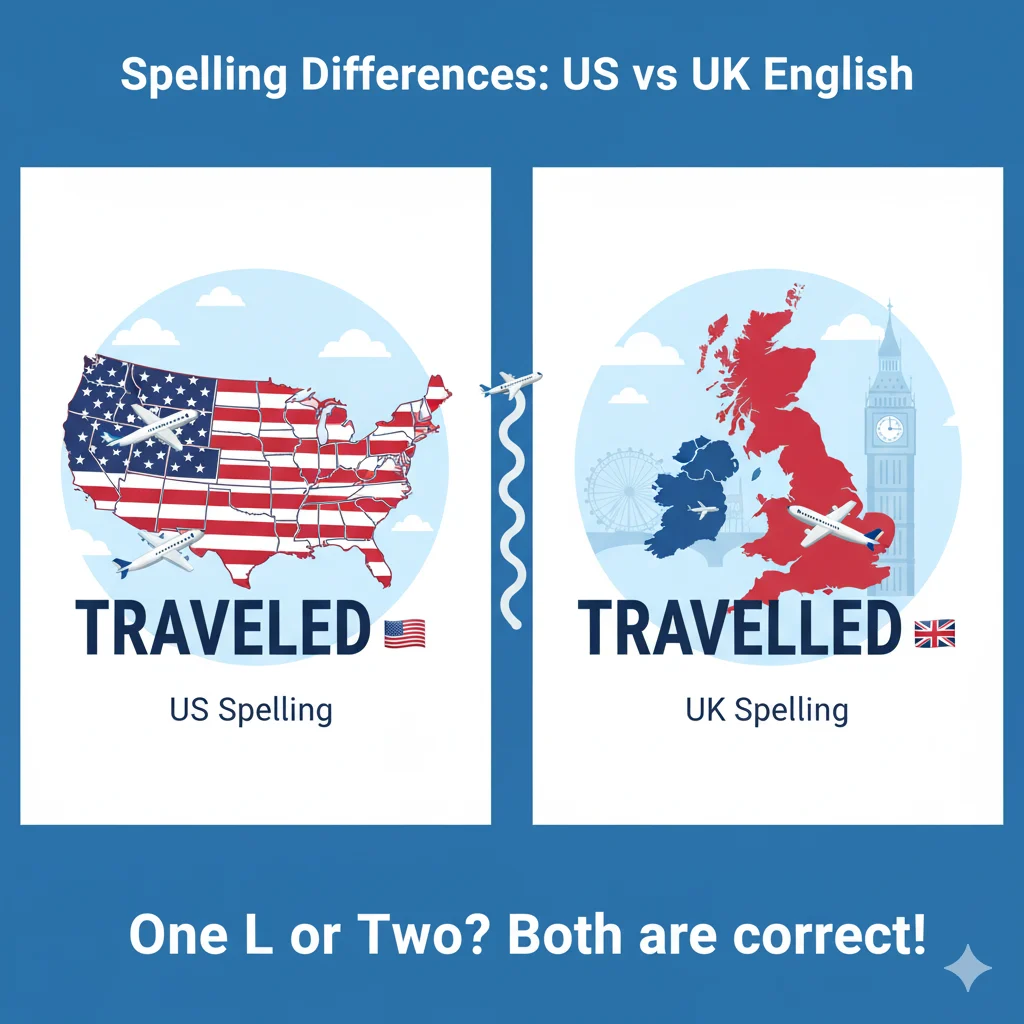
Both words mean the same thing — the only difference is spelling based on English style (American vs. British).
| Feature | Traveled | Travelled |
|---|---|---|
| Language Style | American English | British, Canadian, Australian English |
| Number of Ls | One “L” | Two “L”s |
| Example Sentence | I traveled to Florida. | I travelled to France. |
| Used In | USA | UK, Canada, Australia |
| Correctness | ✅ Correct in American English | ✅ Correct in British English |
Quick Tip to Remember:
👉 If you use “color” (not “colour”), then use “traveled.”
👉 If you use “colour” (not “color”), then use “travelled.”
🚫 Common Mistakes and How to Avoid Them
Even though both spellings are correct, mixing them in the same document can look unprofessional.
❌ Common Mistake 1:
I have traveled to London and travelled to Paris.
✅ Correct:
I have traveled to London and traveled to Paris. (American English)
or
I have travelled to London and travelled to Paris. (British English)
❌ Common Mistake 2:
Using the wrong spelling for your audience.
If you’re writing a school essay in the U.S., your teacher expects “traveled.”
If you’re writing for a British blog, they’ll prefer “travelled.”
Simple Fix:
👉 Choose one English style (American or British) and stick with it throughout your writing.
⚖️ Totaled, Totaling, or Totalling — What’s the Difference and Which One Is Correct?
✈️ When to Use “Traveled”
Use “traveled” when writing in American English.
You’ll see this spelling in U.S. books, websites, news, and schools.
Examples:
- We traveled to California during spring break.
- My grandparents traveled across the country in an RV.
- She has traveled for work most of her life.
- They traveled by plane to meet family.
- I’ve traveled with friends many times before.
Memory Hack:
🧠 Think: “America loves simple words.”
→ One “L” = Simpler = American English.
🌍 When to Use “Travelled”
Use “travelled” when writing in British, Canadian, or Australian English.
It fits perfectly in essays, news articles, or stories published in those regions.
Examples:
- We travelled across Europe by train.
- He travelled from London to Edinburgh in one day.
- They have travelled together since college.
- I travelled home for the holidays.
- She travelled overseas to study.
Memory Hack:
🇬🇧 “The British love doubling letters.”
→ Two “L”s = British English.
🧩 Quick Recap: Traveled vs. Travelled
- ✈️ Both mean the same thing — past tense of “travel.”
- 🇺🇸 Traveled = American English (one L).
- 🇬🇧 Travelled = British/Canadian/Australian English (two Ls).
- 📚 Always be consistent with your English style.
- 🧠 Remember: “Color → Traveled” | “Colour → Travelled.”
📘 Advanced Tips: Origins and Grammar Notes
The difference comes from how American and British English evolved.
In the 1800s, Noah Webster (creator of American dictionaries) simplified many English spellings — dropping extra letters like the second “L” in words such as travelled, cancelled, and modelled.
That’s why we have:
- Traveled (US) vs Travelled (UK)
- Canceled (US) vs Cancelled (UK)
- Modeled (US) vs Modelled (UK)
In formal writing or exams, both forms are accepted as long as you’re consistent.
Mixing styles (e.g., using “color” and “travelled” together) looks careless and can confuse readers.
✍️ Cancelled or Canceled: What’s the Difference and Which Is Correct?
✍️ Mini Quiz: Test Your Knowledge!
Fill in the blanks with the correct word — traveled or travelled.
- We _______ to Japan last year.
- She has _______ for business many times.
- They _______ together during summer vacation.
- He _______ from Canada to the U.K. last month.
- My parents have _______ to several countries.
✅ Answers:
(1) traveled (US) / travelled (UK)
(2) traveled / travelled
(3) traveled / travelled
(4) traveled / travelled
(5) traveled / travelled
❓ FAQs About “Traveled” vs “Travelled”
1. What’s the difference between traveled and travelled?
They mean the same thing — the only difference is spelling. “Traveled” is American English; “travelled” is British English.
2. Which one is correct, traveled or travelled?
Both are correct. Use “traveled” for U.S. audiences and “travelled” for British, Canadian, or Australian readers.
3. Why does American English use one L?
American English simplified many double-letter spellings (like travelled → traveled) thanks to Noah Webster’s dictionary reforms.
4. Can I use both in the same text?
It’s best not to. Choose one spelling style and stick with it for consistency and clarity.
5. Is traveled a verb or an adjective?
It’s usually a verb (past tense of “travel”), but can also act as an adjective — e.g., “a well-traveled person.”
🏁 Conclusion
So now you know — “traveled” and “travelled” are both correct!
The difference lies only in where you are and which English style you follow.
Use “traveled” for American writing and “travelled” for British, Canadian, or Australian contexts.
Keep practicing, stay consistent, and you’ll write with confidence — no matter where you travel! 🌍✈️

Arwen Blythe is a passionate language and culture enthusiast, crafting clear, engaging guides on words, phrases, and modern English for Definevs.com readers.