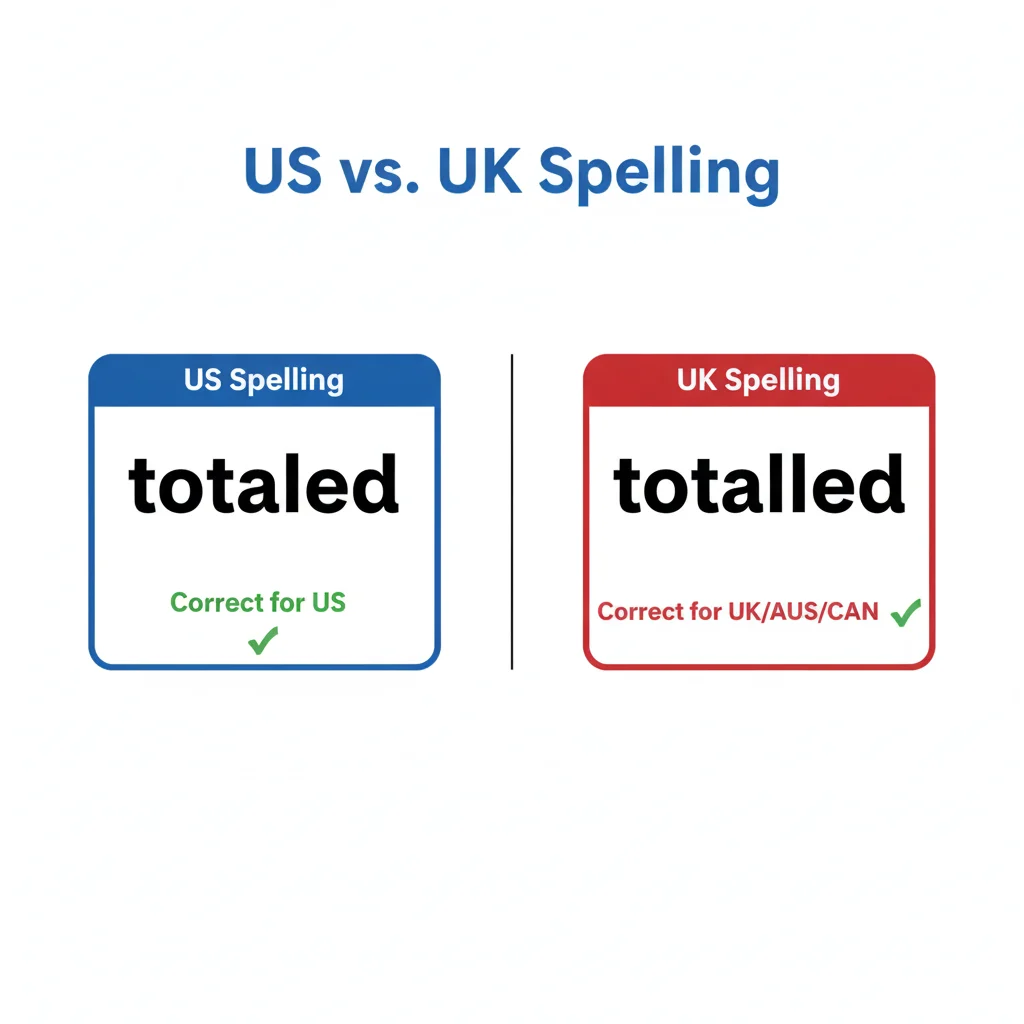
“Totalled” and “totaling” come from the verb “to total,” meaning to add up completely or to destroy a vehicle so badly that repairing it isn’t worth it. “Totalled” (double L) is preferred in UK English, while “totaled” (single L) is common in US English. “Totaling” follows the same rule.Have you ever stared at the words “totalled” and “totaling” and wondered whether you’re spelling them correctly? Or maybe you’ve seen both versions — with one L and with two — and thought, “Okay… which one is right?” You’re not alone. These terms confuse millions of writers, students, and professionals every year.
Here’s the simple truth: both spellings are correct, but which one you use depends on your type of English.
In this article, you’ll learn:
- The exact meaning of “totalled” and “totaling”
- Their origin and evolution
- How they change between US and UK English
- Real-life examples and usage
- Common mistakes and FAQs
- A clear table comparison for quick reference
What Does “Totalled / Totaling” Mean?
“Totalled” means completely destroyed, especially referring to a vehicle, or added up to a final amount. “Totaling” refers to the act of adding up numbers or causing complete damage. Spellings differ by region (US vs UK).
Origin and Popularity
The verb “to total” comes from the Latin word “totalis,” meaning whole or entire. By the early 1900s, North American insurance companies began using “totaled” to describe vehicles that were damaged beyond repair. This grew into the common phrase “totaled car.”
In the UK, however, English spelling traditions kept the double-L form (“totalled,” “totalling”), similar to travelled, cancelled, and modelled.
Quick Timeline
- 1800s: “Total” used mainly in math and accounting
- Early 1900s: Auto industry adopts “totaled” (US)
- 1950s–Present: Diverging spelling: US → totaled, UK → totalled
- Today: Both widely accepted globally, depending on region
“Totalled / Totaling” Meaning in Different Contexts
1. In Everyday Writing
- Refers to adding up numbers
- Can also mean something was destroyed or ruined
2. In Car Accidents or Insurance
- “The car was totaled/totalled” → Too expensive to repair
- Very common in US insurance terminology
3. In Business & Finance
- “Expenses totaled/totalled $50,000.”
- “We’re totaling the quarterly revenue.”
4. In Academic or Formal Writing
- Use spelling based on your standard (US or UK).
- Both are acceptable but consistency is required.
Examples of “Totalled / Totaling” in Conversations
Chat-Style Examples
Friend 1: Did you hear about Mark’s car?
Friend 2: Yeah, it was completely totaled after the crash.
Coworker 1: Have you finished the report?
Coworker 2: Almost. I’m just totaling the final numbers.
Student A: What did your expenses total last month?
Student B: Around $300, I think.
UK English Example
“The storm totalled the greenhouse. Nothing was left standing.”
US English Example
“The accident totaled the front of the car.”
Similar or Related Terms
Here are useful related terms that enhance understanding:
| Term | Meaning |
|---|---|
| Damaged beyond repair | Severe destruction (often used in insurance) |
| Summed / Summation | Mathematical term similar to “totaling” |
| Destroyed / Wrecked | Informal alternatives to “totaled” |
| Added up | Everyday expression for totaling numbers |
How to Use “Totalled / Totaling” Correctly
✔ Do’s
- Use “totaled / totaling” in US English
- Use “totalled / totalling” in UK, Australia, Canada
- Use it when talking about adding numbers
- Use it when describing vehicle destruction
✘ Don’ts
- Don’t mix spellings in the same document
- Don’t use “totalled” for minor damage
- Don’t assume one version is incorrect — both are correct depending on region
Common Mistakes or Misinterpretations
❌ Mistake 1: Thinking one spelling is “wrong”
Both are correct. It’s purely a regional preference.
❌ Mistake 2: Using the wrong spelling for your audience
A US professor expects totaled, not totalled.
❌ Mistake 3: Confusing the financial sense with the destruction sense
“Totaling” numbers ≠ “totaling” a car.
❌ Mistake 4: Mixing US and UK spellings together
Inconsistent writing reduces professionalism and clarity.
Insite / Insight: The Tiny Difference You Always Get Wrong 🤔
FAQ Section
1. What does “totalled” mean in simple terms?
It means something was completely destroyed or added up to a final number. The double-L spelling is mostly used in the UK, Canada, and Australia.
2. Is “totaled” or “totalled” correct?
Both are correct. Totaled is standard in US English, while totalled is used in UK English and other Commonwealth regions.
3. What does “totaling” mean?
“Totaling” refers to the act of adding numbers together or causing complete destruction, depending on context. In the UK, it’s spelled totalling.
4. Can I use “totalled” in formal writing?
Yes — just be consistent with your region’s spelling. Academic and corporate writing prefer one standardized version.
5. What does “car was totaled” mean?
It means the car is so badly damaged that repairing it costs more than it’s worth, making it an insurance write-off.
6. Which spelling should I use for international audiences?
Use US English (totaled/totaling) — it’s more globally recognized.
Conclusion
Understanding the difference between “totalled” and “totaling” is simpler than it looks. Both spellings come from the same verb, but they’re used differently across regions. If you’re writing for a US audience, choose totaled/totaling. For UK or Commonwealth audiences, stick with totalled/totalling. Their meanings stay the same: either adding numbers together or describing something completely destroyed — often a vehicle.
Now that you know how to use these terms confidently, you’ll never second-guess the spelling again. Keep exploring our site for more clear explanations of confusing English words and phrases!

Arwen Blythe is a passionate language and culture enthusiast, crafting clear, engaging guides on words, phrases, and modern English for Definevs.com readers.