Do you ever get confused between “to” and “too” while writing? Don’t worry — you’re not alone!
Even native English speakers mix them up because they sound the same but have different meanings and uses.
In this simple guide, we’ll clearly explain:
- What each word means
- The difference between “to” and “too”
- How to use them correctly in sentences
- Common mistakes (and how to fix them)
- Easy memory tricks and examples
By the end, you’ll never confuse “to” and “too” again — for real!
🧐 What Does Each Word Mean?
Let’s start with what each word means and how it’s used.
🔹 “To” — Definition and Usage
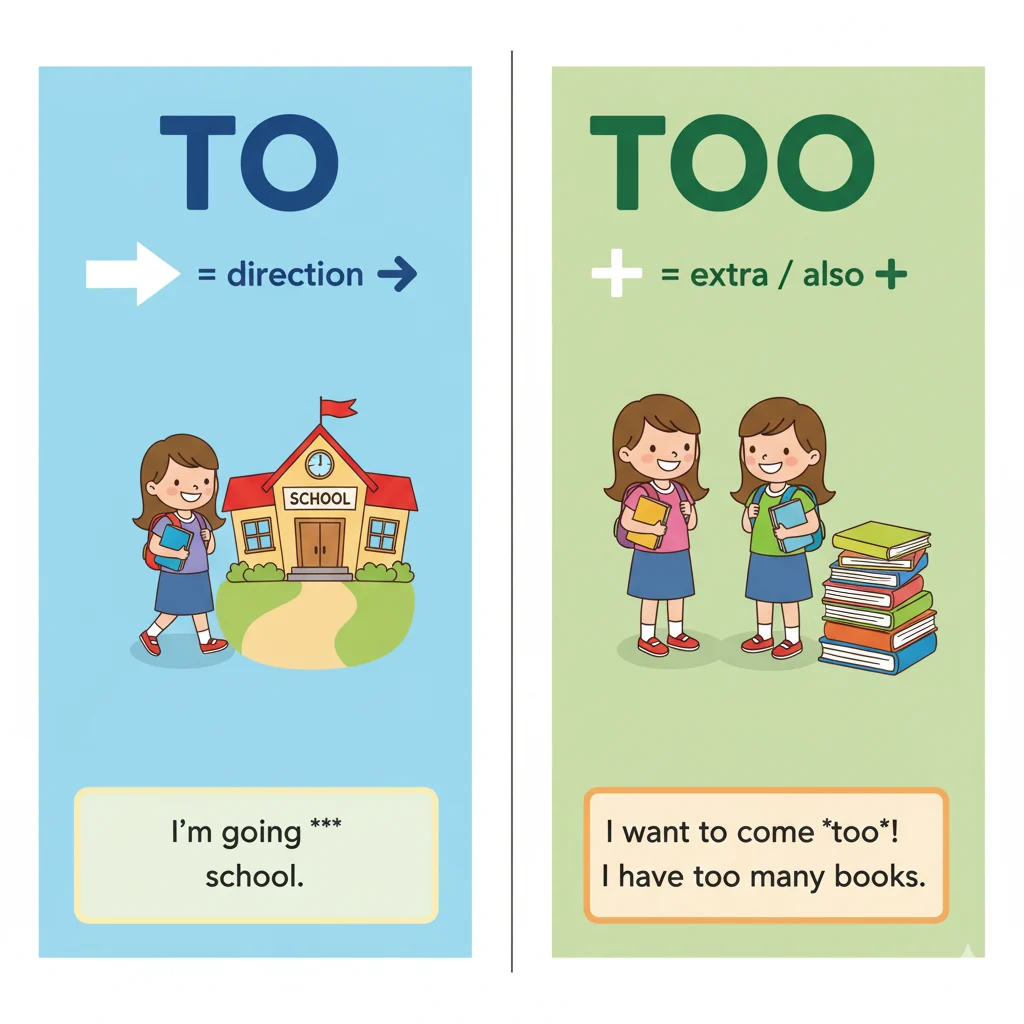
“To” is one of the most common words in English. It’s a preposition that usually shows direction, purpose, or relation. Sometimes, it’s also used before a verb (called an infinitive).
Meaning: Shows movement, purpose, or relationship.
Examples:
- I’m going to school. (direction)
- She wants to play outside. (before a verb)
- Give this to your teacher. (receiver)
Think of “to” as a little arrow ➡️ — it points toward something or someone.
🔹 “Too” — Definition and Usage
“Too” is an adverb. It means “also,” “as well,” or “very/excessively.”
Meaning: Shows addition or an extreme degree.
Examples:
- I want to go too. (also)
- It’s too hot to play outside. (very hot)
- You’re too kind. (very kind)
So, “too” is used when something is extra, excessive, or when you’re adding yourself or someone else to a statement.
⚖️ The Key Difference Between “To” and “Too”
Here’s the simple difference:
| Feature | To | Too |
|---|---|---|
| Part of Speech | Preposition or part of infinitive | Adverb |
| Meaning | Shows direction, purpose, or relationship | Means “also,” “as well,” or “very” |
| Example | I’m going to the park. | It’s too cold outside. |
| Quick Tip | Think of “to” as a direction arrow ➡️ | Think of “too” as “extra” (it even has an extra o!) |
💡 Quick Tip to Remember:
👉 “Too” has an extra ‘o’ — it means extra or more.
👉 “To” is short — used when moving toward something.

🚫 Common Mistakes and How to Avoid Them
Let’s look at some typical mix-ups and how to fix them.
| ❌ Incorrect | ✅ Correct | Explanation |
|---|---|---|
| I’m going too school. | I’m going to school. | You’re showing direction, so use “to.” |
| It’s to cold outside. | It’s too cold outside. | You mean “very cold,” so use “too.” |
| I want to go to. | I want to go too. | You’re adding yourself (“also”), so use “too.” |
✅ Memory Hack: If you can replace it with “also” or “very,” use too. Otherwise, use to.
🧭 When to Use “To”
Use “to” when you’re:
- Showing direction – “I walked to the shop.”
- Showing purpose – “I came here to study.”
- Connecting verbs – “I like to dance.”
- Showing relationship – “This belongs to me.”
- Indicating time – “It’s ten to five.”
More Examples:
- She’s traveling to Karachi.
- He gave the pen to Ali.
- We’re going to the party tonight.
- I love to read stories before bed.
🧠 Simple Trick: If your sentence involves movement, direction, or purpose, use to.
🌟 When to Use “Too”
Use “too” when you mean:
- Also / As well – “I want ice cream too.”
- Very / Extremely – “It’s too late to call.”
- Excessively – “She talks too much.”
More Examples:
- You’re coming too, right?
- That movie was too scary for me.
- He’s too tired to play football.
- Don’t eat too many sweets!
🧠 Memory Hack: “Too” has two o’s — think of it as meaning “too much” or “me too.”
🧩 Quick Recap: To vs Too
Here’s an easy summary to remember forever:
- To = shows direction, purpose, or relationship.
👉 “I’m going to school.” - Too = means “also” or “very.”
👉 “I’m hungry too.” / “It’s too hot.”
✅ In Short:
- “To” → movement or purpose.
- “Too” → extra, also, or excessive.
📘 Advanced Tips for Learners
1. Origin & Grammar Insight:
- “To” comes from Old English “tō,” meaning direction or goal.
- “Too” evolved from “to” but added an extra ‘o’ in Middle English to mean “in addition.”
2. Formal Writing Tips:
In essays or exams, mixing them up can change meaning completely:
- ❌ “I’m happy to.” (incomplete)
- ✅ “I’m happy too.” (adds agreement)
3. Social Media & Texting:
Online, people sometimes write “tooo” for emphasis, like “That’s tooo cute!” — but that’s informal. Use it only in friendly chats, not in school or professional writing.
🧠 Mini Quiz: Test Yourself!
Fill in the blanks with to or too:
- I’m going ___ the park.
- It’s ___ hot today!
- She wants ___ learn piano.
- I love pizza, and my brother does ___.
- Give this book ___ Sara.
- You’re ___ funny!
- He forgot ___ call you.
Answers: 1. to, 2. too, 3. to, 4. too, 5. to, 6. too, 7. to
❓ FAQs
1. What is the difference between “to” and “too”?
“To” shows direction or purpose, while “too” means “also” or “very.”
2. How can I remember the difference easily?
Think of too as “extra” — it has an extra o!
3. Can I start a sentence with “To”?
Yes! Example: “To be honest, I don’t know.”
4. Can I use “too” in formal writing?
Yes, but only when it means “also.” Avoid it when expressing emotion like “too cute!” in formal essays.
5. Is “to” always a preposition?
Mostly yes, but sometimes it’s part of a verb (infinitive), like “to eat,” “to go,” or “to learn.”
🏁 Conclusion
Now you know the real difference between “to” and “too” — one shows direction, and the other means “also” or “very.”
Remember the extra “o” rule:
- “To” → direction/purpose.
- “Too” → extra or also.
With these simple tricks, you’ll never make the same mistake again. Keep practicing, keep learning, and soon your English writing will be too good to correct!

Kael Donovan is a language enthusiast and writer at Definevs.com, simplifying complex words and grammar rules into fun, easy-to-understand guides for readers.