The correct and most accepted word is “till.”
The spelling “til” is often seen online, but it is not standard English and is considered informal or incorrect in formal writing. If you want to sound correct, clear, and professional, always use “till.”
Many English learners get confused between “till” and “til.” They look almost the same, they sound the same, and people often use them as if they mean the same thing. Because of this, writers, students, and even adults sometimes wonder which one is correct. Should you write “Wait till 5 PM” or “Wait til 5 PM”?
This guide will help you understand the difference between “till” and “til” in the simplest way possible. You will learn their meanings, the correct usage, common mistakes, and easy examples you can use in daily life. Every explanation is written in clear, friendly language so even a class-4 student can understand it without stress.
By the end, you will know exactly when to use “till,” when not to use “til,” and how to remember the rule forever.
What Does Each Word Mean? (Simple Definitions)
1. What Does “Till” Mean?
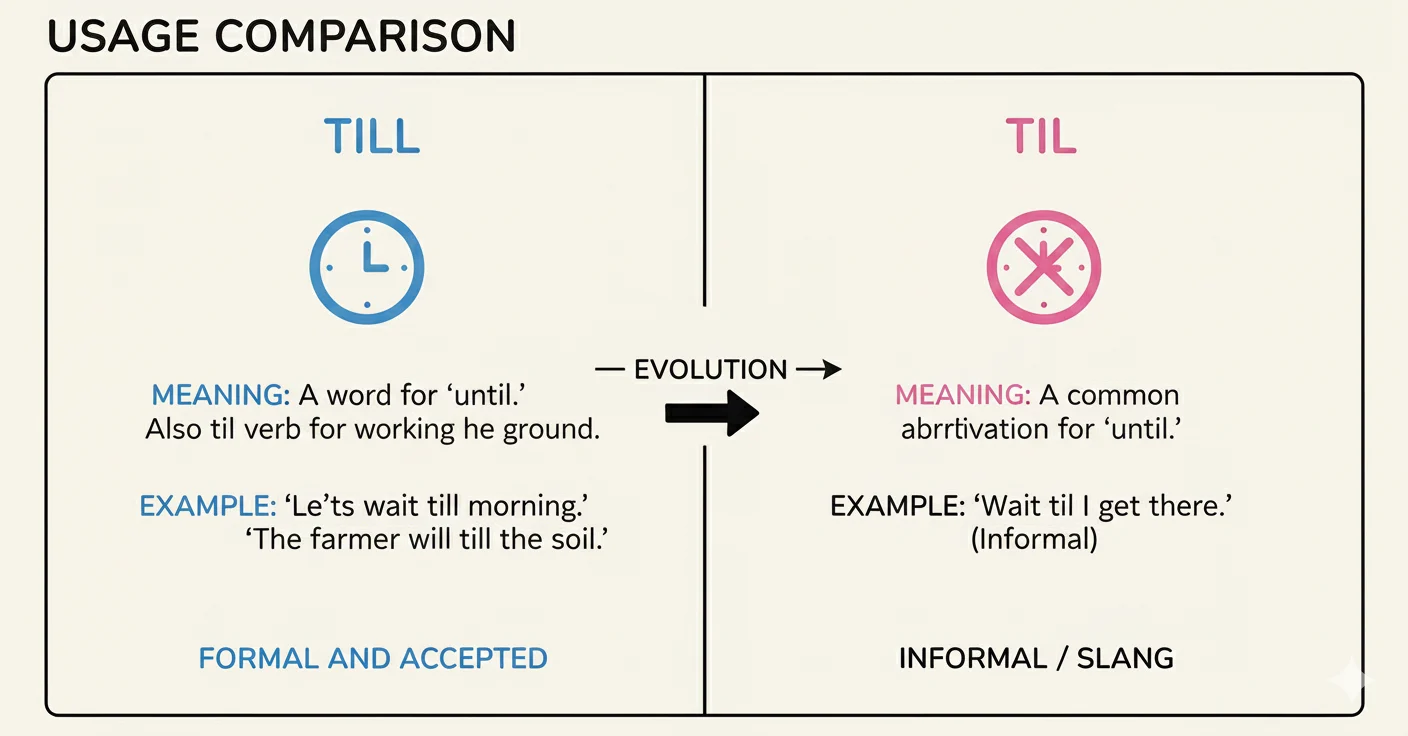
“Till” is a preposition and conjunction that means “up to the time of.”
It is the correct and standard spelling.
Easy Examples of “Till”:
- I will wait till you finish.
- The shop stays open till 10 PM.
- She worked till the morning.
Think of “till” as a gentle bridge showing time from one moment up to another.
2. What Does “Til” Mean?
“Til” is not standard English.
It is often used online, in texting, or informally, but it is not accepted in formal writing, school essays, or exams.
The spelling “til” is considered incorrect by traditional English grammar rules.
Examples of How People Use “Til” (But Shouldn’t):
- Wait til I call you. ❌
- I won’t sleep til midnight. ❌
- Stay here til I return. ❌
To be correct and safe:
➡️ Use “till,” not “til.”
The Key Difference Between Till and Til (With Table)
| Word | Meaning | Correct? | Example Sentence | Notes |
|---|---|---|---|---|
| Till | Up to the time of | ✔️ Yes | “Wait till I come back.” | Standard English |
| Til | Same intended meaning, but not standard | ❌ No | “Wait til I come back.” | Informal or incorrect |
Quick Tip to Remember
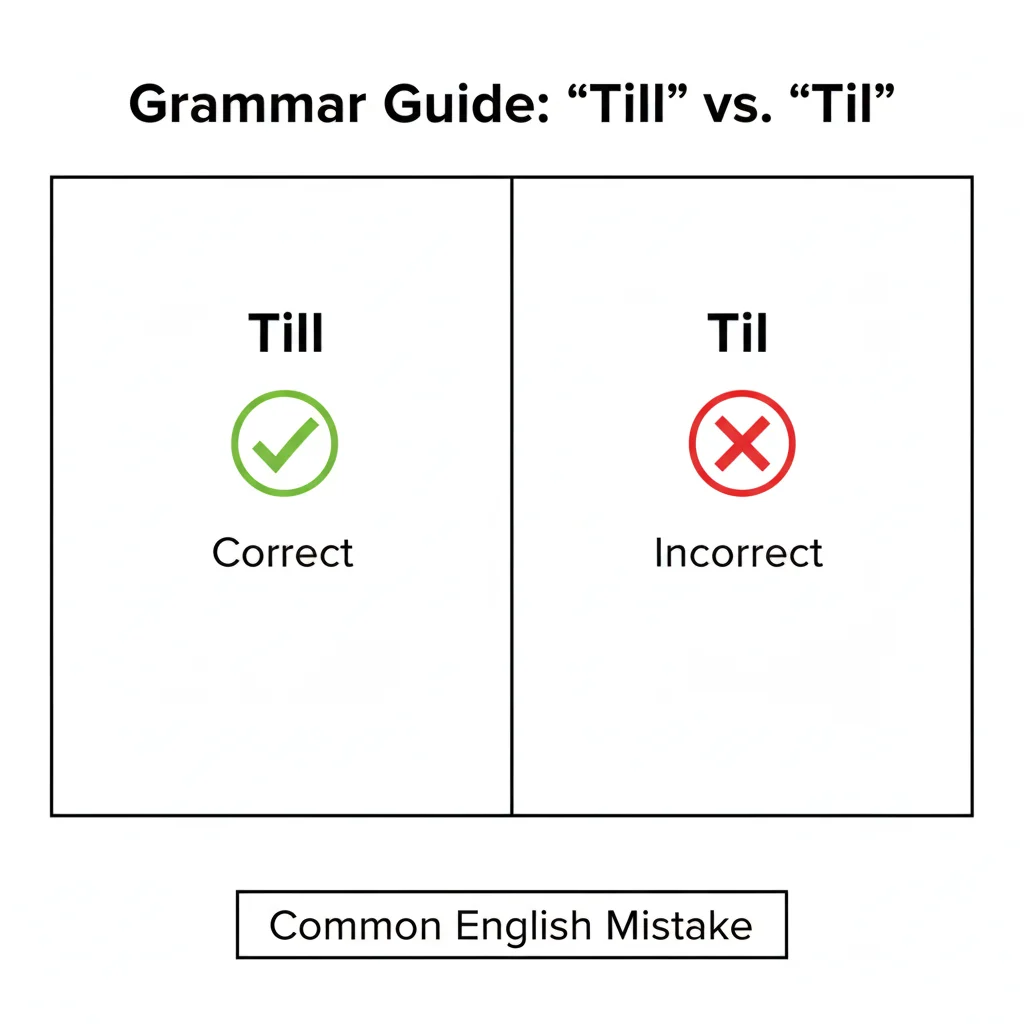
Till is the real word.
Til is the wrong shortcut.
Common Mistakes and How to Avoid Them
Mistake 1: Writing “til” in school essays
❌ Wrong: I can stay here til the rain stops.
✔️ Correct: I can stay here till the rain stops.
Why it happens:
People think “til” is shorter or looks more modern.
How to fix it:
Remember: Shortcuts are not always correct. Use “till.”
Mistake 2: Thinking “till” is short for “until”
Many think “till” is just a shorter form of “until,” but this is not true.
Fact:
Till is older than until.
So it is a real, complete word.
Mistake 3: Mixing up “till,” “til,” and “’til”
You may also see ’til with an apostrophe.
This version is also not standard and should be avoided in formal writing.
Correct choice: Always choose “till.”
When to Use “Till” (With Real-Life Examples)
Use “till” when you want to show time up to a certain point.
Easy Example Sentences:
- I will play till sunset.
- You can stay here till your dad comes.
- The lights will be on till 11 PM.
- She waited till the bus arrived.
- Keep studying till you understand.
Where you can use “till”:
- School writing
- Homework
- Textbooks
- Essays
- Professional emails
- Exams
- Daily conversation
It is always safe, always correct.
When to Use “Til” (With Important Note)
Short Answer:
Do NOT use “til” in formal English.
However, you might see “til” in:
- Social media posts
- Text messages
- Music lyrics
- Informal chats
- Creative writing for stylistic effect
Memory Hack:
Think of “til” as a broken word missing a letter.
If a word looks broken, don’t use it in school or professional writing.
Quick Recap: Till vs Til
- Till = Correct, standard, accepted everywhere.
- Til = Not standard. Avoid in school and formal writing.
- Both are used for time, but only ‘till’ is grammatically right.
- If you want to be clear and correct: Always choose “till.”
Advanced Tips
1. History
The word “till” has existed since Old English.
“Until” was created later by adding “un-” in front of “till.”
This means “till” is not short for “until,” but a full word on its own.
2. Formal Writing
In essays, reports, and exams, teachers expect correct spelling.
So write:
✔️ The library stays open till 8 PM.
3. Online Writing
People use shortcuts online to save time.
That’s why “til” became common.
But common ≠ correct.
4. Clarity Matters
Using the proper word makes your writing look clean, educated, and professional.
Mini Quiz: Test Your Understanding
Fill in the blanks with “till” or “til.” (Correct English only uses one.)
- Please wait ___ I finish my work.
- The store is open ___ midnight.
- I won’t sleep ___ my mom returns.
- Stay here ___ the bell rings.
- She worked ___ morning.
Answers:
- till
- till
- till
- till
- till
Because till is the only correct choice.
5 Helpful FAQs
1. Which is correct: till or til?
Till is correct. Til is not standard English.
2. Is “till” short for “until”?
No. “Till” is an older word than “until.”
3. Can I use “til” in school essays?
No. Always use “till.”
4. Are “till,” “’til,” and “til” the same?
They look similar, but only “till” is correct.
5. Is “till” formal?
Yes. You can safely use “till” in all formal and informal writing.
Conclusion
Understanding the difference between “till” and “til” is simple once you know the rule. Till is the correct and complete English word, and it works in every situation — school writing, everyday conversation, essays, and professional communication. On the other hand, til is only an informal shortcut that should not be used in formal English.
The goal of good writing is clarity, and choosing the right word helps you express your ideas clearly and confidently. Now that you know the meaning and usage of both forms, you can avoid common mistakes and write English that looks smart and polished.
Keep practicing, keep learning, and keep improving your English every day!

Arwen Blythe is a passionate language and culture enthusiast, crafting clear, engaging guides on words, phrases, and modern English for Definevs.com readers.