Have you ever stopped while writing and thought, “Should I use then or than?” 🤔 Don’t worry — you’re not alone! Many English learners, even adults, confuse these two tiny words because they sound similar but mean completely different things.
In this fun and simple guide, you’ll learn the difference between “then” and “than”, their meanings, correct usage, and real-life examples. By the end, you’ll always know which word to use — whether you’re writing an essay, chatting online, or doing your homework. 💬
Let’s dive in and master then vs than once and for all! 🚀
📘 What Does Each Word Mean?
✨ “Then” — What It Means
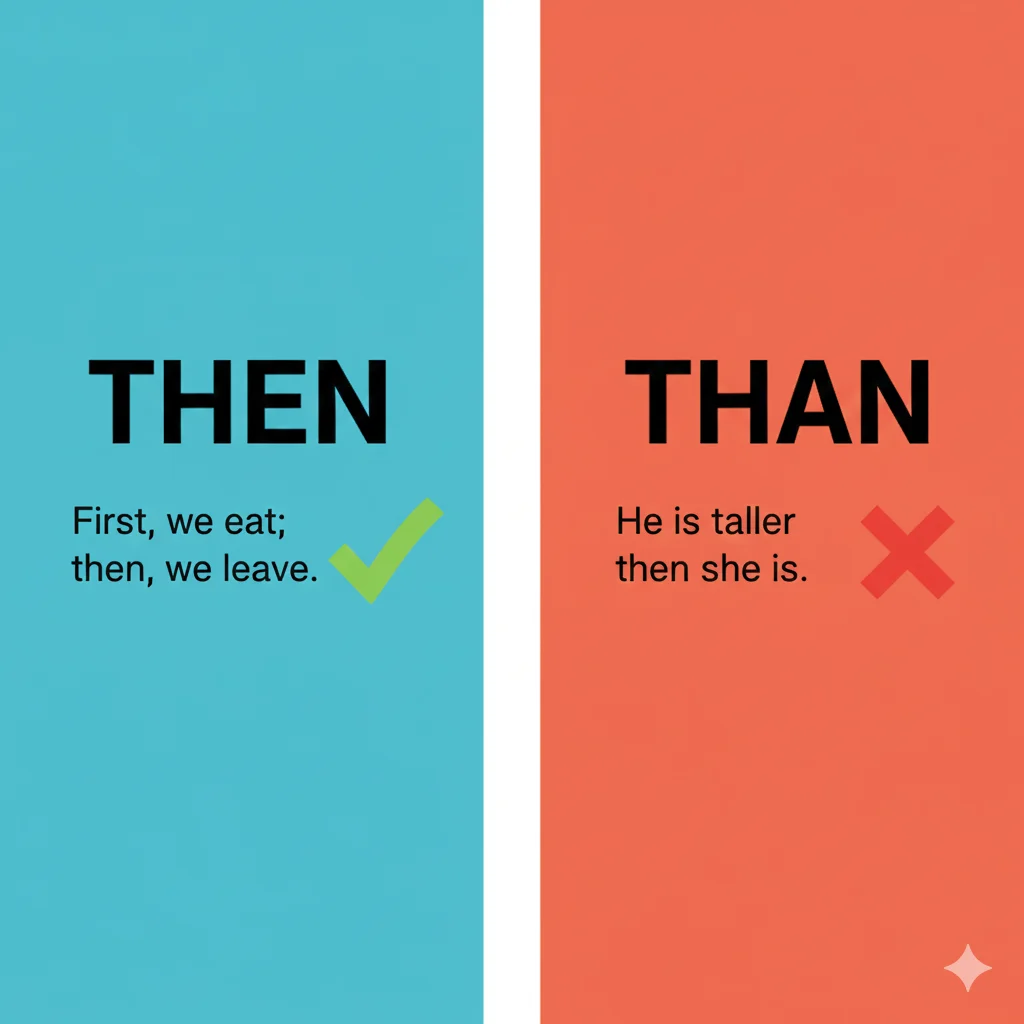
Then shows time, order, or results. It usually tells when something happens or what happens next. It’s often used as an adverb.
✅ Easy meaning: “Then” = at that time or next.
Examples:
- I finished my homework, then I played games. 🎮
- Back then, there were no smartphones!
- If you’re hungry, then eat something. 🍎
👉 Tip: Think of “then” as a timeline word. It helps show what happens after or before.
✨ “Than” — What It Means
Than is used for comparisons. It tells how two things are different. It’s a conjunction (a joining word).
✅ Easy meaning: “Than” = used to compare two things.
Examples:
- My dog is bigger than yours. 🐶
- I’d rather read than watch TV. 📚
- She’s faster than me at running. 🏃♀️
👉 Tip: Think of “than” as a comparison word. It helps show differences.
🪄 The Key Difference Between “Then” and “Than”
| Feature | Then | Than |
|---|---|---|
| Main Use | Shows time or sequence | Shows comparison |
| Part of Speech | Adverb | Conjunction |
| Meaning | At that time / next | Used to compare |
| Example 1 | I’ll eat dinner, then go to bed. | She’s taller than me. |
| Example 2 | Back then, we had fun at the park. | This cake tastes better than that one. |
| Example 3 | Study first, then play later. | He’s older than his brother. |
💡 Quick Tip to Remember:
If you’re talking about time, use then.
If you’re comparing, use than.
🧠 Memory Hack:
Think of the A in “thAn” as the A in “compAre.”
🚫 Common Mistakes and How to Avoid Them
❌ Wrong: I like pizza more then burgers.
✅ Correct: I like pizza more than burgers. 🍕
Why: You’re comparing pizza and burgers — so you need than.
❌ Wrong: I finished lunch, than I went outside.
✅ Correct: I finished lunch, then I went outside. 🌞
Why: You’re talking about what happened next — so you need then.
❌ Wrong: She was younger then him.
✅ Correct: She was younger than him. 👧
Why: That’s a comparison, not a timeline.
⏰ When to Use “Then”
Use then when you want to:
- Talk about time 🕒
- Describe what happens next ➡️
- Show results or consequences ⚡
Examples:
- I brushed my teeth, then went to bed. 💤
- Finish your homework, then you can play.
- If it rains, then we’ll stay home. ☔
- First I was scared, then I felt brave. 💪
- Let’s eat breakfast, then leave for school. 🏫
💭 Memory Trick:
If you can replace it with “next,” “at that time,” or “after that,” it’s then!
⚖️ When to Use “Than”
Use than when you want to compare people, things, or ideas.
Examples:
- My backpack is heavier than yours. 🎒
- Summer is hotter than winter. 🌞❄️
- A car is faster than a bicycle. 🚗🚲
- She’s kinder than he is. 💕
- Reading is better than scrolling all day. 📖📱
💭 Memory Trick:
If your sentence is comparing things, it’s than!
🧩 Quick Recap: “Then” vs “Than”
✅ Then → Time or sequence
✅ Than → Comparison
Easy Summary:
- If it tells when → use then.
- If it shows difference → use than.
🪶 Examples to Remember:
- I studied hard, then took the test.
- My score is higher than yesterday’s.
🌍 Advanced Tips for Grammar Lovers
📖 Origin:
- “Then” comes from Old English þænne, meaning at that time.
- “Than” comes from þanne, used for comparing.
🖊️ Formal Writing Tip:
In essays or exams, using then and than correctly shows strong grammar skills. Teachers notice these little details! 👩🏫
📱 In Texting or Online Writing:
It’s common to mix them up when typing fast — but using the right one makes your message clearer and smarter.
💬 Example:
“Better than ever!” sounds confident.
“Better then ever!” sounds confusing. 😅
🧠 Mini Quiz — Test Yourself!
Fill in the blanks with then or than 👇
- I’ll call you back, _____ go to dinner.
- She’s taller _____ her brother.
- We studied first, _____ watched a movie.
- A lion is stronger _____ a cat.
- If you finish early, _____ we can play.
- My score is better _____ before.
- We’ll eat, _____ do our homework.
✅ Answers: 1. then | 2. than | 3. then | 4. than | 5. then | 6. than | 7. then
💬 FAQs
1. What’s the difference between then and than?
Then shows time or sequence, while than is used for comparisons.
2. Can I use “then” in place of “than”?
No! Doing so changes the meaning of the sentence.
3. How can I remember when to use “than”?
Remember the “A” in “than” stands for compare.
4. Is “then” always about time?
Mostly yes, but it can also show results — like “If it rains, then we’ll stay home.”
5. Why do people mix up “then or than”?
Because they sound similar — but practice makes it easy to tell them apart!
🌟 Conclusion
Now you know the real difference between then and than! 🎉 Remember — use then for time or sequence and than for comparison. The more you practice, the easier it becomes. Every time you write, think: “Am I talking about time or comparing things?” ⏰⚖️
Keep learning, keep practicing, and soon you’ll never mix them up again. Grammar is just like a game — the more you play, the better you get! 💪

Kael Donovan is a language enthusiast and writer at Definevs.com, simplifying complex words and grammar rules into fun, easy-to-understand guides for readers.