Have you ever stopped while writing and asked yourself, “Should I use then or than?” 🤔
You’re not alone! Many English learners — even native speakers — mix these two tiny words. They sound similar but mean completely different things.
In this guide, you’ll learn:
- What then and than really mean
- The difference between then and than
- How to use each correctly with easy examples
- Common mistakes to avoid
- Fun tips and a quick quiz to test your knowledge
By the end, you’ll never confuse then and than again — promise!
🧩 What Does Each Word Mean?
Let’s start by understanding both words clearly.
What Does “Then” Mean?
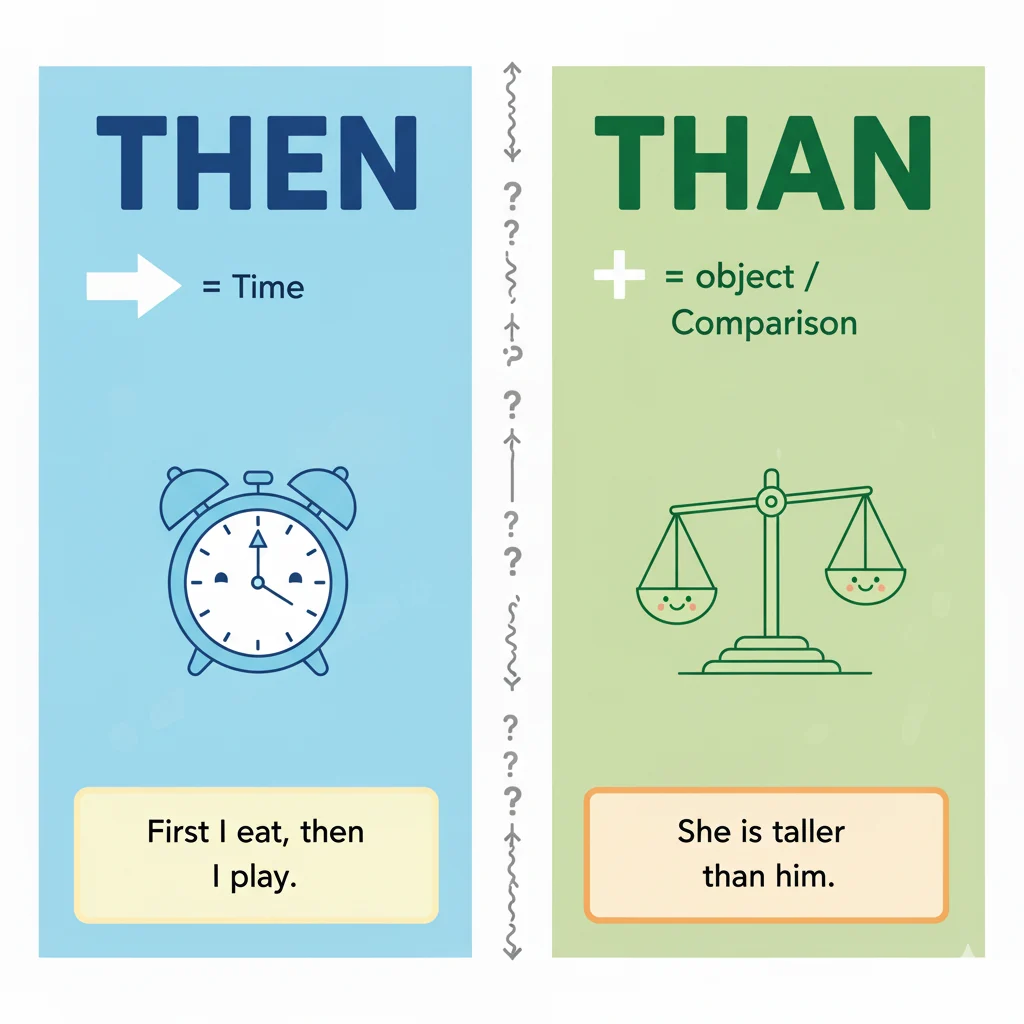
“Then” is usually an adverb. It tells us about time, order, or results — what happens next, after, or as a result.
👉 Simple meaning: At that time or next in order.
Examples:
- I finished my homework, then I played games.
- If you study hard, then you will pass the test.
- Back then, we didn’t have smartphones.
You can think of “then” as something that moves time forward — it’s all about “what happens next.”
What Does “Than” Mean?
“Than” is a conjunction used for comparison — when you’re showing the difference between two things.
👉 Simple meaning: Used to compare one thing with another.
Examples:
- My bag is heavier than yours.
- She runs faster than her brother.
- I’d rather sleep than study today.
So, remember: “Than” = Comparison
You use it when you’re choosing, comparing, or showing difference.
⚖️ The Key Difference Between Then and Than
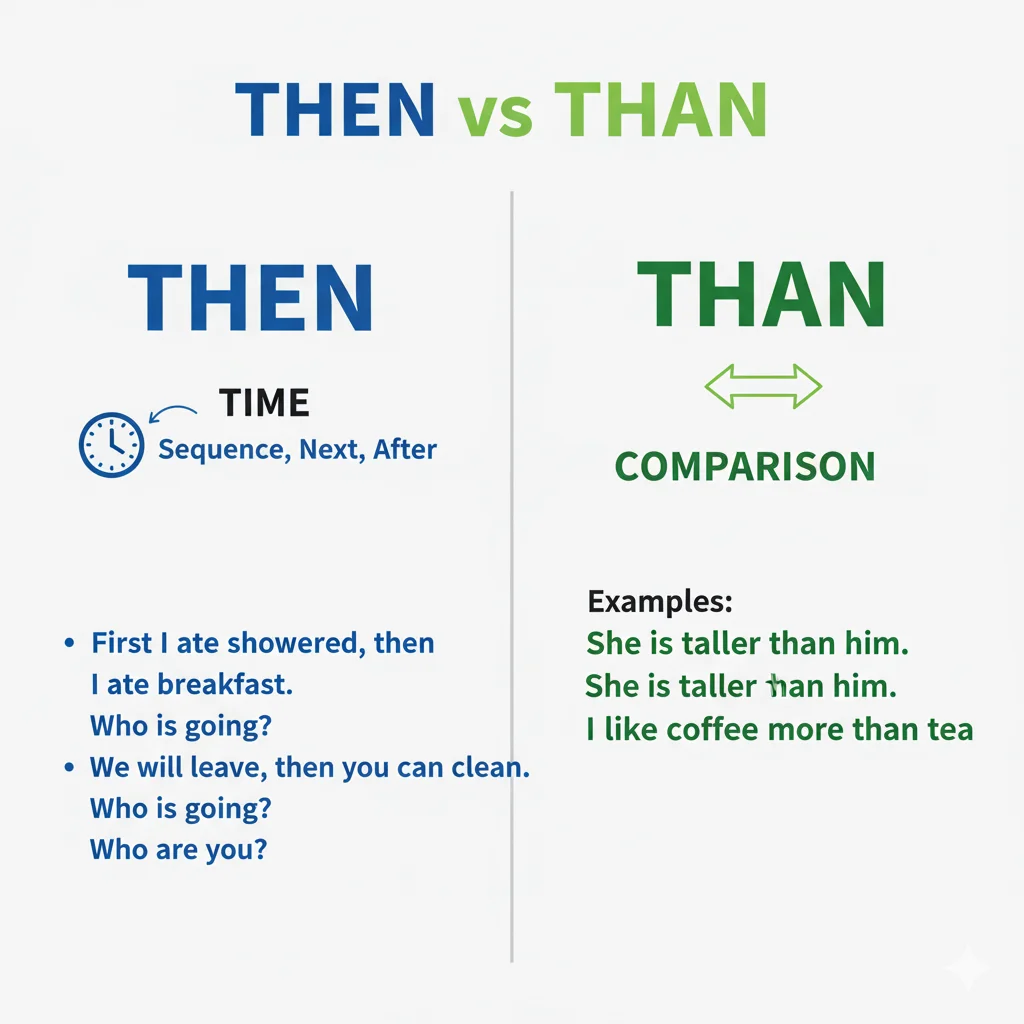
Here’s a quick side-by-side look at the difference between “then” and “than.”
| Feature | Then | Than |
|---|---|---|
| Part of Speech | Adverb / Sometimes Noun | Conjunction / Preposition |
| Main Use | Refers to time or sequence | Used for comparison |
| Meaning | At that time / Next / As a result | In contrast to / Compared to |
| Example 1 | We went to dinner, then watched a movie. | This pizza is better than that one. |
| Example 2 | Back then, everything was cheaper. | She’s taller than her sister. |
Quick Tip to Remember:
If you’re talking about time, use then.
If you’re comparing things, use than.
🚫 Common Mistakes and How to Avoid Them
Here are some of the most common errors learners make — and how to fix them.
❌ Wrong: I’d rather go now then later.
✅ Correct: I’d rather go now than later.
(We’re comparing two options — “now” and “later.”)
❌ Wrong: We ate lunch, than went to the park.
✅ Correct: We ate lunch, then went to the park.
(This shows sequence — one thing happened after another.)
❌ Wrong: She’s smarter then me.
✅ Correct: She’s smarter than me.
(We’re comparing two people — use than.)
Tip:
Whenever you can replace the word with “next,” use then.
If you can replace it with “compared to,” use than.
⏰ When to Use “Then”
Use then when you’re:
- Talking about time (something that happened or will happen)
- Showing what comes next in a list or process
- Explaining results or consequences
Examples:
- I’ll call you then.
- First, brush your teeth, then go to bed.
- If it rains, then we’ll stay home.
- Back then, I lived with my grandparents.
- She worked hard, then succeeded.
Memory Trick:
Think of then like a timeline — it moves time forward!
⚖️ When to Use “Than”
Use than when you’re:
- Comparing two or more things
- Expressing preferences or differences
Examples:
- This cake is sweeter than the last one.
- He’s more confident than before.
- I’d rather walk than drive.
- My phone is newer than yours.
- She is better at drawing than painting.
Memory Hack:
“Than” has an “A” — think of “comparison.” (They both have “A” in them!)
🔁 Quick Recap: Then vs Than
Here’s an easy summary to remember:
- Then = Time / Order / Result
➜ “I’ll eat lunch, then go out.” - Than = Comparison / Difference
➜ “Pizza is better than burgers.”
Simple Rule:
If you can ask “when?” use then.
If you can ask “who’s better?” or “what’s different?” use than.
🌍 Advanced Tips (Bonus for Curious Learners)
- Origin:
“Then” comes from Old English þanne, meaning “at that time.”
“Than” evolved from the same root but shifted to show contrast. - In Formal Writing:
Always check spelling — using the wrong word can change your entire sentence meaning.
Example:
“I’d rather read than sleep” ≠ “I’d rather read then sleep.”
(One shows preference; the other shows order!) - In Texting or Online Chats:
Many people type “then” by mistake because autocorrect suggests it — always proofread!
🧠 Mini Quiz: Test Yourself!
Fill in the blanks with then or than.
- She’s taller ___ her best friend.
- First we’ll eat, ___ we’ll go shopping.
- I’d rather dance ___ sing.
- Back ___, things were different.
- He’s more responsible ___ before.
- Study hard, and ___ you’ll succeed.
- This test is easier ___ the last one.
Answers: 1. than | 2. then | 3. than | 4. then | 5. than | 6. then | 7. than
📝 FAQs About “Then” and “Than”
1. What is the main difference between “then” and “than”?
“Then” refers to time or sequence, while “than” is used for comparison.
2. Is “than” only used for comparisons?
Yes, “than” always compares one thing to another (like taller than, better than).
3. Can I use “then” in place of “after”?
Yes! “Then” can often replace “after.” Example: “We’ll eat, then go home.”
4. Why do people confuse “then” and “than”?
Because they sound similar, especially when spoken quickly — but their meanings are totally different.
5. How can I remember the difference easily?
Think: “ThAn = compArison.” If it compares, use than!
✨ Conclusion
So now you know the real difference between then and than — and how to use them like a pro!
- Then talks about time or sequence.
- Than is used for comparison.
Keep practicing by writing short sentences daily. The more you use them, the easier they’ll feel — and soon, you’ll never mix them up again.
Remember: Practice makes perfect — and grammar gets easier each day! 🌟

Kael Donovan is a language enthusiast and writer at Definevs.com, simplifying complex words and grammar rules into fun, easy-to-understand guides for readers.