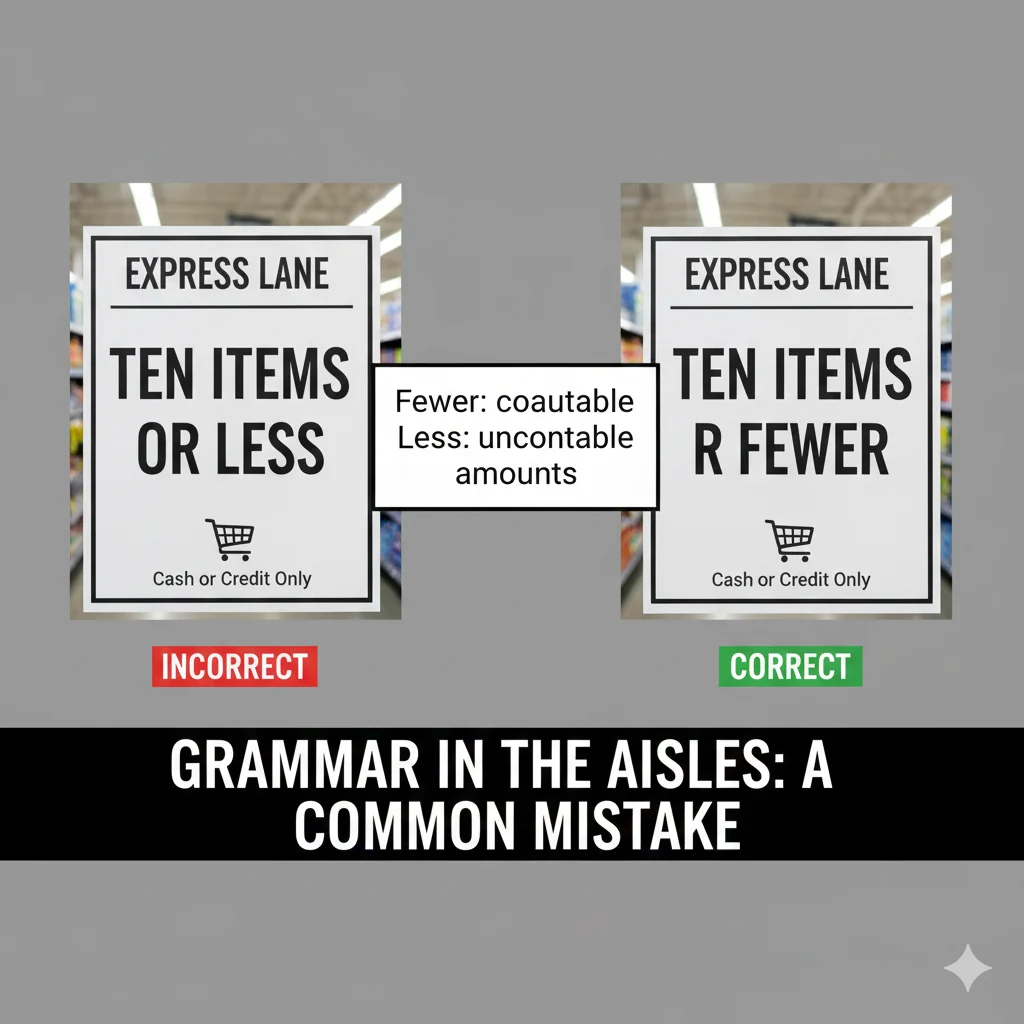
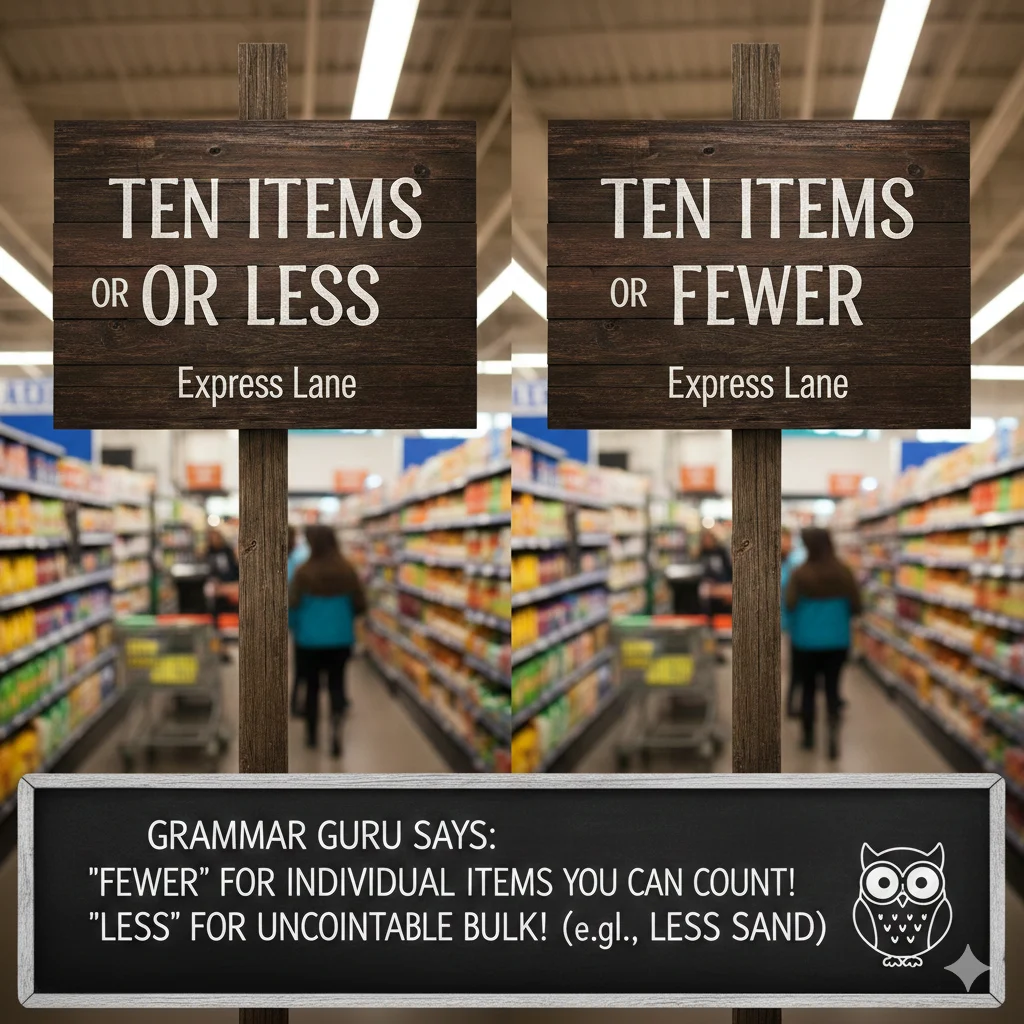
Have you ever stood in a supermarket express lane and seen a sign that says “Ten Items or Less” — and wondered if it should be “Ten Items or Fewer”? 🤔
You’re not alone!
This is one of the most common grammar debates in English. Even native speakers mix them up because they sound right — but only one is grammatically correct in most situations.
In this simple guide, you’ll learn:
- The meaning and correct usage of “less” and “fewer”
- The key difference between them
- Examples, common mistakes, and memory tricks to help you never forget the rule again
🧠 What Does Each Word Mean?
Let’s start by understanding the meaning of both words separately.
What Does “Less” Mean?
“Less” is used when talking about things you can’t count individually — like water, time, money, or love.
It describes amount or quantity (uncountable nouns).
Examples:
- I have less time today.
- Please put less sugar in my tea.
- There’s less water in the bottle.
👉 Think of “less” as for stuff you measure, not count.
What Does “Fewer” Mean?
“Fewer” is used when you can count the items — like books, apples, or cars.
It describes number (countable nouns).
Examples:
- I have fewer books than you.
- There are fewer people in class today.
- She made fewer mistakes this time.
👉 Think of “fewer” as for things you can count one by one.
🔍 The Key Difference Between “Less” and “Fewer”
| Feature | Less | Fewer |
|---|---|---|
| Used for | Uncountable nouns (things you measure) | Countable nouns (things you count) |
| Refers to | Quantity or amount | Number of items |
| Examples | less water, less time, less sugar | fewer apples, fewer cars, fewer chairs |
| Quick Tip | Can’t count it → use less | Can count it → use fewer |
💡 Quick Tip to Remember:
If you can add “many” before the noun, use fewer.
If you can add “much”, use less.
- much time → less time
- many books → fewer books
❌ Common Mistakes and How to Avoid Them
Even supermarkets sometimes get it wrong! Let’s fix that confusion.
Mistake 1:
❌ “I have less friends than before.”
✅ “I have fewer friends than before.”
(You can count friends → use fewer.)
Mistake 2:
❌ “There are less cars on the road.”
✅ “There are fewer cars on the road.”
(Cars are countable.)
Mistake 3:
❌ “I spent less hours studying.”
✅ “I spent fewer hours studying.”
(Hours can be counted.)
Why this happens:
People often say “less” because it sounds smoother and faster.
But grammatically, fewer is correct for countable items.
🧺 When to Use “Ten Items or Fewer”
Use “Ten Items or Fewer” when you’re talking about countable things — like items in your shopping cart.
You can count each item: 1, 2, 3…10.
Examples:
- This lane is for ten items or fewer.
- Please choose fewer than ten books.
- Students with fewer than five assignments may leave early.
- I’ve bought fewer gifts this year.
📘 Memory Hack:
If you can count it one by one — like apples or clothes — use fewer.
🕓 When to Use “Ten Items or Less”
Use “less” when the noun is uncountable or refers to time, money, distance, or weight.
Examples:
- We have less than an hour left.
- The bag weighs less than 5 kilograms.
- He spent less money this month.
- She showed less interest in the topic.
So if the word represents something you can’t count, or is treated as a single measurement, less is correct.
🧾 Why Do Stores Say “Ten Items or Less”?
Technically, “Ten items or fewer” is the correct form because you can count each item.
However, “Ten items or less” became popular in everyday English because it’s shorter and sounds smoother.
Even grammar experts accept that “Ten items or less” is now so common that it’s considered informal but widely understood.
Some stores (especially in the UK) have changed their signs to “Ten items or fewer” to be grammatically precise.
✅ Fun fact:
In 2008, the UK supermarket Tesco changed its signs to say “Up to 10 items” to avoid the debate altogether!
🧩 Quick Recap: Less vs Fewer
Here’s a quick way to remember the rule:
- 🧮 Can count it? → use fewer
- 🧴 Can measure it? → use less
- ✏️ “Ten items or fewer” = correct in grammar
- 💬 “Ten items or less” = common in casual speech
🧠 Advanced Tips
1. Historical Note
The rule dates back to the 18th century, when grammarians first distinguished between countable and uncountable nouns.
Before that, “less” was used for both types — so “Ten items or less” isn’t totally wrong historically.
2. In Formal Writing
Use “fewer” in essays, reports, and official documents.
Example: “There were fewer errors in the final draft.”
3. In Informal Speech
“Less” often sounds more natural and is accepted in everyday conversation.
Example: “I have less than ten minutes left.”
4. In Math and Measurements
Always use less when talking about numbers as amounts or totals.
Example: “5 is less than 10.”
🧩 Mini Quiz — Test Yourself!
Fill in the blanks with less or fewer:
- I ate _______ cookies today.
- There’s _______ milk in the fridge.
- We made _______ mistakes this time.
- He spends _______ money now.
- The park has _______ visitors on weekdays.
Answers:
- fewer | 2. less | 3. fewer | 4. less | 5. fewer
❓ FAQs
1. Which is correct: “Ten items or less” or “Ten items or fewer”?
Grammatically, “Ten items or fewer” is correct because items are countable. “Ten items or less” is informal but commonly used.
2. Why do stores use “Ten items or less”?
Because it sounds simpler and more natural. Many people use “less” in daily speech even when “fewer” is technically right.
3. What’s the main difference between less and fewer?
Less = uncountable (time, water, money).
Fewer = countable (books, apples, cars).
4. Can I use “less” for numbers?
Yes, when referring to amounts or totals: “5 is less than 10.”
5. Is “less people” wrong?
Yes, grammatically it should be “fewer people” because you can count people.
🏁 Conclusion
So, here’s the bottom line:
Use “fewer” when talking about things you can count, and “less” when talking about things you can’t.
That’s why “Ten items or fewer” is grammatically correct — but “Ten items or less” has become acceptable in everyday speech.
Now that you know the difference, you’ll never hesitate again in the express lane! 😉
Keep practicing — the more you use these words correctly, the more natural it becomes.

Isla Merrin is a language and writing expert at Definevs.com, creating simple, engaging guides to help readers master words, grammar, and modern English usage.