Ever wondered whether you should say “I sang a song” or “I have sung a song”? 🤔
You’re not alone — many English learners get confused between sang and sung because both come from the same verb: “sing.”
In this simple guide, you’ll learn:
- The difference between “sang” and “sung”
- When to use each word correctly
- Real-life examples you can remember easily
- Common mistakes and quick grammar tips to avoid them
By the end, you’ll never have to guess again which one to use!
🎶 What Does Each Word Mean?
Both “sang” and “sung” come from the base verb “sing.”
They both talk about actions related to singing — but they are used in different tenses.
Let’s break it down simply 👇
🎤 Sing (Base Form)
- Meaning: To make music with your voice.
- Example Sentences:
- I love to sing.
- She can sing beautifully.
- They sing together in a choir.
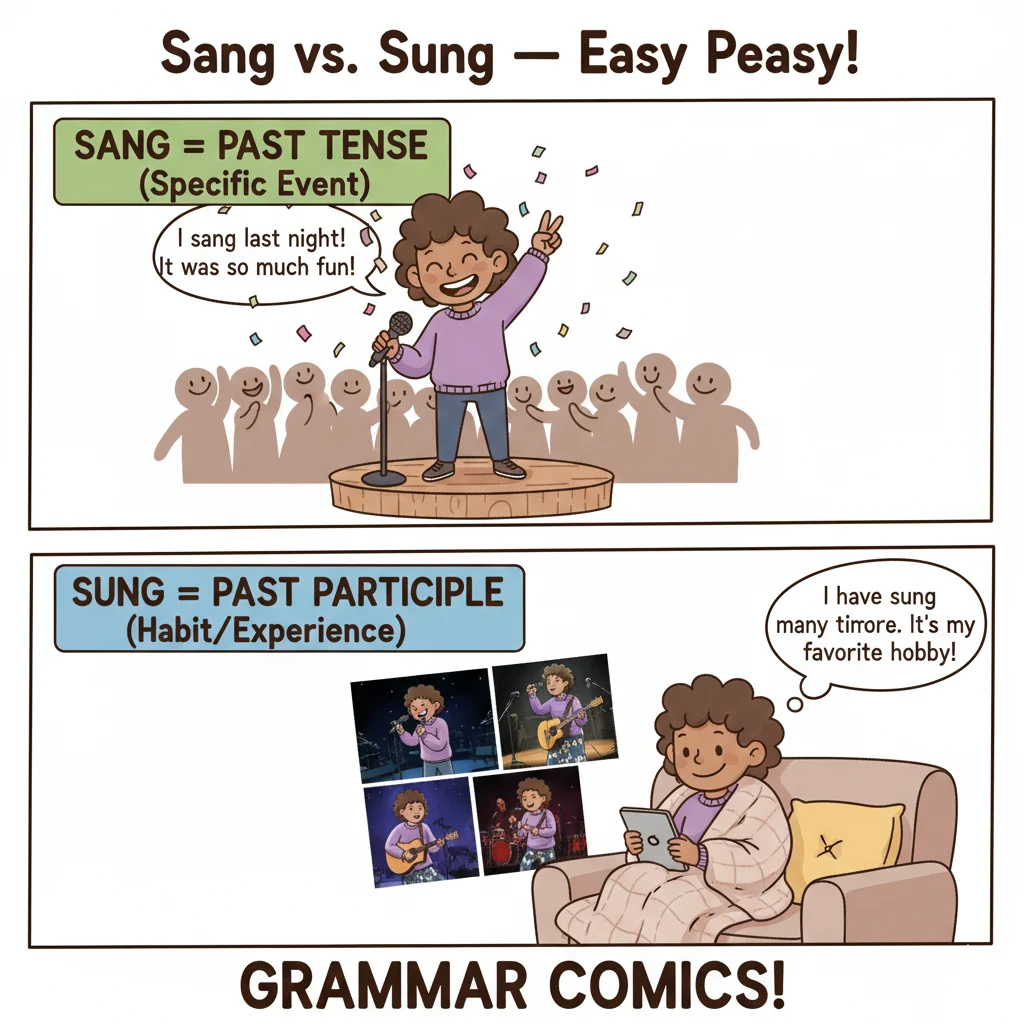
🎤 Sang (Past Tense)
- Part of Speech: Verb (past tense of sing)
- Used for: Actions that happened in the past.
- Meaning: You already sang at a specific time before now.
- Examples:
- I sang at the school concert yesterday.
- She sang her favorite song last night.
- They sang loudly in the car.
🎤 Sung (Past Participle)
- Part of Speech: Verb (past participle of sing)
- Used for: Perfect tenses (with have, has, had).
- Meaning: It shows that singing happened before now but connects to the present or another action.
- Examples:
- I have sung this song many times.
- She has sung for years.
- They had sung before the rain started.
📘 Quick Grammar Tip:
- “Sang” = simple past (no “have”)
- “Sung” = used with “have,” “has,” or “had”
⚖️ The Key Difference Between “Sang” and “Sung”
Here’s an easy comparison table to help you see the difference clearly:
| Feature | Sang | Sung |
|---|---|---|
| Verb Form | Past tense | Past participle |
| Helper Verbs | ❌ Not used with “have” | ✅ Used with “have / has / had” |
| Meaning | Action completed in the past | Action connected to another time or continuing |
| Example Sentence | “I sang yesterday.” | “I have sung today.” |
| Usage Tip | Use it alone | Use it with “have,” “has,” or “had” |
🧠 Quick Memory Trick:
If you see “have / has / had” — always use “sung.”
If not — use “sang.”
❌ Common Mistakes and How to Avoid Them
Mistake 1:
🚫 “I have sang this song before.”
✅ Correct: “I have sung this song before.”
➡️ Why: “Have” needs the past participle (sung), not the simple past (sang).
Mistake 2:
🚫 “She sung beautifully at the party.”
✅ Correct: “She sang beautifully at the party.”
➡️ Why: There is no “have / has / had,” so use the simple past sang.
Mistake 3:
🚫 “They have sang together for years.”
✅ Correct: “They have sung together for years.”
➡️ Why: The word “have” requires sung, not sang.
💡 Easy Tip:
If you say “have,” think “sung.”
If you talk about yesterday, last night, or last week, think “sang.”
🕒 When to Use Sang
Use “sang” when talking about something that already happened in the past — with a clear time mentioned.
Examples:
- I sang in the music competition yesterday.
- She sang with her friends at karaoke night.
- They sang the school anthem this morning.
- My dad sang me a lullaby when I was little.
- We sang together after dinner.
📘 Remember:
If the sentence includes yesterday, last night, ago, or a specific time, use sang.
🧠 Mini Memory Hack:
“Sang” rhymes with “rang” (from “ring”) — both are simple past forms.
🕰️ When to Use Sung
Use “sung” with have, has, or had to talk about actions that:
- Happened before another time, or
- Are connected to the present.
Examples:
- I have sung that song at many events.
- She has sung since she was five.
- They had sung before the guests arrived.
- We have sung this hymn many times.
- He has sung on TV before!
🧠 Quick Visual Trick:
Picture “have” as a stage light that shines on “sung.”
Whenever you see “have,” “has,” or “had,” that light turns on, and “sung” steps into the spotlight! 🎤✨
🔁 Quick Recap: Sang vs Sung
Here’s everything you need to remember in one glance:
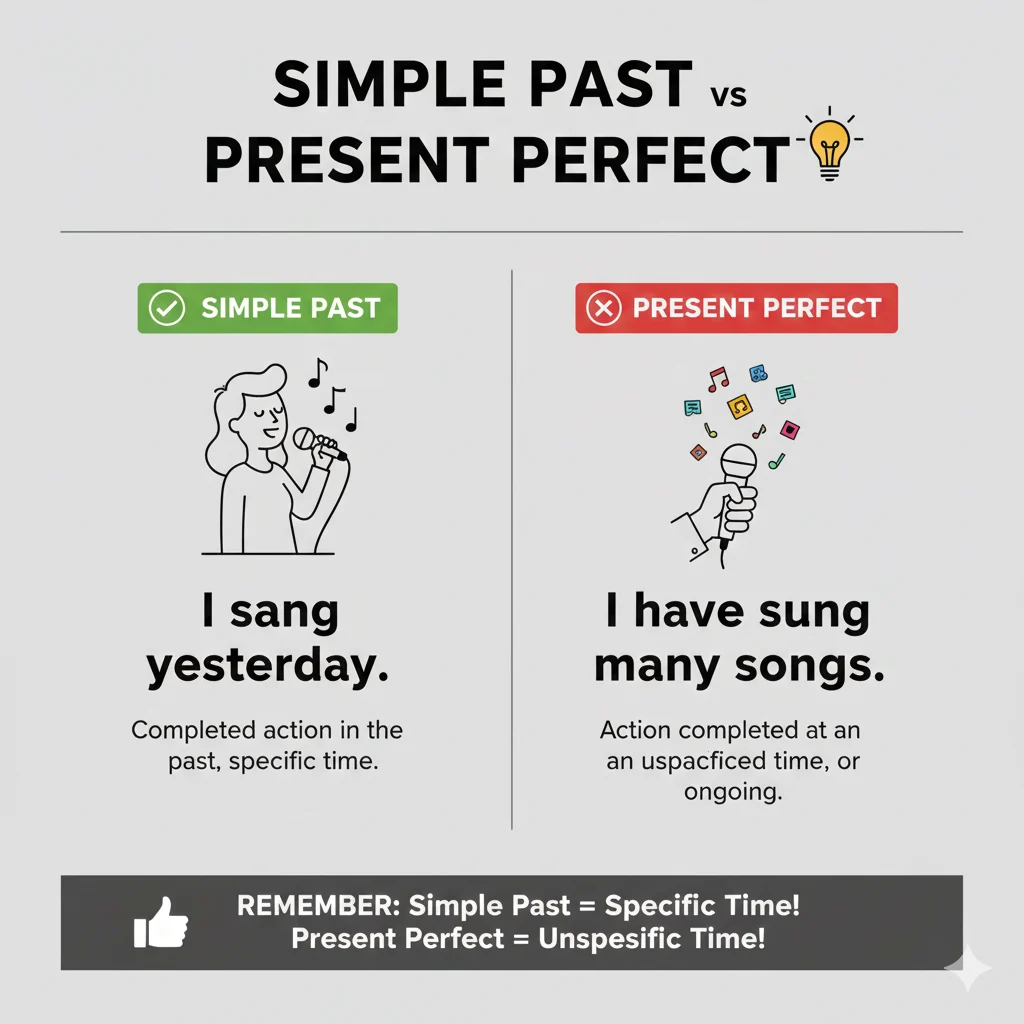
- ✅ Sang = Past tense (no “have”)
→ I sang yesterday. - ✅ Sung = Past participle (used with “have / has / had”)
→ I have sung many songs. - ❌ Don’t mix them!
→ Wrong: I have sang.
→ Right: I have sung.
💡 Advanced Tips and Fun Facts
- Origin: Both come from the Old English verb singan, meaning “to sing.”
- Form Group: “Sing, Sang, Sung” is part of a strong verb pattern — like ring/rang/rung or begin/began/begun.
- In Formal Writing: Use “sung” correctly with perfect tenses. Example: “The anthem has been sung by millions.”
- In Songs or Speech: “Sang” fits naturally in stories or past events.
💬 Pro Tip: In writing tests or essays, correct tense use (sang/sung) shows strong grammar skills.
🧩 Mini Quiz: Test Your Knowledge!
Fill in the blanks with sang or sung.
- She ________ at the concert last night.
- I have ________ that tune before.
- They ________ before the ceremony started.
- We ________ along with the radio yesterday.
- He has ________ in many competitions.
- My mom ________ when she was my age.
- The national anthem has been ________ proudly.
(Answers: 1. sang, 2. sung, 3. sung, 4. sang, 5. sung, 6. sang, 7. sung)
Passed Away / Past Away: The Hidden Truth You Never Noticed 😮
❓ FAQs
1. What is the difference between “sang” and “sung”?
“Sang” is the past tense of “sing,” used for actions in the past. “Sung” is the past participle, used with “have,” “has,” or “had.”
2. Can I say “I have sang”?
No ❌. The correct form is “I have sung.”
3. When should I use “sang”?
Use “sang” when you’re talking about a finished past action — like “I sang yesterday.”
4. What is the base form of “sang” and “sung”?
The base form is “sing.”
5. Why are “sang” and “sung” often confused?
Because they both mean the same action but appear in different tenses. The helper verbs (have/has/had) help you choose the correct one.
🧾 Conclusion
Now you know the difference between sang and sung! 🎶
- Use “sang” for simple past actions.
- Use “sung” with have, has, or had.
Keep practicing by writing short sentences or singing your favorite songs — for real! 😄
The more you use them, the easier it becomes to pick the right one naturally.

Isla Merrin is a language and writing expert at Definevs.com, creating simple, engaging guides to help readers master words, grammar, and modern English usage.