Stopped or Stoped is a common spelling question that many English learners and writers search every day. A single wrong letter can change how professional your writing looks. The clear and correct answer is simple: “Stopped” is the correct spelling, while “Stoped” is incorrect. Knowing this small rule can instantly improve your English.
This confusion happens because English follows specific spelling patterns that are easy to miss. When a verb like stop ends with one vowel and one consonant, the final letter doubles before adding -ed. Many people are never taught this rule clearly, which is why the mistake keeps happening.
In this article, you’ll learn the exact rule, easy examples, and a quick trick to remember it forever. After reading, you won’t hesitate again when writing stopped.
What Does Each Word Mean?
What Does “Stopped” Mean?
Stopped is the correct past tense of the verb stop.
We use “stopped” to talk about something that ended, paused, or came to a halt.
Examples of “Stopped”
- The car stopped at the red light.
- She stopped talking when the teacher entered.
- It stopped raining after an hour.
What Does “Stoped” Mean?
Stoped is NOT a correct English word.
It is simply a common spelling mistake made when people forget to double the “p.”
Examples (Incorrect)
❌ The car stoped.
❌ She stoped playing.
❌ It stoped snowing.
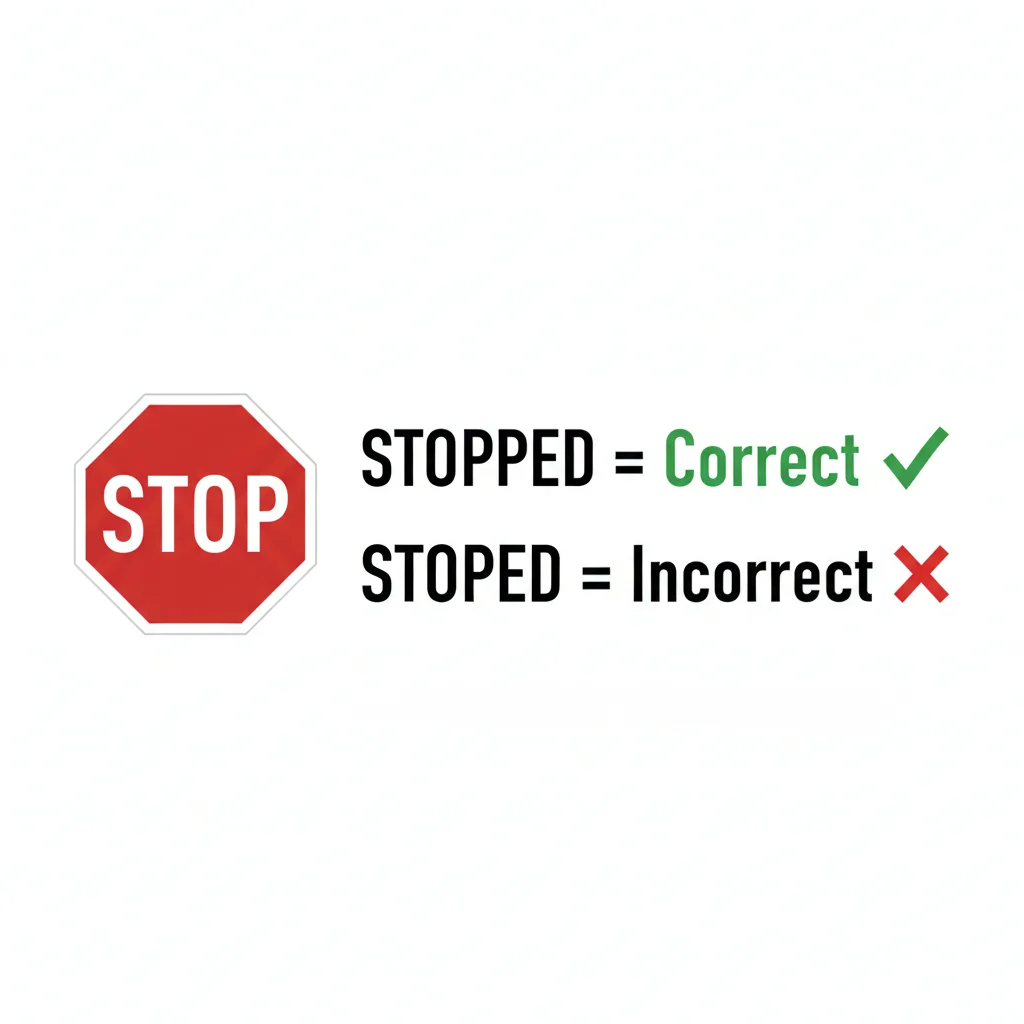
The only correct spelling is stopped.
⭐ The Key Difference Between “Stopped” and “Stoped”
| Word | Correct? | Meaning | Example Sentence |
|---|---|---|---|
| Stopped | ✔ Yes | Past tense of “stop” | “He stopped the game.” |
| Stoped | ✘ No | Not a real English word | ❌ “He stoped the game.” |
Quick Tip to Remember
👉 Double the P before adding -ed when a short verb ends with a vowel + consonant:
stop → stopped
Think of a “stop sign.” It has 8 sides, so the word needs a strong stop — double P!
Common Mistakes and How to Avoid Them
❌ Mistake 1: Forgetting to Double the P
Incorrect: She stoped walking.
Correct: She stopped walking.
Why it happens:
Because learners think one “p” feels enough.
Fix:
Short verbs like stop, hop, clap need a doubled final consonant when adding “-ed.”
❌ Mistake 2: Using Stoped in Fast Typing
People type fast on phones and skip letters.
Fix:
If your sentence is in the past, always check:
Does it sound like “stah-pt”?
Then it must be stopped.
❌ Mistake 3: Mixing With Regular Verbs
Some verbs don’t double letters: played, opened, called.
But stop follows a special rule.
Fix:
Remember: 1 vowel + 1 consonant + short verb = double the last letter.
When to Use “Stopped” (With Examples)
Use stopped when you want to talk about an action that ended in the past.
Examples:
- The music stopped suddenly.
- She stopped running after two miles.
- They stopped fighting and apologized.
- My dog stopped barking when it saw me.
- The movie stopped because of a power cut.
Use “stopped” for:
- Past events
- Finished activities
- Something that no longer continues
When to Use “Stoped”
You should never use stoped, because it is not a real English word.
Memory Hack
Imagine the P as a door.
To “stop” something, the door must fully close.
So the double P acts like a double-locked door: stopped.
Quick Recap: Stopped vs Stoped
- Stopped = Correct spelling
- Stoped = Incorrect spelling
- Add -ed for past tense
- Double the P because “stop” is a short verb
- Always use stopped in speaking and writing

Advanced Tips (Optional)
✔ Why “Stopped” Has Double P
English doubles the final consonant of a short verb with one syllable before adding -ed.
Other examples:
- clap → clapped
- hop → hopped
- tap → tapped
✔ Using “Stopped” in Essays
In formal writing, “stopped” is perfectly acceptable.
Example:
“The machine stopped functioning due to overheating.”
✔ Online or Texting
Even in casual messages, correct spelling helps avoid confusion.
“Stoped” may make your message look rushed or unprofessional.
Mini Quiz: Choose the Correct Word
Fill in the blanks using stopped or stoped:
- The baby finally ______ crying.
- It ______ raining during the picnic.
- My phone ______ working yesterday.
- She ______ talking when she saw me.
- They ______ playing after sunset.
(Answers: stopped, stopped, stopped, stopped, stopped)
Frequently Asked Questions
1. What is the difference between stopped and stoped?
Stopped is the correct past tense of “stop,” while stoped is not a real English word and should never be used.
2. Why do we double the P in stopped?
Because “stop” is a one-syllable verb ending in vowel + consonant. English spelling rules require doubling the last consonant before adding “-ed.”
3. Is stoped ever correct in any language?
No. In modern English, “stoped” has no meaning or usage.
4. How can I remember the correct spelling?
Think of a “stop sign.” When you “stop,” the sound is strong — so the letter P becomes strong and doubles.
5. Can I use stopped in formal writing?
Yes! “Stopped” is correct and acceptable in essays, emails, and professional work.
Conclusion
Now you know the clear difference between stopped and stoped.
Only stopped is correct, and it simply means that an action ended in the past. By remembering the rule of doubling the final consonant for short verbs, you can avoid one of the most common spelling mistakes in English.
With practice, using the right spelling will become natural. Keep learning, keep practicing, and your English will improve every single day!

Mira Loxley is a passionate language and writing expert at Definevs.com, turning tricky words and grammar into clear, engaging guides for every reader.