Have you ever seen the words “stop” and “go” and thought — “Well, they’re opposites, right?” Yes, they are! But there’s much more to them than just red lights and green lights.
These two short words carry powerful meanings that we use every single day — in traffic, in conversations, and even in life decisions (“Should I stop or go?”).
In this easy guide, you’ll learn:
- What stop and go mean
- The difference between stop and go
- How to use them correctly in sentences
- Common mistakes to avoid
- Fun examples and a quick memory trick
By the end, even a 4th grader will know exactly when to say stop and when to say go with confidence!
🧠 What Does Each Word Mean?
Let’s start by understanding both words clearly.
Stop — Meaning and Use
“Stop” means to bring something to an end or to make something not move anymore. It’s a verb (an action word).
Examples:
- Please stop talking — the class has started.
- The car stopped at the red light.
- I stopped eating junk food to stay healthy.
👉 Think of “stop” as a pause, end, or break — it means don’t continue!
Go — Meaning and Use
“Go” means to move, travel, or continue forward. It’s also a verb — the opposite of stop.
Examples:
- You can go when the light turns green.
- Let’s go to the park after lunch.
- Time to go home — it’s getting late!
👉 “Go” always shows movement, permission, or progress.
⚖️ The Key Difference Between “Stop” and “Go”
Even though “stop” and “go” are opposites, their meanings can shift slightly depending on the situation.
Here’s a simple comparison:
| Feature | Stop | Go |
|---|---|---|
| Meaning | To pause or end movement | To move or continue |
| Action Type | Stopping something already in motion | Starting or continuing motion |
| Examples | “Stop running.” | “Go ahead.” |
| Signal Color | 🔴 Red | 🟢 Green |
| Emotion / Idea | Caution, ending, rest | Energy, start, action |
💡 Quick Tip to Remember:
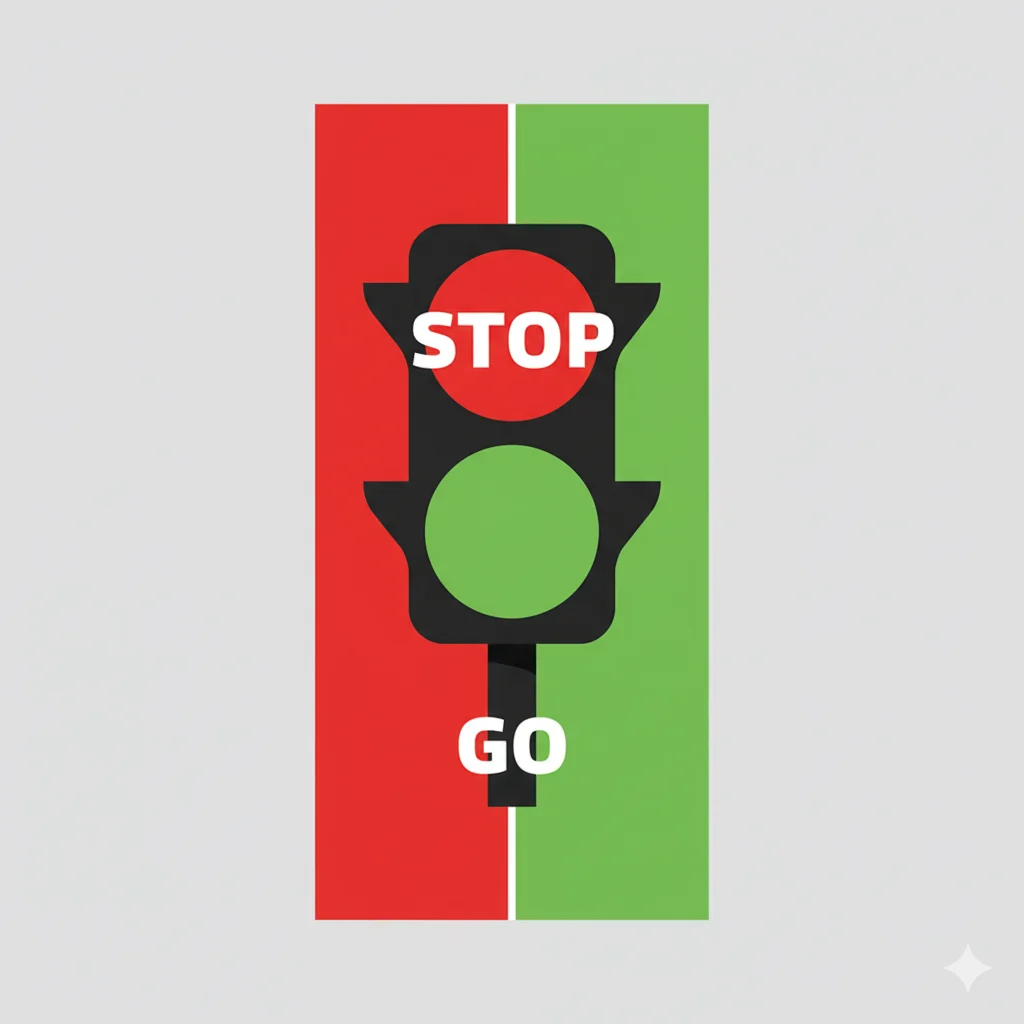
- Red = Stop (pause or end)
- Green = Go (move or start)
You can even imagine a traffic light to remember — it tells you exactly when to stop or go!
🚫 Common Mistakes and How to Avoid Them
Even though “stop” and “go” seem simple, many English learners make small mistakes with them.
❌ Mistake 1: Using “stop” when you should say “go”
Incorrect: “Stop to your seat.”
Correct: “Go to your seat.”
(You can’t stop to a place — you go there!)
❌ Mistake 2: Forgetting “to” after “stop”
Incorrect: “Stop do that.”
Correct: “Stop to do that.” or “Stop doing that.”
❌ Mistake 3: Mixing tense forms
Incorrect: “He go to school yesterday.”
Correct: “He went to school yesterday.”
Remember, “go” becomes “went” in past tense, but “stop” becomes “stopped.”
🟥 When to Use “Stop”
Use “stop” when something needs to pause, end, or cease.
✅ Examples:
- Stop running in the hallways!
- Please stop the video — I missed something.
- Don’t stop believing in yourself.
- We stopped working when it started to rain.
- She told him to stop shouting.
Memory Hack:
👉 When you see or hear something dangerous, wrong, or too much — think STOP!
🟩 When to Use “Go”
Use “go” when you want to start, continue, or move forward.
✅ Examples:
- It’s time to go home.
- You may go now.
- Let’s go for a walk!
- They go swimming every weekend.
- The movie will go on despite the rain.
Memory Hack:
👉 “Go” means green light! When things are safe or ready — you can move ahead.
🧩 Quick Recap: Stop vs Go
Here’s a short summary to make sure you’ve got it:
- Stop = Pause or end something.
- Go = Start or move ahead.
- Stop means don’t continue, while go means keep moving.
- Both are verbs that describe actions.
- Think of a traffic light — Red = Stop, Green = Go!
🌍 Advanced Tips and Fun Facts
- Origin:
“Stop” comes from Old English stoppian, meaning to block or cease.
“Go” comes from Old English gān, meaning to move or walk. - In life quotes:
“Don’t stop until you’re proud.”
“Let’s go chase our dreams.” - In exams or essays:
Use “stop” when referring to ending something (e.g., “Stop pollution”).
Use “go” when describing movement or continuation (e.g., “Go forward with your goals”). - In texting:
“Let’s gooo!” — shows excitement or motivation.
“Stop it 😂” — often playful or joking.
🧠 Mini Quiz: Test Your Understanding!
Fill in the blanks with stop or go:
- Please ______ talking when the teacher enters.
- You can ______ when the light turns green.
- Don’t ______ believing in yourself.
- I told him to ______ shouting.
- Let’s ______ to the park after lunch.
- The bus will not ______ until everyone is seated.
- She said, “______ it, you’re making me laugh!”
(Answers: 1. stop, 2. go, 3. stop, 4. stop, 5. go, 6. go, 7. stop)
❓ FAQs
1. What is the main difference between “stop” and “go”?
“Stop” means to pause or end something, while “go” means to move or continue forward. They are opposites.
2. Can both “stop” and “go” be verbs?
Yes! Both are action words (verbs). “Stop” means to end, and “go” means to begin or move.
3. What’s an easy way to remember “stop” vs “go”?
Think of a traffic light — red means stop, green means go!
4. Can I use “go” in past tense as “goed”?
No. The correct past tense of “go” is “went.”
5. When should I use “stop doing” vs “stop to do”?
Use “stop doing” when you quit an action.
Use “stop to do” when you pause one thing to do another.
Example: “I stopped eating.” / “I stopped to eat.”
🏁 Conclusion
Now you know the difference between stop and go — two small but mighty words that shape how we speak, move, and act every day.
Whenever you’re unsure, just imagine the traffic light:
🔴 Stop means pause, 🟢 Go means move forward!
Keep practicing these in your writing and speech — and soon, you’ll use them correctly and confidently in any situation.

Arwen Blythe is a passionate language and culture enthusiast, crafting clear, engaging guides on words, phrases, and modern English for Definevs.com readers.