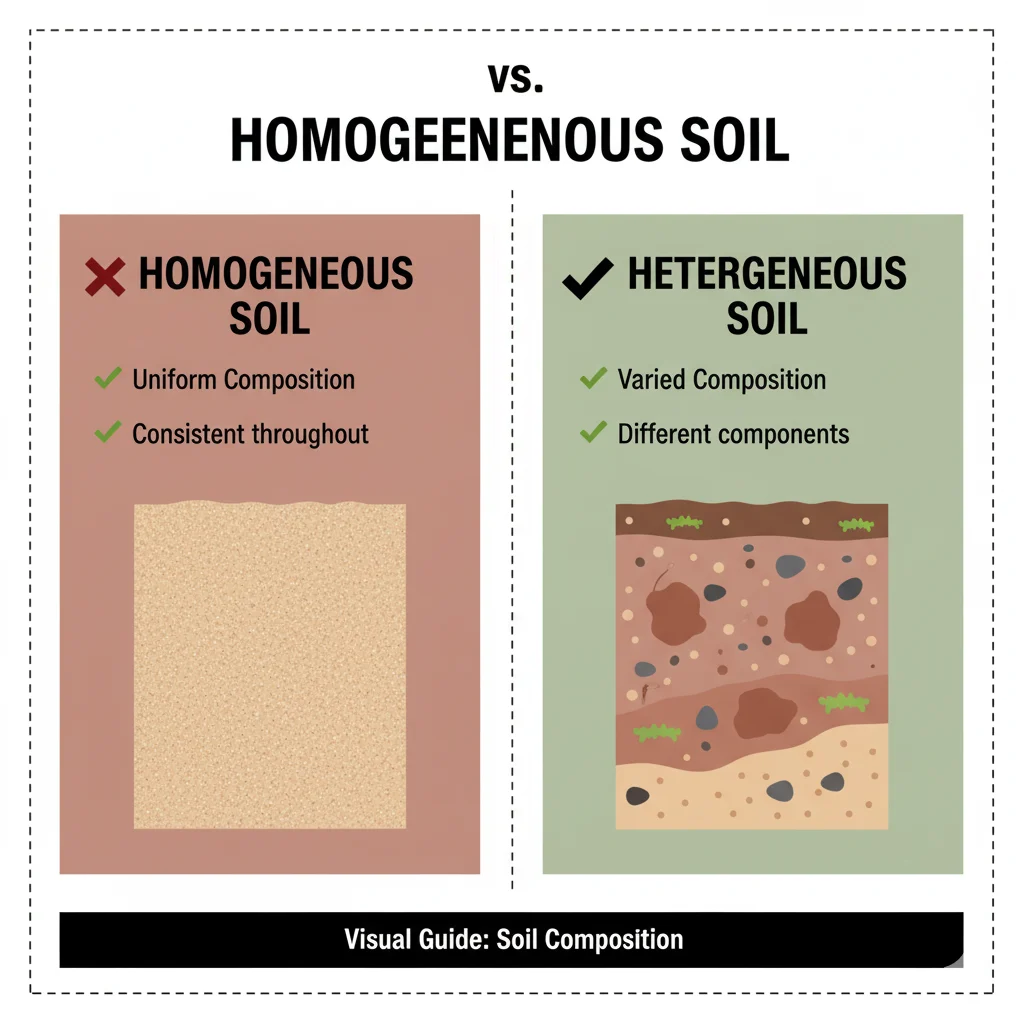
Soil can be either homogeneous or heterogeneous.
Heterogeneous soil contains different types of particles or layers mixed together unevenly.
Homogeneous soil has a uniform composition and texture throughout.
Have you ever dug into a garden and noticed that some soil feels the same everywhere while other soil seems mixed with different textures and colors? That’s because soil can be homogeneous or heterogeneous. Many people confuse these two terms because both describe types of soil, but they are very different in composition and behavior.
In this guide, you’ll learn:
- What homogeneous and heterogeneous soil mean
- The key differences between them
- Examples you can see in your garden or school
- How to identify each type easily
By the end, you’ll never mix them up again — even a beginner can understand and explain them confidently!
What Does Each Word Mean?
Homogeneous Soil
Definition: Soil that has the same composition, texture, and appearance throughout. Every part of it looks and feels the same.
- Part of speech: Adjective
- Examples:
- The sand in the sandbox is homogeneous because every scoop feels identical.
- Gardeners prefer homogeneous soil for growing flowers evenly.
- Scientists used homogeneous soil to test plant growth without surprises.
Heterogeneous Soil
Definition: Soil that has a mixed composition with different types of particles or layers. Parts of it may feel different or look different.
- Part of speech: Adjective
- Examples:
- The riverbank has heterogeneous soil with sand, clay, and small rocks.
- Farmers noticed heterogeneous soil required extra care for planting.
- In playgrounds, heterogeneous soil appears when dirt and gravel mix.
The Key Difference Between Soil Homogeneous and Heterogeneous
| Feature | Homogeneous Soil | Heterogeneous Soil |
|---|---|---|
| Composition | Uniform, same throughout | Mixed, varies in different parts |
| Appearance | Consistent color and texture | Different colors, textures, or layers |
| Ease of Use | Easy to manage for planting | Needs careful management due to unevenness |
| Example | Sandbox sand or pure clay | Riverbank, garden soil with rocks and clay |
Quick Tip: Think “homo = same” and “hetero = different” — it’s the easiest way to remember!

Common Mistakes and How to Avoid Them
Incorrect: “All garden soil is homogeneous.”
Corrected: “Some garden soil is homogeneous, but many gardens have heterogeneous soil.”
Incorrect: “Heterogeneous soil is always bad for plants.”
Corrected: “Heterogeneous soil can be useful if managed properly, especially for plants that need different nutrients.”
Why mistakes happen: People assume all soil looks the same, but observing texture and color differences helps avoid confusion.
When to Use Homogeneous Soil
Homogeneous soil is ideal when you want uniform plant growth or controlled experiments.
Examples:
- School science projects need homogeneous soil to test seed growth.
- Farmers use homogeneous soil in greenhouses for consistency.
- Gardeners fill pots with homogeneous soil for flowering plants.
- Landscaping projects often prefer homogeneous soil for smooth lawns.
When to Use Heterogeneous Soil
Heterogeneous soil is common in natural environments where soil mixes naturally with rocks, clay, or organic matter.
Examples:
- Hiking trails often have heterogeneous soil with rocks and sand.
- Riverbanks have heterogeneous soil due to water depositing different particles.
- Vegetable gardens may need heterogeneous soil to provide various nutrients.
- Parks sometimes feature heterogeneous soil for trees and shrubs.
Memory Hack: Imagine hetero = different — heterogeneous soil is like a salad with many ingredients.
Quick Recap: Soil Homogeneous vs Heterogeneous
- Homogeneous soil: Same composition, easy to manage, consistent texture and color.
- Heterogeneous soil: Mixed composition, needs careful management, varies in texture and appearance.
- Tip: Homo = same, Hetero = different.
Advanced Tips
- The words homogeneous and heterogeneous come from Greek — “homo” = same, “hetero” = different.
- Formal writing: Scientists and agronomists often specify soil type in research papers.
- Online writing: Misusing these terms can confuse readers in blogs or educational content.
Mini Quiz
Fill in the blanks:
- For a school plant experiment, it’s better to use __________ soil.
- Soil with rocks, clay, and sand mixed together is __________ soil.
- Riverbanks usually have __________ soil.
- __________ soil is uniform in composition.
- Remember: Homo means ________, Hetero means ________.
- Sand that looks and feels the same everywhere is __________ soil.
- Homogeneous
- Heterogeneous
- Heterogeneous
- Homogeneous
- Homogeneous / Heterogeneous
- Homogeneous
FAQs
1. What is the main difference between homogeneous and heterogeneous soil?
Homogeneous soil has a uniform composition and texture, while heterogeneous soil contains mixed particles and varies in appearance and texture.
2. Can heterogeneous soil be used for gardening?
Yes, but it may need careful management to balance nutrients and texture for plants.
3. How can I tell if soil is homogeneous?
Look for uniform texture and color. Every scoop should feel and appear the same.
4. Why is homogeneous soil preferred for experiments?
It ensures consistent results because every part of the soil behaves the same way.
5. What are real-life examples of heterogeneous soil?
Riverbanks, playgrounds with sand and gravel, or garden soil mixed with clay, rocks, and organic matter.
Conclusion
Now you know the difference between homogeneous and heterogeneous soil! Homogeneous soil is uniform, while heterogeneous soil contains a mix of particles. Remember the simple trick: homo = same, hetero = different. Observing soil carefully can help in gardening, school experiments, or landscaping. Keep practicing, and soon you’ll identify and use these terms correctly every time!

Isla Merrin is a language and writing expert at Definevs.com, creating simple, engaging guides to help readers master words, grammar, and modern English usage.