Have you ever seen someone write “smoothe” instead of “smooth” and wondered which one is right? You’re not alone! Many English learners (and even native speakers) mix up these two because they look similar — just one extra “e,” right?
But here’s the truth: only one spelling is correct, and the other is a common mistake that often appears online or in old texts.
In this easy guide, you’ll learn:
- The meaning of “smooth” and “smoothe”
- The difference between them
- How to use “smooth” correctly in sentences
- Common mistakes to avoid
- Fun memory tips and examples you’ll never forget
By the end, you’ll never be confused again — smooth sailing all the way! 🌊
🧐 What Does Each Word Mean?
Let’s look at both words one by one and see what they really mean.
✅ Smooth — The Correct Word
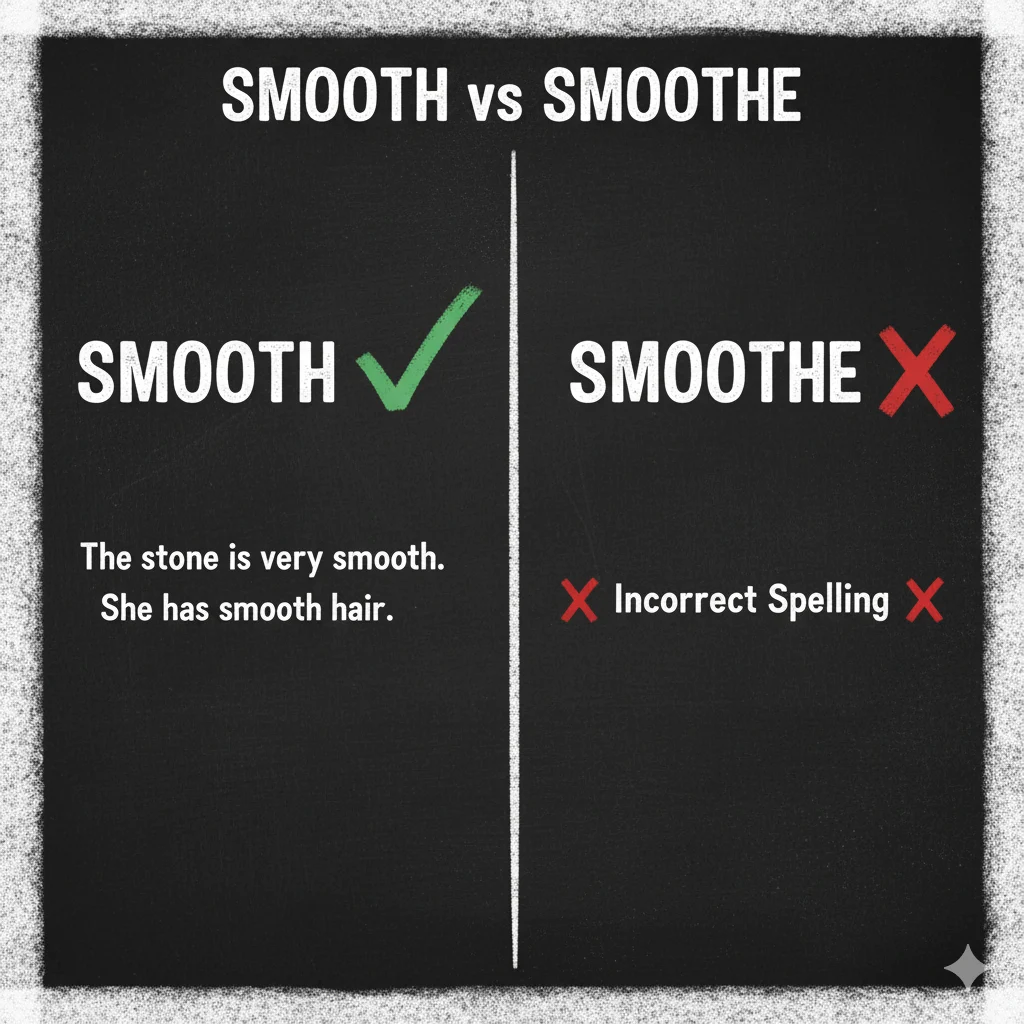
“Smooth” is the correct spelling in modern English.
It can be used as an adjective, verb, or noun, depending on how you use it.
Meanings:
- Adjective: Something even, soft, or without roughness.
- Verb: To make something flat or soft.
- Noun: The quality of being even or gentle.
Examples:
- The baby’s skin feels smooth.
- She used a cloth to smooth the wrinkles on her dress.
- His voice has a calm smoothness to it.
❌ Smoothe — The Incorrect Form
The word “smoothe” (with an “e”) is not recognized in standard English dictionaries today.
It was an archaic spelling centuries ago but has since disappeared from modern usage.
If you see “smoothe” today, it’s likely a misspelling or an old poetic variation no longer accepted in proper grammar.
Examples (Incorrect):
- ❌ The road feels smoothe.
- ❌ She tried to smoothe her hair.
✅ Correct: “The road feels smooth.”
✅ Correct: “She tried to smooth her hair.”
🔍 The Key Difference Between Smooth and Smoothe
Here’s a quick comparison of how these two forms differ in meaning and usage:
| Word | Part of Speech | Correctness | Meaning | Example |
|---|---|---|---|---|
| Smooth | Adjective / Verb / Noun | ✅ Correct | Flat, even, soft, or gentle | “The fabric is smooth.” |
| Smoothe | — | ❌ Incorrect (archaic) | None in modern English | “Smoothe surface” ❌ |
Quick Tip to Remember:
👉 If you see “smoothe” with an “e,” remember: Extra “E” = Error!
Only “smooth” is correct in today’s English.

⚠️ Common Mistakes and How to Avoid Them
Mistake 1: Writing “smoothe” because it “looks nicer.”
- ❌ Incorrect: “Smoothe chocolate tastes amazing.”
- ✅ Correct: “Smooth chocolate tastes amazing.”
Why it happens:
People often assume words ending in “th” need an “e,” like “breathe” or “bathe.”
But “smooth” doesn’t follow that rule — it’s already complete!
Mistake 2: Confusing sound patterns.
“Smooth” ends with a soft “th” sound, but adding “e” doesn’t change how it’s said — only makes it wrong!
🕹️ When to Use “Smooth”
Use “smooth” in these situations:
- To describe texture or surface:
- The lake was calm and smooth.
- Her hair feels smooth after washing.
- To describe movement or behavior:
- The dancer moved in a smooth motion.
- His speech was smooth and confident.
- To talk about making something even:
- He used a roller to smooth the paint.
- She tried to smooth her shirt before leaving.
- To describe personality or charm:
- He’s such a smooth talker — always knows what to say!
🧠 Memory Trick:
Imagine you’re smoothing a blanket — every wrinkle disappears, just like confusion disappears when you remember “smooth” = correct.
🪞 When to Use “Smoothe”
Simple answer: Don’t.
“Smoothe” is not used in modern English.
It may appear in very old poetry or historical writings, but you should never use it in emails, essays, or conversations today.
Example (Old English usage):
“To smoothe the troubled brow of fate.”
Even here, modern editors replace “smoothe” with “smooth.”
Memory Hack:
If you’re typing and your spell-check underlines “smoothe,” it’s your friendly reminder — it’s wrong!
📋 Quick Recap: Smooth vs Smoothe
Here’s a quick summary you can save for later:
- ✅ Smooth = Correct modern spelling.
- ❌ Smoothe = Outdated or incorrect spelling.
- Smooth means flat, soft, or without bumps.
- Used as adjective, verb, or noun.
- Smoothe adds an unnecessary “e” — avoid it!
Quick rule to remember:
“Keep it simple, keep it smooth — no extra ‘e’ to lose!”
💡 Advanced Tips
🌍 Word Origin
“Smooth” comes from Old English “smōð,” meaning “even” or “gentle.”
It has kept the same basic meaning for over 1,000 years — no “e” was ever needed!
✍️ In Writing and Exams
Use “smooth” in:
- Essays: “The transition between paragraphs was smooth.”
- Descriptions: “She spoke in a smooth, calming voice.”
Using “smoothe” in writing will mark your work as incorrect, even in informal settings.
💬 In Texting or Online
When chatting or posting on social media, “smooth” is still correct — even slangy phrases like “smooth move” or “smooth vibes” always use the no ‘e’ version.
🧩 Mini Quiz — Test Your Knowledge!
Fill in the blanks with smooth or smoothe:
- The baby’s skin felt ________.
- Please ________ out the paper wrinkles.
- The singer’s voice was calm and ________.
- He tried to ________ things over after the fight.
- Her handwriting is so ________.
Answers: 1) smooth 2) smooth 3) smooth 4) smooth 5) smooth
(See? Easy — only one correct word!)
Busing vs Bussing – The One Tiny Difference Everyone Misses!
❓FAQs
1. Which is correct — smooth or smoothe?
Only “smooth” is correct in modern English. “Smoothe” is an old or mistaken form.
2. Why do people still use “smoothe”?
It looks similar to words like “breathe,” so some people think it needs an “e,” but that’s false.
3. Is “smoothe” ever acceptable?
No. It’s considered outdated and incorrect in all modern English writing.
4. How do you remember the correct spelling?
Think: “Smooth” is simple — no rough edges, no extra letters.
5. Can “smooth” be a verb?
Yes! You can say, “Please smooth your hair,” meaning “make it flat or even.”
🎯 Conclusion
To wrap it up — “smooth” is the correct, modern spelling used in everyday English.
The version “smoothe” is outdated and incorrect.
Whether you’re writing an essay, chatting with friends, or describing something soft, remember:
Smooth is right — smoothe is not!
Keep practicing, and soon your English will be as smooth as silk! 🪶

Isla Merrin is a language and writing expert at Definevs.com, creating simple, engaging guides to help readers master words, grammar, and modern English usage.