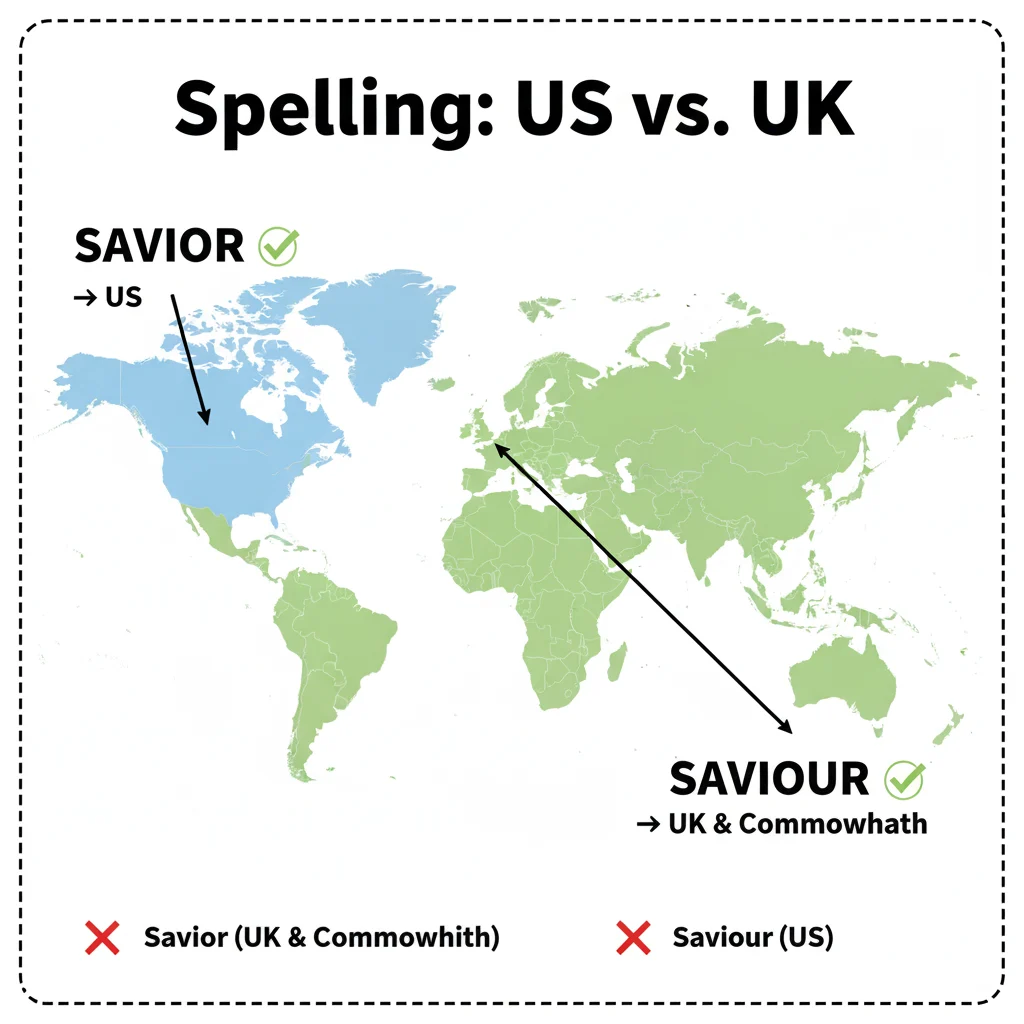
“Savior” and “saviour” mean the same thing — a person who saves, rescues, or helps someone.
The only difference is spelling: “savior” is American English, while “saviour” is British English. Both are correct depending on regional usage.
Have you ever come across the words “savior” and “saviour” and wondered which one is correct—or whether they mean different things? You’re not alone. These two spellings show up in books, religious texts, songs, motivational quotes, and modern conversation, but many people still get confused about when to use each one.
Here’s the simple truth: they mean the same thing, but their usage depends on where you are and which English dialect you follow.
In this article, you’ll learn:
- The clear meaning of savior / saviour
- How the spellings evolved
- Where each version is most commonly used
- Examples in sentences and real conversations
- Common mistakes, FAQs, and tips for correct usage
Let’s break it all down in a friendly, easy-to-understand way.
What Does “Savior / Saviour” Mean?
“Savior” or “saviour” refers to a person who saves, rescues, or helps someone in a major or meaningful way.
It can be used in religious contexts, everyday speech, literature, and inspirational writing.
- “Savior” = American English spelling
- “Saviour” = British English spelling
Both forms are grammatically correct.
Origin and Popularity
The word “savior/saviour” comes from the Latin word salvator, meaning “one who saves.”
It entered English through Old French (sauveour) and has existed for centuries, especially in religious texts.
Timeline of Usage
- 1300s–1500s: Early English texts use “sauveour” and later “saviour.”
- 1600s: The King James Bible popularizes “saviour” throughout the English-speaking world.
- 1800s: American English spelling reforms simplify many “-our” words.
- Modern era:
- “Savior” dominates in the U.S.
- “Saviour” persists in the U.K., Canada, Australia, India, Pakistan, and other Commonwealth regions.
Why the Popularity Shift?
American spelling trends favored shorter, more phonetic forms. This is why Americans use:
- color (vs. colour)
- honor (vs. honour)
- savor (vs. savour)
- savior (vs. saviour)
Despite this, both spellings remain globally recognized and understood.
Savior / Saviour Meaning in Different Contexts
1. In Everyday Conversation
Used to describe someone who saves you from a problem, stress, or embarrassment.
- “You’re my savior for bringing me coffee!”
- “That discount code was a real saviour.”
2. In Religious Contexts
Often capitalized (“Savior/Saviour”) when referring to a divine figure such as Jesus Christ in Christianity.
- “Jesus is our Savior.” (US)
- “Jesus is our Saviour.” (UK)
3. In Literature or Poetry
Used metaphorically to describe a hero, helper, or redeemer.
- “The rain was the saviour of the dying crops.”
4. On Social Media (Instagram, TikTok, X)
Used casually in captions, jokes, and appreciation posts.
- “This filter is my savior 💫”
- “Late-night snacks = ultimate saviour.”
5. In Formal Writing
Either form can be correct depending on:
- Audience location
- Publication style guide
- Brand preference

Examples of Savior / Saviour in Conversations
Friendly Conversation
A: I forgot my umbrella and it started raining.
B: I brought an extra one — I’m your saviour today!
A: Seriously, you saved me.
Social Media Post
“Weekend naps are the real savior of my sanity 😴✨”
Religious Example
“Our Saviour guides us through every hardship.”
Formal Usage
“The new software update was the savior of our entire project timeline.”
Similar or Related Terms
Here are related words that enhance semantic :
| Term | Meaning | When to Use |
|---|---|---|
| Rescuer | Someone who saves from danger | Physical or emergency situations |
| Redeemer | One who brings improvement or salvation | Often religious or metaphorical |
| Helper | Someone who assists | Casual, everyday support |
| Hero | Someone admired for courage | Dramatic or inspiring situations |
| Protector | One who guards or defends | Formal or poetic contexts |
How to Use “Savior / Saviour” Correctly
✅ DO:
- Use “savior” for American audiences.
- Use “saviour” for British/Commonwealth audiences.
- Use capital S (“Savior/Saviour”) when referencing religious figures.
- Use in both literal and metaphorical contexts.
❌ DON’T:
- Don’t mix spellings in the same document.
- Don’t capitalize unless referring to a divine or formal title.
- Don’t assume one form is “more correct” than the other — both are standard.
Common Mistakes or Misinterpretations
❌ Mistake 1: Thinking only one spelling is correct
Both spellings are valid depending on regional use.
❌ Mistake 2: Using the wrong spelling for your audience
A US website using “saviour” may seem inconsistent, and vice versa.
❌ Mistake 3: Assuming it’s only a religious term
It also works for casual, humorous, and modern contexts.
❌ Mistake 4: Confusing it with “save” or “safe”
Though related, they serve different grammatical purposes.
FAQ Section
1. What does “savior / saviour” mean in simple terms?
It means someone who saves, rescues, or helps another person. It can be used in everyday speech or in religious contexts, depending on capitalization and tone.
2. Is “savior” or “saviour” correct?
Both are correct. “Savior” is used in American English, while “saviour” is used in British and Commonwealth English. The meaning stays the same.
3. Is it a slang word or a formal word?
It is a standard English term, not slang. It can be used in casual conversation, formal writing, and religious texts.
4. When should I capitalize “Savior” or “Saviour”?
Capitalize it when referring to a divine or religious figure, such as “Jesus the Savior.”
5. What is the difference between “savior” and “hero”?
A savior rescues someone from harm or difficulty, while a hero is admired for courage or noble actions. The words overlap but are not identical.
6. Can “savior/saviour” be used metaphorically?
Yes. It’s often used in modern language to describe something or someone that “saved the day” — like coffee, friends, discounts, or even apps.
Conclusion
Now that you clearly understand the meaning of “savior / saviour”, you’ll never be confused about how or when to use each spelling again. The difference is purely regional: “savior” belongs to American English, while “saviour” is used in British and Commonwealth English. Both share the same powerful meaning — someone who rescues, helps, or brings relief in big or small ways.
Whether you’re writing a caption, crafting a formal article, or reading a religious text, choosing the correct spelling simply depends on your audience. Keep exploring our site for more word comparisons, meanings, and trending language guides!

Isla Merrin is a language and writing expert at Definevs.com, creating simple, engaging guides to help readers master words, grammar, and modern English usage.