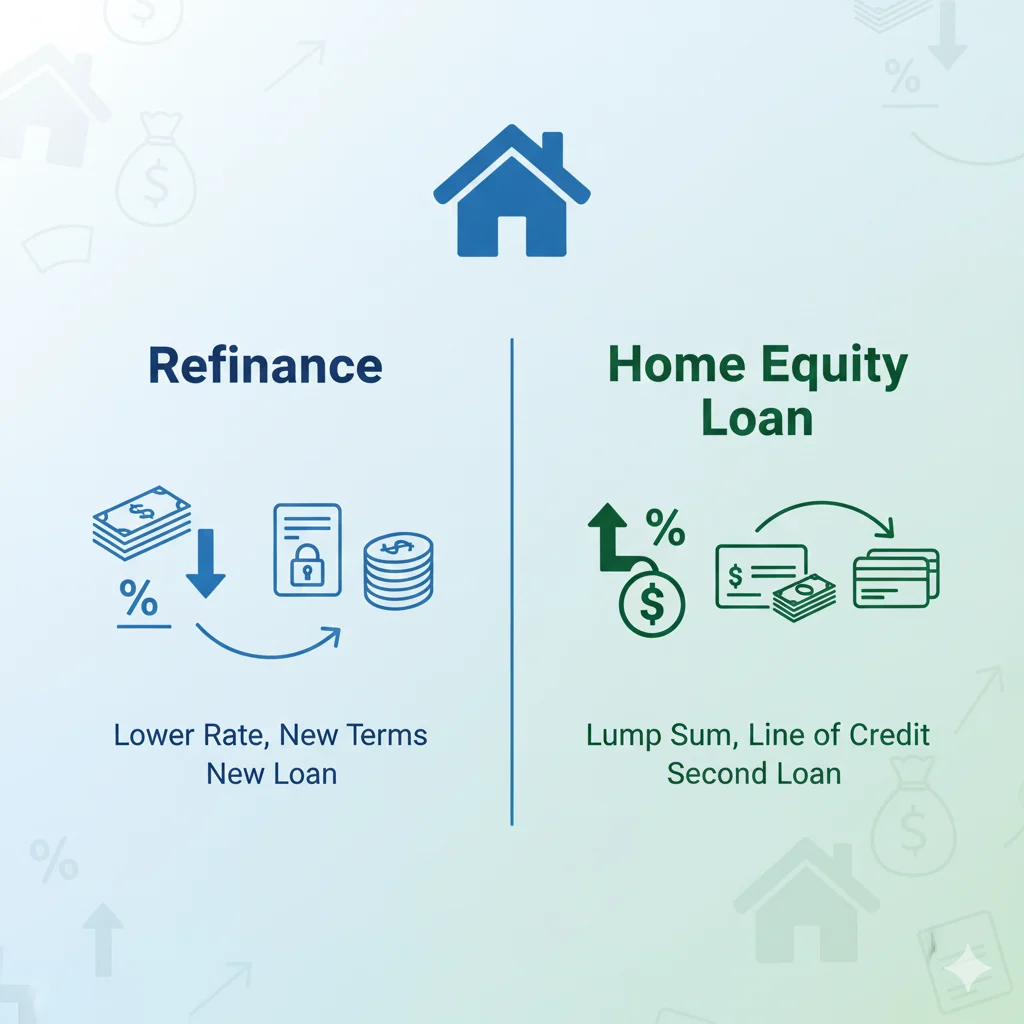
Ever wondered what the difference between refinance and a home equity loan really is? 🤔 Many people — even adults — mix up these two terms because both involve borrowing money using your home. But they actually work quite differently!
In this guide, you’ll learn what refinancing and home equity loans mean, how they’re used in both finance and language, and which one fits your situation best. We’ll also break things down with simple examples, grammar-style comparisons, and easy memory tricks — so you’ll never confuse them again
💬 What Does Each Word Mean?
Let’s start by understanding what each word actually means — both in finance and in simple English usage.
Refinance – Meaning
Refinance means to replace an existing loan with a new one, usually to get a lower interest rate or better terms.
In grammar usage, it’s a verb — something you do.
Examples:
- I decided to refinance my mortgage to lower my payments.
- She plans to refinance her student loans next year.
- The company refinanced its debts to save money.
👉 Think of “refinance” as starting fresh with a new deal.
Home Equity Loan – Meaning
A home equity loan means borrowing against the value of your home — kind of like taking out a second mortgage 💵. You keep your current loan and add another one based on how much of your house you already own.
In grammar terms, it’s a noun phrase — a thing, not an action.
Examples:
- We took out a home equity loan to renovate our kitchen.
- A home equity loan can help cover education costs.
- They used a home equity loan to pay off credit card debt.
👉 Think of “home equity loan” as borrowing extra money while keeping your main loan.
🔍 The Key Difference Between Refinance and Home Equity Loan
Here’s the easiest way to see how they differ:
| Feature | Refinance | Home Equity Loan |
|---|---|---|
| Definition | Replacing your existing loan with a new one | Borrowing extra money using your home’s value |
| Action Type | Verb (you do it) | Noun phrase (a thing you take) |
| Loan Structure | One new loan replaces the old one | You have two loans: your main mortgage + equity loan |
| Purpose | To lower interest rate or change terms | To borrow cash for big expenses |
| Risk Level | Moderate | Slightly higher (two payments to manage) |
| Example Sentence | I refinanced my mortgage for a better rate. | We took a home equity loan for repairs. |
💡 Quick Tip:
If you’re changing your old loan — it’s refinancing.
If you’re adding another loan — it’s a home equity loan.

🚫 Common Mistakes and How to Avoid Them
People often mix these up because both deal with borrowing from your home’s value. Here are a few examples:
❌ Mistake 1: “I refinanced to get extra cash.”
✅ Fix: You took a home equity loan to get cash. Refinancing replaces your old loan — it doesn’t add new money unless it’s a cash-out refinance.
❌ Mistake 2: “I applied for a home equity refinance.”
✅ Fix: It’s either a home equity loan or a refinance, not both together.
❌ Mistake 3: “I refinanced my home equity loan.”
✅ Fix: You can refinance a home equity loan, but it becomes a new refinance, not the same product.
💡 When to Use “Refinance”
Use refinance when you want to:
- Lower your interest rate 📉
- Shorten or extend your loan term
- Change loan type (from adjustable to fixed)
- Consolidate multiple loans into one
Examples:
- My parents refinanced their mortgage after ten years.
- You can refinance when rates drop.
- The bank offered to refinance my car loan.
- We’ll refinance next spring to save money.
- Businesses often refinance debts to improve cash flow.
🧠 Memory Trick:
Think “re-” = replace. “Refinance” starts with re, meaning you’re replacing your loan.
🏠 When to Use “Home Equity Loan”
Use home equity loan when you want to:
- Borrow money for home improvement 🛠️
- Pay off credit card debt 💳
- Cover big expenses like tuition or medical bills
- Keep your current mortgage unchanged
Examples:
- A home equity loan helped us pay for college.
- We used our home equity loan to remodel the bathroom.
- They applied for a home equity loan to start a small business.
- You can get a home equity loan if your home’s value has increased.
- Our home equity loan has a fixed interest rate.
🧠 Memory Trick:
Think of “equity” as extra value. A home equity loan means extra money from your home.
🧾 Quick Recap: Refinance vs Home Equity Loan
Here’s an easy summary to remember 👇
- Refinance = Replace your old loan 🔁
- Home Equity Loan = Add a second loan 💰
- Refinance → new terms, better rate, single payment
- Home Equity Loan → extra cash, two payments
- Both use your home’s value, but their purposes differ
📘 Grammar View:
- Refinance → Verb (Action: you do it)
- Home Equity Loan → Noun phrase (Thing: you take it)
🌍 Advanced Tips
- Origin: “Refinance” comes from Latin re- (again) + finance (deal with money). “Equity” comes from aequitas (fairness/value).
- In formal writing: Always use refinance as a verb (“to refinance”) and home equity loan as a noun.
- In texting or casual writing: Don’t shorten them to “refi” or “HEL” unless your audience understands finance slang.
🧩 Mini Quiz
Fill in the blanks with the correct word:
- We plan to ______ our mortgage to get a lower rate.
- She took a ______ to pay for her daughter’s wedding.
- The bank said we could ______ our car loan next year.
- They used a ______ to repair the roof.
- He wants to ______ his house loan to reduce payments.
(Answers: 1. Refinance, 2. Home equity loan, 3. Refinance, 4. Home equity loan, 5. Refinance)
❓ FAQs
1. What’s the main difference between refinance and home equity loan?
Refinance replaces your existing loan with a new one, while a home equity loan adds a second loan using your home’s value.
2. Can I refinance and have a home equity loan at the same time?
Yes, but refinancing might pay off your equity loan depending on your lender’s terms.
3. Which is better: refinance or home equity loan?
It depends on your goal — refinance if you want lower rates; home equity loan if you need extra cash.
4. Is refinance a verb or a noun?
“Refinance” is a verb — an action you take.
5. What is a quick way to remember the difference?
Think: Refinance = Replace, Home Equity Loan = Add.
🏁 Conclusion
Now you know exactly what refinance and home equity loan mean — both in finance and in grammar! 🎓 Understanding the difference helps you use them confidently in real life, writing, or conversations. Whether you’re explaining money terms or improving your English, these two phrases show how one small change in meaning can make a big difference. Keep practicing, stay curious, and soon you’ll master tricky word pairs like a pro!

Isla Merrin is a language and writing expert at Definevs.com, creating simple, engaging guides to help readers master words, grammar, and modern English usage.