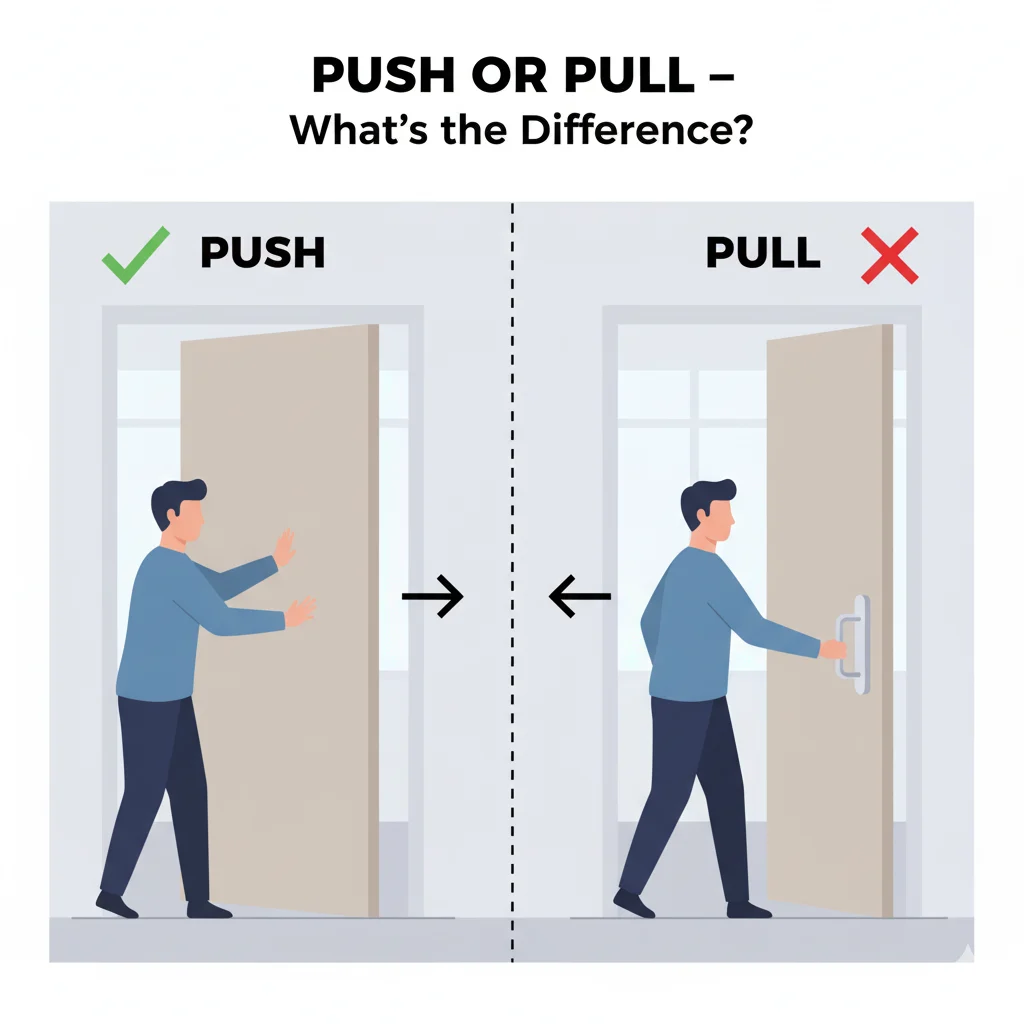
Have you ever stood in front of a door wondering, “Should I push or pull?” 😅
You’re not alone! The words push and pull seem simple, yet many people mix them up — both in English writing and in daily life.
This guide makes it easy for anyone, even a beginner, to understand the difference between “push” and “pull.”
You’ll learn:
- What push and pull mean
- The difference between them
- When to use each word correctly
- Real-life examples and quick tips to remember them forever
Let’s make sure you never confuse push or pull again!
🧩 What Does Each Word Mean?
Push — Definition and Meaning
Push means to move something away from you by using force.
It’s an action word (verb) that shows you’re applying pressure to send something forward or outward.
Examples of “push”:
- She pushed the door open.
- Please push the button to start the machine.
- He pushed the cart through the supermarket.
In short: When you use your hands or body to move something away, you’re pushing it.
Pull — Definition and Meaning
Pull means to move something toward you by holding or grabbing it.
It’s also a verb, showing the opposite action of “push.”
Examples of “pull”:
- He pulled the rope to lift the bucket.
- Please pull the door to close it.
- The dog pulled the leash hard.
In short: When you move something closer to you, you’re pulling it.
⚖️ The Key Difference Between Push and Pull
Both words describe motion or force — but in opposite directions.
| Action | Push | Pull |
|---|---|---|
| Direction of Force | Away from you | Toward you |
| Basic Meaning | Move something forward or outward | Move something backward or closer |
| Example Sentence | “Please push the door open.” | “Please pull the door open.” |
| Body Movement | Extending your hands | Bending your arms toward you |
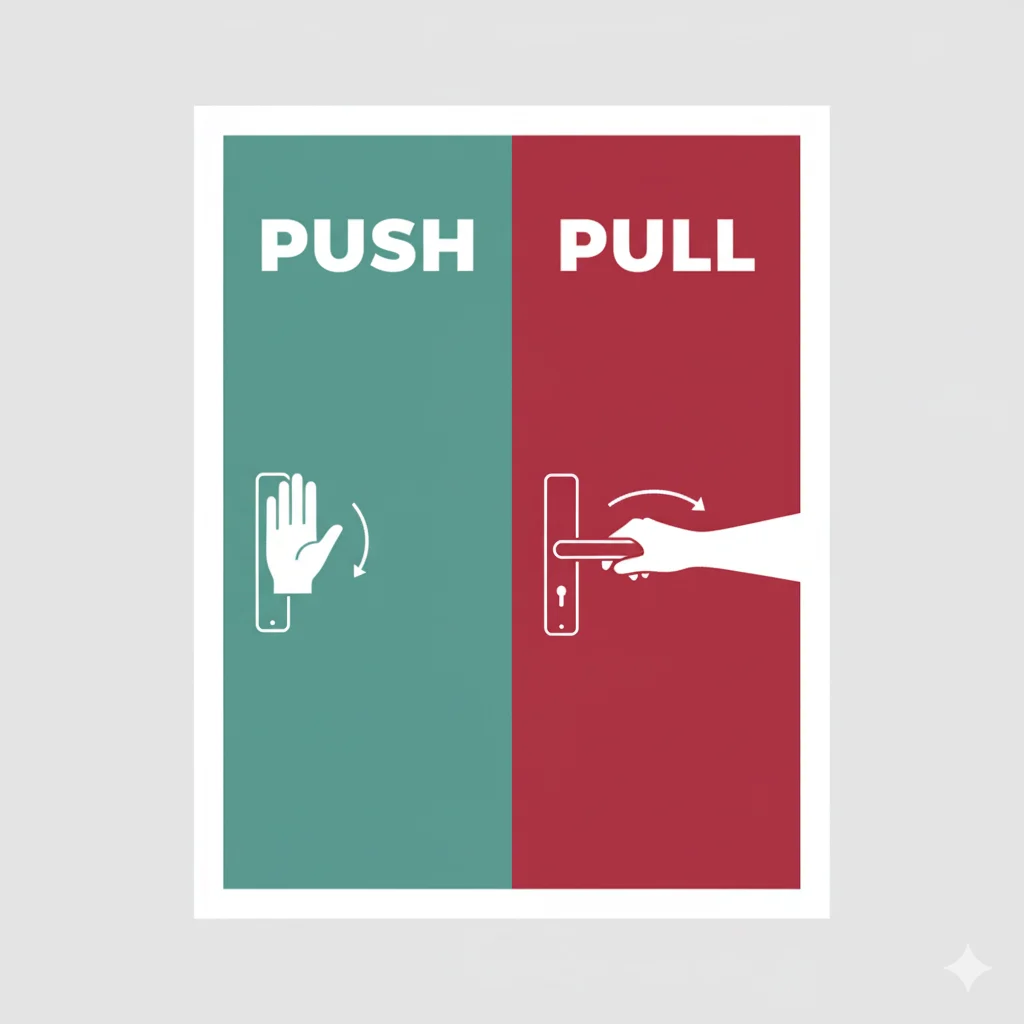
| Common Use | Buttons, doors, trolleys | Handles, ropes, drawers |
💡 Quick Tip to Remember:
👉 Push = Go forward.
👉 Pull = Bring backward.
🚫 Common Mistakes and How to Avoid Them
Here are some everyday mix-ups:
❌ Wrong: I pulled the shopping cart forward.
✅ Correct: I pushed the shopping cart forward.
❌ Wrong: Please push the drawer to open it.
✅ Correct: Please pull the drawer to open it.
Why these mistakes happen:
People often confuse direction — forgetting whether the motion moves away or toward them.
Fix it fast:
Remember this rule —
If it comes closer to you, it’s pull.
If it goes away from you, it’s push.
🟢 When to Use “Push”
Use push when you’re applying force to move something away from your body.
Examples:
- Push the door to get inside the room.
- He pushed the heavy box across the floor.
- The teacher asked students to push their chairs under the desk.
- She pushed the red button to turn off the alarm.
- The baby pushed his toy car with his hand.
🧠 Memory Trick:
Think of push as “Put it away.”
Both start with the letter P and remind you to move things away from you.
🔵 When to Use “Pull”
Use pull when you’re bringing something closer to your body.
Examples:
- Please pull the door if it doesn’t open.
- He pulled his chair to the table.
- The horse pulled the cart slowly.
- Don’t pull my hair!
- The fisherman pulled the net out of the water.
🧠 Memory Trick:
Think of pull as “Pull it toward you.”
Both have “ul” — like “you’ll” — reminding you it’s toward yourself.
🧭 Quick Recap: Push vs Pull
Here’s everything you need to remember — at a glance!
- Push = move away from you.
- Pull = move toward you.
- Both are verbs showing movement or force.
- Push = extend your hands.
- Pull = bend your arms.
✅ Easy Trick:
If it moves closer — Pull.
If it moves away — Push.
📚 Advanced Tips
Even though push and pull are simple, they appear in many idioms and phrases too:
- Push forward → to continue or make progress.
Example: “We must push forward with our plan.” - Pull together → to work as a team.
Example: “If we all pull together, we’ll finish early.” - Push someone’s buttons → to annoy someone.
Example: “Stop pushing my buttons!” - Pull someone’s leg → to joke or tease.
Example: “I’m just pulling your leg!”
These phrases don’t always mean physical movement — but they use push and pull to express effort, emotion, or teamwork.
💡 Origin Note:
Both words come from Old English — pūscian (push) and pullian (pull) — both describing physical movement long before modern English evolved.
📝 Mini Quiz — Test Yourself!
Fill in the blanks with push or pull:
- Please ____ the door to open it.
- Don’t ____ the rope too hard.
- She ____ the button to call the elevator.
- The horse ____ the wagon uphill.
- He couldn’t ____ the heavy box, so he asked for help.
- I had to ____ my chair closer to the desk.
- The child tried to ____ the door, but it said “Push.”
(Answers: 1-pull, 2-pull, 3-push, 4-pulled, 5-push, 6-pull, 7-pull)
❓ FAQs
1. What is the main difference between push and pull?
Push means moving something away, while pull means bringing something toward you.
2. Are push and pull opposites?
Yes! They are exact opposites in direction — like forward and backward.
3. Can both push and pull be used as nouns?
Yes. Example: “Give the door a push.” or “He gave the rope a pull.”
4. Is “push” or “pull” more common?
Both are equally common in daily English, especially with objects like doors, buttons, and levers.
5. Why do people confuse push and pull?
Because both involve movement and effort — the confusion happens when people forget which direction the force goes.
🏁 Conclusion
Now you know the clear difference between push and pull — two simple but opposite actions we use every day!
Remember: push moves things away, and pull brings them closer.
Practice using both in daily life, and soon you’ll never get stuck on a door again. 😉
Keep learning small grammar details like this — because every word you master makes your English stronger and clearer. 💪

Mira Loxley is a passionate language and writing expert at Definevs.com, turning tricky words and grammar into clear, engaging guides for every reader.