Have you ever gone to open a door, but you pushed when you were supposed to pull? 😅 Don’t worry — you’re not alone!
The words “push” and “pull” are short, simple, and used every day. Yet, people often mix them up — not just on doors, but also in English writing, business, and even emotions (“push someone away” vs “pull someone closer”).
In this guide, you’ll learn:
- The meaning of push and pull
- The difference between the two
- How to use them correctly in sentences
- Common mistakes, memory hacks, and examples you’ll never forget
🧠 What Does Each Word Mean?
🔹 Push – Meaning and Usage
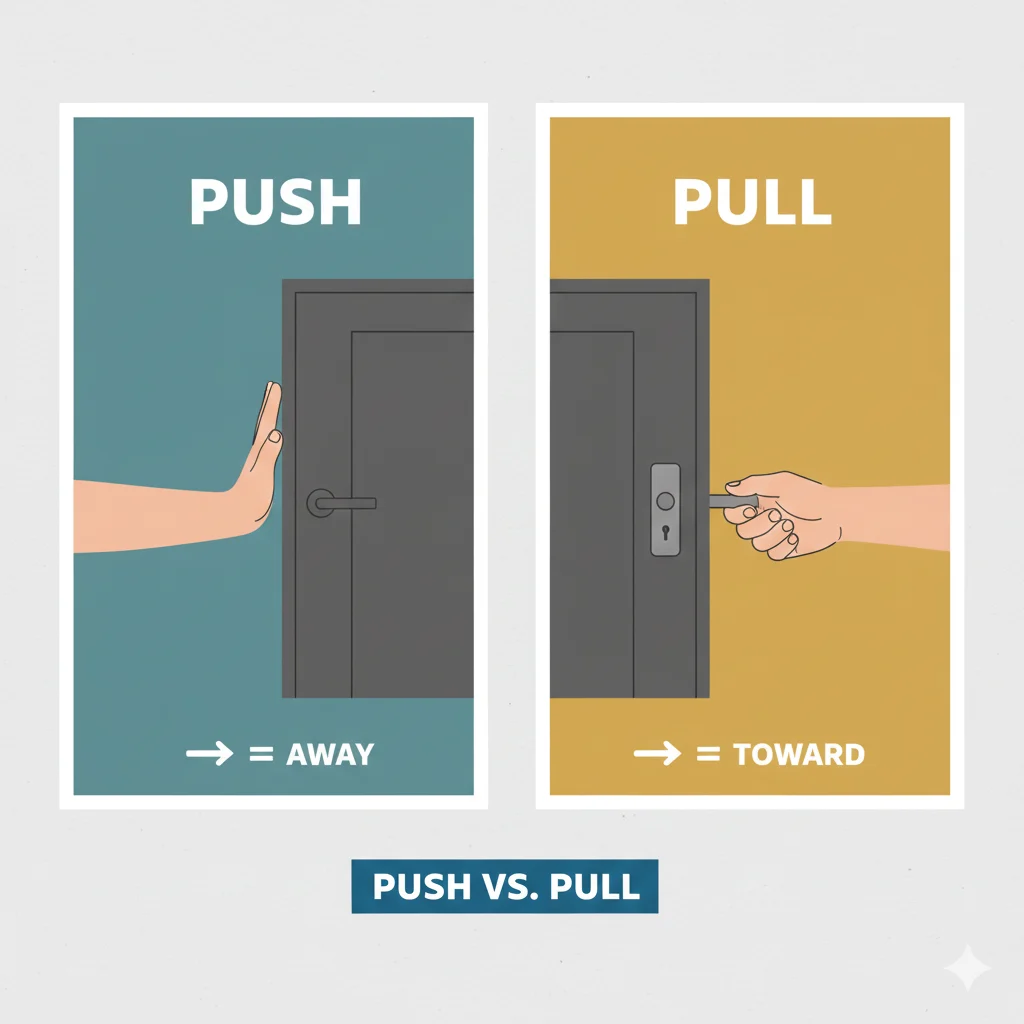
“Push” means to move something away from you by applying force.
It’s a verb — an action word.
You can push a door, a cart, or even a person (gently or emotionally).
Examples:
- She pushed the door to enter the room.
- Please don’t push me while standing in line.
- The coach pushed the team to do better.
🧩 Think of push as “move away.”
🔹 Pull – Meaning and Usage
“Pull” means to bring something toward you using force.
It’s also a verb, opposite to push.
Examples:
- He pulled the chair closer to the table.
- You need to pull the rope to lift the bucket.
- Don’t pull my hair!
🧩 Think of pull as “bring close.”
⚖️ The Key Difference Between Push and Pull
| Feature | Push | Pull |
|---|---|---|
| Basic Meaning | Move something away from you | Bring something toward you |
| Action Direction | Outward | Inward |
| Part of Speech | Verb (can also be a noun) | Verb (can also be a noun) |
| Example (Physical) | “Push the door to open it.” | “Pull the door to open it.” |
| Example (Emotional) | “She pushed her friends away.” | “He pulled his friends closer.” |
| Common Phrase | “Push forward” | “Pull together” |
💡 Quick Tip:
👉 If you move something away — PUSH it.
👉 If you bring it closer — PULL it.
Is It Anyway or Anyways? The Tiny Detail Everyone Gets Wrong 🤯
❌ Common Mistakes and How to Avoid Them
Mistake 1: Using “push” when you mean “pull.”
❌ She pushed the drawer open.
✅ She pulled the drawer open.
Mistake 2: Using “pull” when you should say “push.”
❌ He pulled the button to start the elevator.
✅ He pushed the button to start the elevator.
Mistake 3: Mixing emotional meanings.
❌ “I’m trying to pull people away.”
✅ “I’m trying to push people away.”
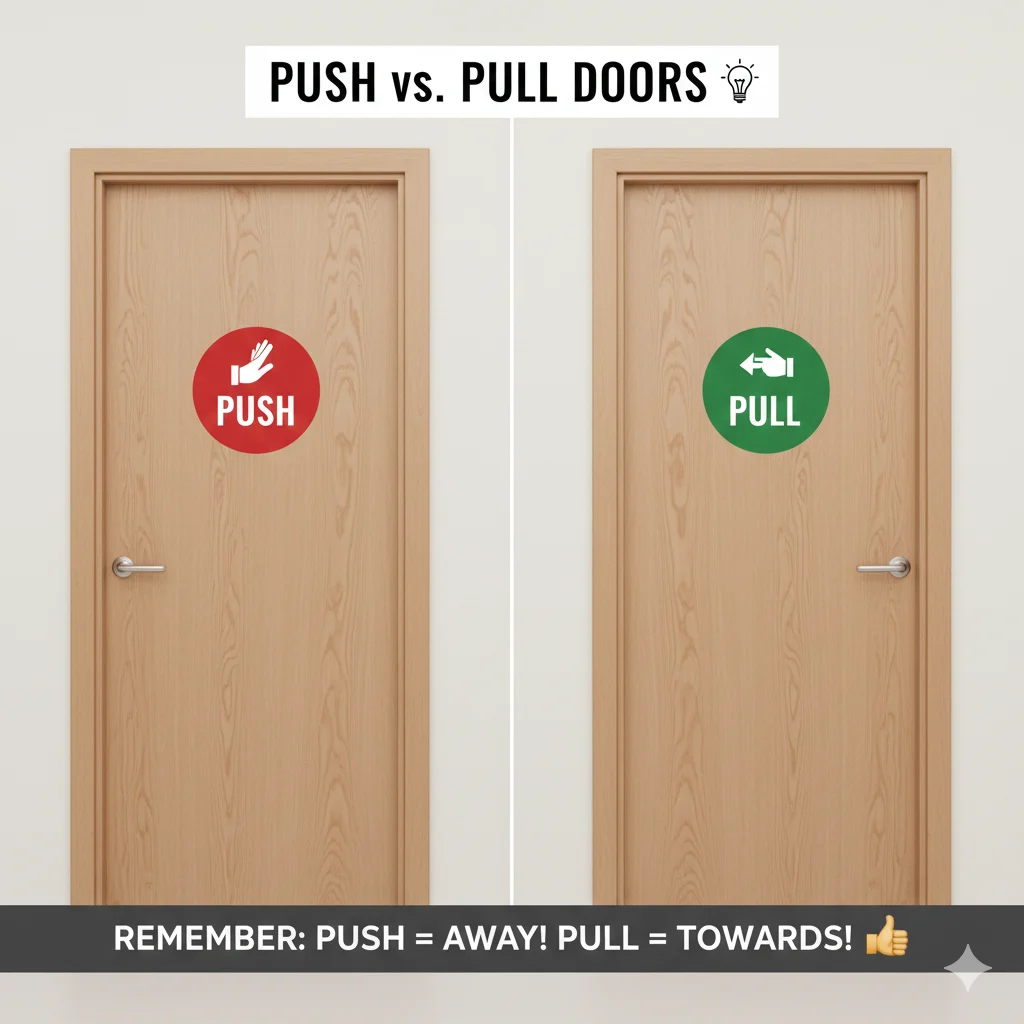
🧩 Fix: Remember — Push = away and Pull = toward.
🕹️ When to Use “Push”
Use push when you move something away or make something go forward.
Examples:
- Please push the door to exit.
- She pushed the toy car across the floor.
- The boss pushed us to finish early.
- He pushed his limits to win the race.
- Don’t push too hard — it might break.
Real-Life Tip:
Imagine pushing a heavy box. The more effort you use, the farther it goes — that’s push.
🧠 Memory Hack:
Push = Point your palms out. (Your hands move away.)
🧲 When to Use “Pull”
Use pull when you bring something toward yourself.
Examples:
- Pull the handle to open the door.
- She pulled her chair closer to the desk.
- The horse pulled the cart down the street.
- He pulled his friend into a hug.
- Don’t pull too hard — it might tear.
Real-Life Tip:
When you use a rope, you always pull it to make something come closer — that’s pull.
🧠 Memory Hack:
Pull = Point your palms in. (Your hands move toward you.)
🔁 Quick Recap: Push vs Pull
- Push = move away from you
- Pull = move toward you
- Both are verbs used to describe direction of force.
- Remember: Push out, Pull in.
📋 Summary Chart:
| Action | Direction | Example Sentence |
|---|---|---|
| Push | Away | “Push the button.” |
| Pull | Toward | “Pull the rope.” |
| Push | Encourage/Force | “She pushed me to try harder.” |
| Pull | Attract/Bring closer | “He pulled me into the group.” |
📚 Advanced Tips: History, Usage & Context
- Origin: Both words come from Old English.
- Push comes from “pousser” (French) meaning to thrust or shove.
- Pull comes from “pullian” (Old English) meaning to draw or tug.
- In business:
- “Push strategy” = promoting a product directly to consumers.
- “Pull strategy” = creating demand so customers come to you.
- In emotions:
- “Push someone away” = avoid or reject them.
- “Pull someone in” = attract or include them.
- In marketing, physics, and leadership, both have metaphorical meanings that describe opposite forces — one repels, the other attracts.
🧩 Mini Quiz: Test Your Understanding
Fill in the blanks with push or pull:
- Please ______ the door to enter.
- Don’t ______ the rope; it’s stuck.
- She ______ the chair closer to sit.
- He ______ the button to call the elevator.
- The child ______ his friend away angrily.
✅ Answers: 1. Pull 2. Pull 3. Pulled 4. Pushed 5. Pushed
❓ FAQs About Push and Pull
1. What is the difference between push and pull?
“Push” means moving something away from you, while “pull” means bringing something toward you.
2. Are push and pull opposites?
Yes! They are direct opposites — one moves outward, the other inward.
3. Can push and pull be nouns?
Yes. Example: “Give the door a push” or “She gave the rope a pull.”
4. What are common push and pull examples in daily life?
Doors, drawers, carts, ropes, buttons, and even relationships — all use the concept of push and pull.
5. How can I remember the difference easily?
Think: Push = away, Pull = toward. Use your hands to visualize!
🏁 Conclusion
Now you know the simple yet powerful difference between push and pull.
“Push” means to move something away from you, and “pull” means to bring it toward you. These words are exact opposites, used in everyday actions, emotions, and even business strategies.
Next time you see a door sign, you’ll know exactly what to do — no more embarrassing moments! 🚪😉
Keep practicing, and soon, using English will be as easy as push and pull.

Mira Loxley is a passionate language and writing expert at Definevs.com, turning tricky words and grammar into clear, engaging guides for every reader.