“Personal effects” is the correct term; “personal affects” is usually wrong.
Many people search this phrase because they are confused about which word to use in writing, legal papers, travel forms, or everyday English. This confusion happens because affects and effects sound similar, but their meanings are very different.
Personal effects means a person’s belongings, such as clothes, wallet, phone, or luggage. It is commonly used in legal, insurance, airport, and official documents. On the other hand, affects is mostly a verb that means to influence emotions or actions, not to describe possessions. Using the wrong term can make your writing look incorrect or unprofessional, especially in formal situations.
If you’ve ever felt unsure or embarrassed about which one to choose, you’re not alone. This article will clearly explain the difference in simple English, with examples and an easy memory trick, so you can use the right word confidently every time.
Personal Effects Meaning
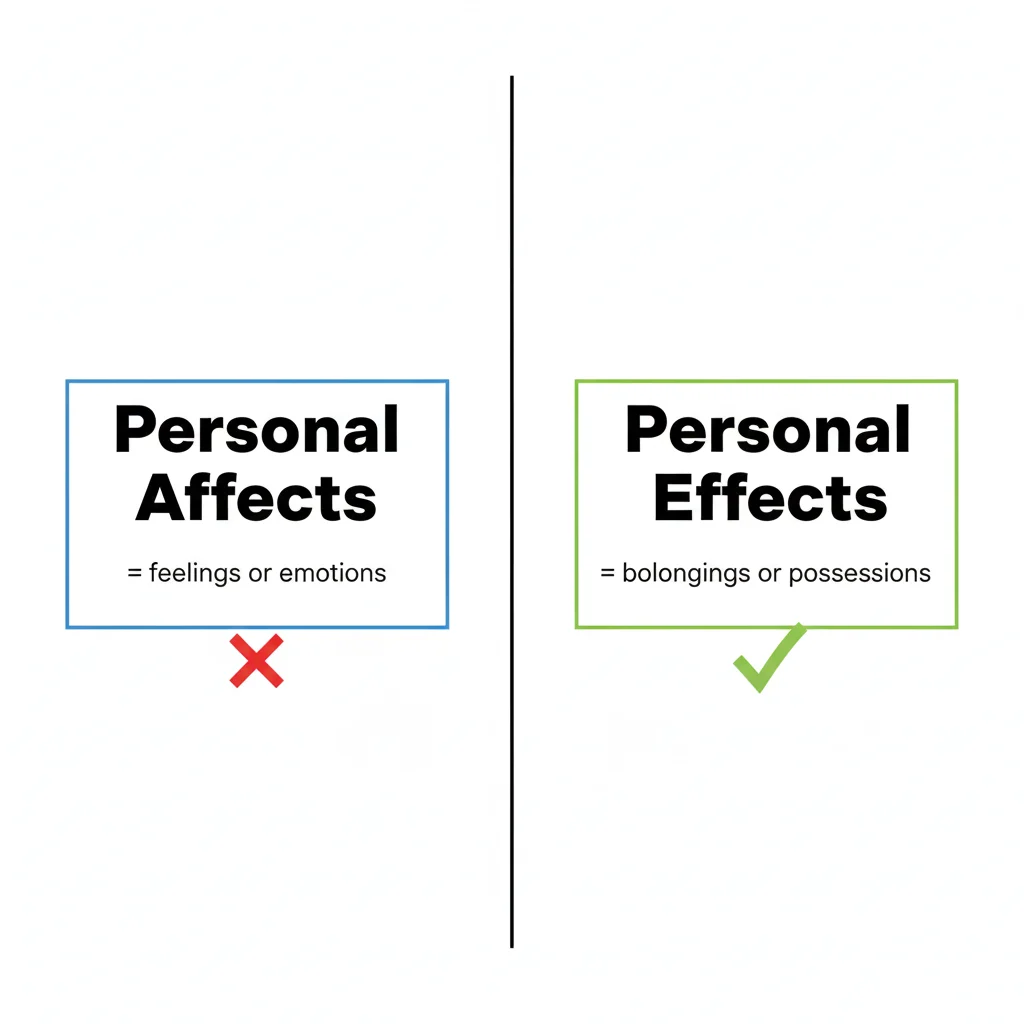
Personal effects means a person’s personal belongings or items that they own or carry with them, such as clothes, wallet, phone, jewelry, documents, or luggage.
This term is commonly used in legal papers, police reports, hospitals, airports, wills, and insurance documents to refer to someone’s possessions.
Example:
- The hospital returned the patient’s personal effects to the family.
- Please keep your personal effects with you at all times.
👉 In simple words: personal effects = personal belongings
📘 What Does Each Word Mean?
Let’s start with their meanings — simple and clear!
🧠 “Affect” — The Verb (Action Word)
Meaning: To influence or change something.
It shows how one thing impacts another.
Part of Speech: Verb (an action word)
Examples:
- The cold weather affects my mood.
- Her kind words affected me deeply.
- Too much screen time can affect your sleep.
Think of “affect” as an action — it’s something that happens or changes something else.
🎒 “Effect” — The Noun (Thing or Result)
Meaning: The result or outcome of something that happened.
It tells what happened after the action.
Part of Speech: Noun (a thing or result)
Examples:
- The medicine had a strong effect.
- The movie had a great effect on me.
- Pollution has bad effects on the environment.
Think of “effect” as the end result — what you can see or feel afterward.
⚖️ The Key Difference Between “Personal Affects” and “Personal Effects”
| Feature | Personal Affects | Personal Effects |
|---|---|---|
| Part of Speech | Verb phrase (rarely used) | Noun phrase |
| Meaning | Emotional influences or feelings of a person (used mostly in psychology) | Personal belongings or items someone owns |
| Example Sentence | “The therapy improved her personal affects.” (psychology use only) | “The police collected his personal effects.” (common use) |
| Common Usage | Rare, technical term | Everyday English, legal or casual use |
personal effect / personal effect meaning
Personal effect is rarely used alone in English and often sounds incomplete. In most cases, personal effects is the correct and natural term when referring to a person’s belongings.
a person’s effects / person effects
The phrase a person’s effects means the belongings or personal items owned by that person, especially in legal or formal writing.
✅ Quick Tip to Remember:
👉 If you’re talking about your belongings, like wallet, keys, or jewelry, use personal effects.
👉 If you’re describing emotions or feelings (in psychology), use personal affects.
🚫 Common Mistakes and How to Avoid Them
Let’s look at a few confusing examples:
❌ Wrong: The officer returned my personal affects.
✅ Right: The officer returned my personal effects.
❌ Wrong: His personal effects changed after the loss.
✅ Right: His personal affects changed after the loss.
Why this happens:
Because “affect” and “effect” sound similar! The key is to remember —
- Affect = Action (verb)
- Effect = End result or item (noun)
it affects me / effects everyone / feeling effects or affects
❌ It effects me deeply.
✅ It affects me deeply.
❌ The problem effects everyone.
✅ The problem affects everyone.
❌ I am feeling the affects.
✅ I am feeling the effects.
personally affected / personally effected
Personally affected is correct when talking about emotions or influence.
Personally effected is usually incorrect in everyday English
👜 When to Use “Personal Effects”
You use personal effects when you’re talking about someone’s personal belongings or items — things they own or carry with them.
Examples:
- The nurse placed the patient’s personal effects in a bag.
- My personal effects include my wallet, phone, and ID card.
- The police gathered the victim’s personal effects.
- Travelers should keep their personal effects safe.
- The will listed his personal effects for inheritance.
💡 Memory Hack:
Think “effects” → “stuff or belongings.” You can see or touch your effects! 🧳
✅ personal effects examples / examples of personal effects
Examples of personal effects include clothes, shoes, wallet, ID card, mobile phone, jewelry, watch, and luggage.
💭 When to Use “Personal Affects”
You use personal affects only in psychology or emotional discussions. It describes someone’s emotional expressions — like facial expressions, tone, or mood.
Examples:
- The doctor studied the patient’s personal affects during therapy.
- Depression may change a person’s affect or emotional display.
- The child’s affect showed happiness when praised.
- The teacher noticed her student’s affect was flat and emotionless.
- His cheerful affect lifted everyone’s mood.
💡 Memory Hack:
Think “affect” → “a face or feeling.” It’s what you feel or show inside or outside! 😊
🧩 Quick Recap: Personal Affects vs Personal Effects
Let’s summarize it simply!
- Affect = Action or Emotion (Verb or feeling)
- Effect = Thing or Result (Noun)
💬 In short:
- Personal Affects → Emotions, expressions, or feelings.
- Personal Effects → Belongings or personal items.
Easy Tip:
👉 If you can hold it in your hand — it’s an effect.
👉 If you can feel it in your heart — it’s an affect. ❤️
🏛️ Advanced Tips & Origin
- “Effect” comes from Latin effectus, meaning “result” or “completion.”
- “Affect” comes from Latin afficere, meaning “to influence or move emotionally.”
- In formal English or legal writing, “personal effects” is common (like in police reports or wills).
- In psychological or medical writing, “personal affects” is rare but correct for emotional context.
⚠️ Note: In texting or casual writing, people often say “personal effects” even when they mean “belongings.” Using “affects” there would sound strange.
🧠 Mini Quiz — Test Your Grammar Skills!
Fill in the blanks with affect or effect:
- The sad story deeply _______ me.
- The storm had a strong _______ on the crops.
- His cheerful _______ made everyone smile.
- The teacher returned the student’s _______ after class.
- Emotions can _______ how we make decisions.
- Please collect your _______ before leaving the office.
- The medicine may _______ your mood slightly.
✅ Answers: 1. affected, 2. effect, 3. affect, 4. effects, 5. affect, 6. effects, 7. affect.
🌟 Conclusion
So now you know — personal affects and personal effects may sound the same, but they mean very different things! 🎯
- Use personal effects when talking about your belongings.
- Use personal affects when describing feelings or emotional expressions.
Practice using both correctly in your writing, and soon you’ll never mix them up again. Keep learning — every new word brings you closer to mastering English with confidence! 💬✨
💬 FAQs
1. What is the main difference between “affect” and “effect”?
“Affect” is a verb meaning to influence; “effect” is a noun meaning result.
2. What does “personal effects” mean?
It means your personal belongings like wallet, watch, phone, or clothes.
3. What does “personal affects” mean?
It refers to your emotional expressions or feelings, often used in psychology.
4. Can I use “personal affects” in daily speech?
Not usually — it’s a technical term used by psychologists or doctors.
5. How can I remember the difference easily?
Think: Affect = Action (emotion), Effect = End result (thing you own).

Arwen Blythe is a passionate language and culture enthusiast, crafting clear, engaging guides on words, phrases, and modern English for Definevs.com readers.