Have you ever written something like “peoples opinions” and wondered if it should be people’s or peoples’?
Don’t worry — you’re not alone! Many English learners (and even native speakers) mix these two forms because they look and sound so similar.
In this easy guide, we’ll explain:
- The meaning of people’s and peoples’
- The difference between them
- How to use each word correctly in sentences
- Common mistakes, examples, and simple tips to remember them
By the end, you’ll never be confused about this grammar rule again — for real!
🧩 What Does Each Word Mean?
Let’s start by understanding what both words actually mean and how they’re used.
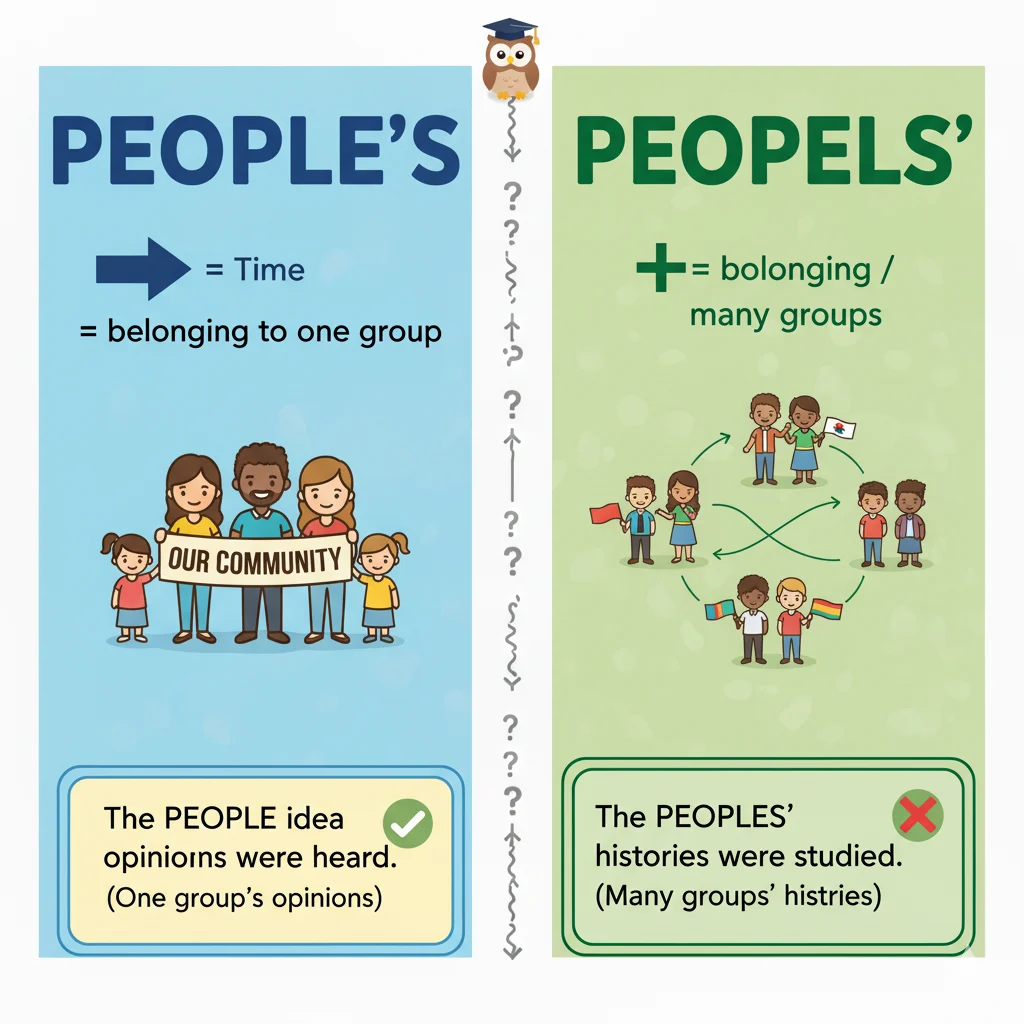
1. People’s — with the apostrophe before “s”
- Meaning: Belonging to people (the plural of person).
- Part of speech: Possessive noun.
- Use when: You’re talking about something owned by a group of people.
Examples:
- The people’s voices must be heard.
- This park is for the people’s enjoyment.
- The people’s opinions matter in a democracy.
✅ Quick tip: “People’s” = something that belongs to people (one group).
2. Peoples’ — with the apostrophe after “s”
- Meaning: Belonging to many groups of people (plural of peoples).
- Part of speech: Possessive plural noun.
- Use when: Talking about different communities, nations, or ethnic groups.
Examples:
- The peoples’ cultures of the world are fascinating.
- The peoples’ traditions in Asia vary widely.
- The treaty protected the peoples’ rights across regions.
✅ Quick tip: “Peoples’” = something that belongs to several groups of people (many populations).
⚖️ The Key Difference Between People’s and Peoples’
Here’s an easy way to see the difference between the two:
| Word | Meaning | Belongs to | Example Sentence |
|---|---|---|---|
| People’s | Belonging to people (one group) | A single group | The people’s decision was final. |
| Peoples’ | Belonging to multiple groups of people | Many groups | The peoples’ traditions were honored. |
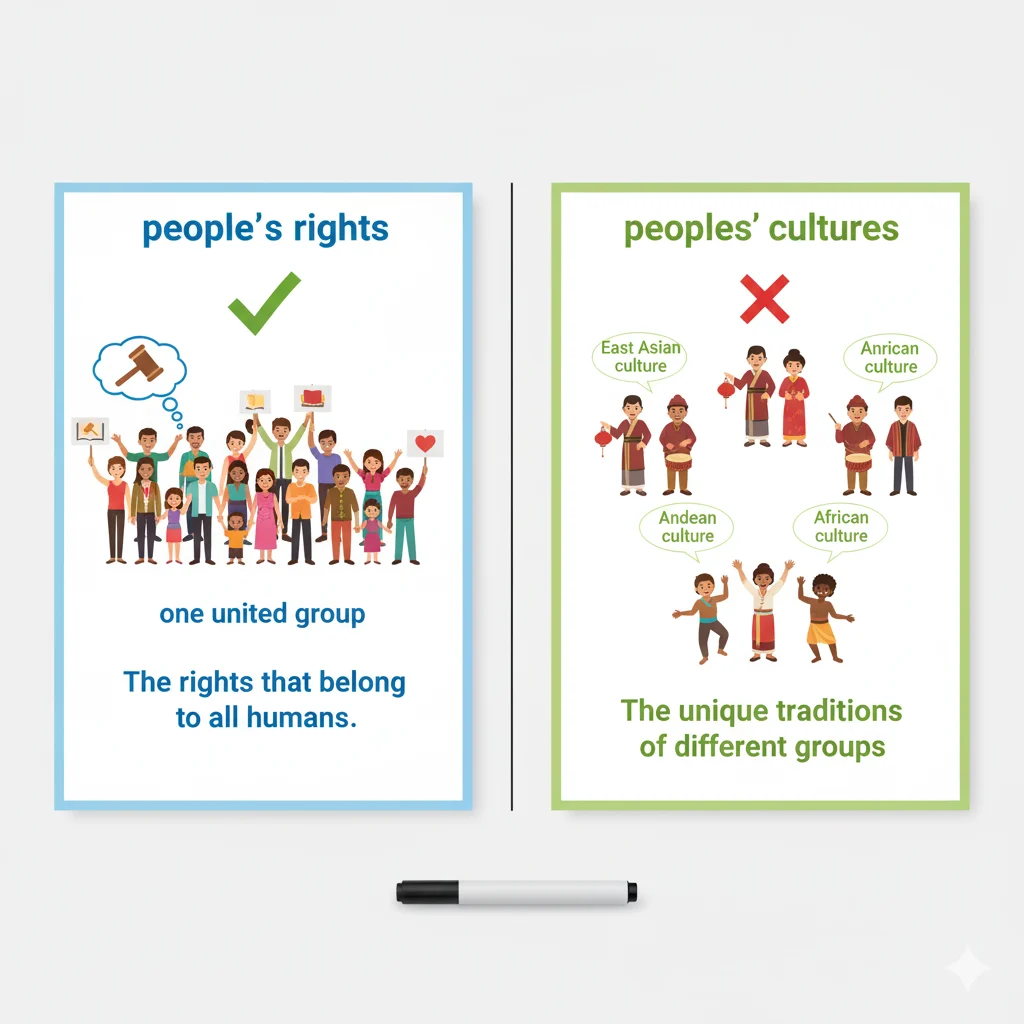
🧠 Quick tip to remember:
If you’re talking about everyone together, use people’s.
If you’re talking about different groups or nations, use peoples’.
🚫 Common Mistakes and How to Avoid Them
Here are some typical mix-ups students make — and how to fix them.
❌ Wrong: The peoples opinions were divided.
✅ Correct: The people’s opinions were divided.
(It’s one group — the people — not many nations.)
❌ Wrong: The people’s of different countries gathered together.
✅ Correct: The peoples of different countries gathered together.
(No apostrophe — we’re just talking about different groups.)
❌ Wrong: The peoples culture is interesting.
✅ Correct: The peoples’ cultures are interesting.
(We’re describing the traditions of many distinct groups.)
💡 How to remember:
- If it’s about ownership by one collective group → use people’s.
- If it’s about ownership by many separate groups → use peoples’.
Jesus’ or Jesus’s: The Tiny Grammar Detail Everyone Gets Wrong
🧍♂️ When to Use “People’s”
Use people’s when you’re talking about things that belong to one community or group of people.
Examples:
- The people’s vote changed the law.
- We must respect the people’s choice.
- The people’s stories were inspiring.
- That is the people’s anthem.
- The people’s hope is for peace.
✅ Memory trick: If it feels like you’re saying “the citizens’” or “the crowd’s,” use people’s.
🌍 When to Use “Peoples’”
Use peoples’ when talking about many distinct nations,unions or ethnic groups, especially in cultural or global contexts.
Examples:
- The peoples’ customs in Africa are beautifully diverse.
- The peoples’ languages of the world show rich history.
- The agreement respected all peoples’ rights.
- The museum displays the peoples’ art from ancient times.
- The peoples’ unity brought peace after years of conflict.
💡 Memory hack:
If the sentence includes words like nations, cohorts cultures, or countries, you probably need peoples’.
🔁 Quick Recap: People’s vs Peoples’
Let’s quickly summarize everything you’ve learned:
- People’s = one group’s possession
→ Example: The people’s vote was counted. - Peoples’ = many groups’ possession
→ Example: The treaty supported all peoples’ rights.
✅ Easy trick:
One community → people’s
Many communities → peoples’
💡 Advanced Tips: Grammar & History
- “People” comes from the Latin populus, meaning “nation.”
- “Peoples” is the plural of people, used when discussing many nations or ethnicities.
- In modern writing, “people’s” is far more common — you’ll see “peoples’” mainly in formal, academic, or historical texts.
Formal Example:
“The United Nations Charter upholds the peoples’ right to self-determination.”
Casual Example:
“The people’s opinions were shared on social media.”
Using the wrong one in formal writing can slightly change meaning — so choosing carefully shows language precision.
🧠 Mini Quiz: Test Yourself!
Fill in the blanks with people’s or peoples’:
- The __________ opinions were divided on the issue.
- The treaty protected the __________ cultures.
- The __________ voice is stronger together.
- The __________ art of ancient cohort, valuable.
- The __________ decision changed history.
✅ Answers:
- people’s
- peoples’
- people’s
- peoples’
- people’s
❓ FAQs
1. What’s the main difference between people’s and peoples’?
“People’s” shows ownership by one group of people, while “peoples’” shows ownership by many different groups or nations.
2. Is peoples’ a real word?
Yes! It’s less common but correct when referring to multiple groups of people (e.g., the indigenous peoples’ traditions).
3. When should I use people’s?
Use it when something belongs to the general public, like the people’s choice or the people’s rights.
4. Why does people already end with ‘s’?
Because people is already plural — that’s why we only add an apostrophe + s to show possession (people’s).
5. Can I ever use both forms in the same paragraph?
Yes, if you’re comparing one group with many.
Example: The people’s freedom and the neighboring peoples’ traditions were both celebrated.
🏁 Conclusion
Now you know the clear difference between people’s and peoples’ — and when to use each.
Remember:
- People’s = one group’s possession
- Peoples’ = many groups’ possession
Practice using both in your writing and conversations, and soon it’ll feel completely natural.
Keep learning a little English every day — because strong grammar builds confident communication! 💬✨

Arwen Blythe is a passionate language and culture enthusiast, crafting clear, engaging guides on words, phrases, and modern English for Definevs.com readers.