Have you ever stopped while writing and wondered whether to use people’s or peoples’? 🤔
You’re not alone! These two words look almost the same, but their meanings and uses are slightly different — and mixing them up is one of the most common grammar mistakes in English.
In this easy guide, we’ll learn the difference between people’s and peoples’, what each means, and how to use them correctly in writing and conversation. Whether you’re a student, beginner, or English learner, this article will make things crystal clear — with fun examples, tips, and even a mini quiz at the end! 🌟
📚 What Does Each Word Mean?
Let’s break down both words in the simplest way possible 👇
✴️ People’s
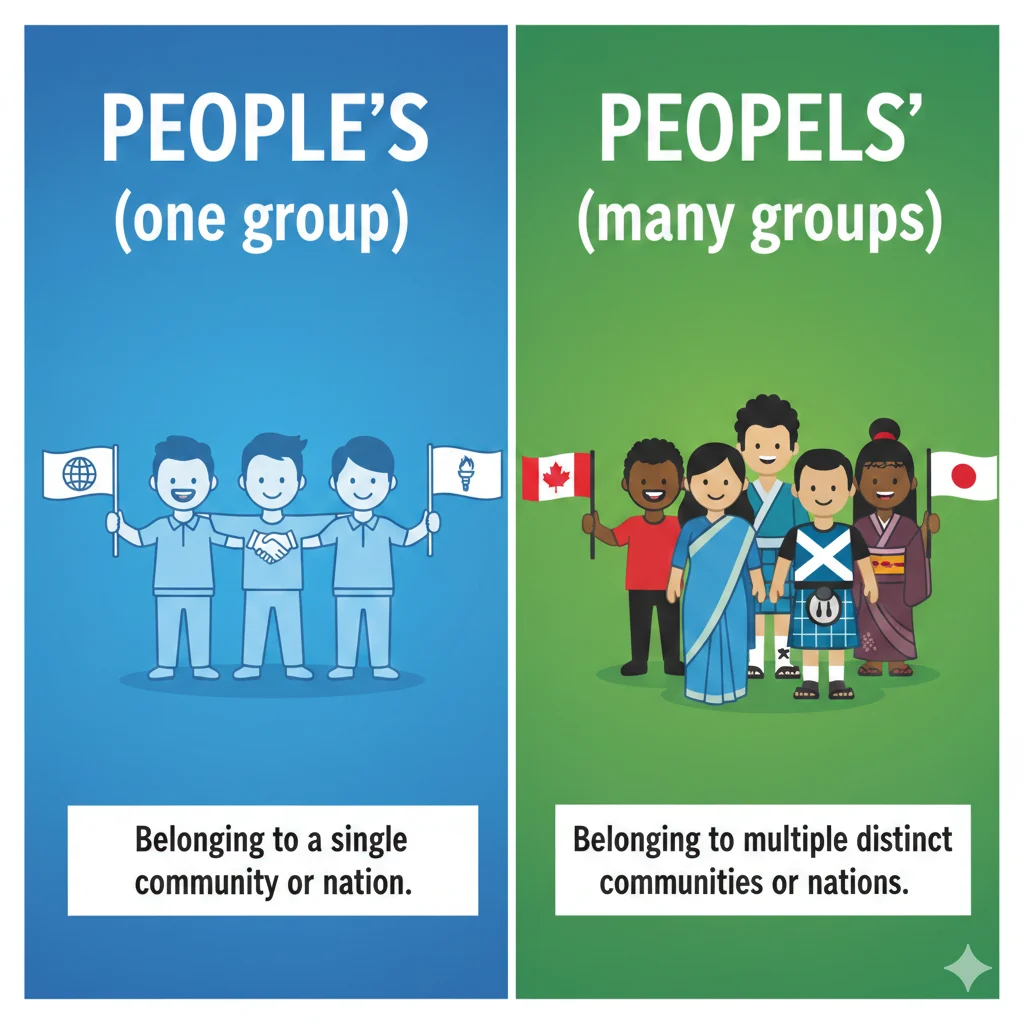
Meaning: Belonging to people (more than one person).
Part of Speech: Possessive noun.
So, people’s shows ownership — something that belongs to the people.
Examples:
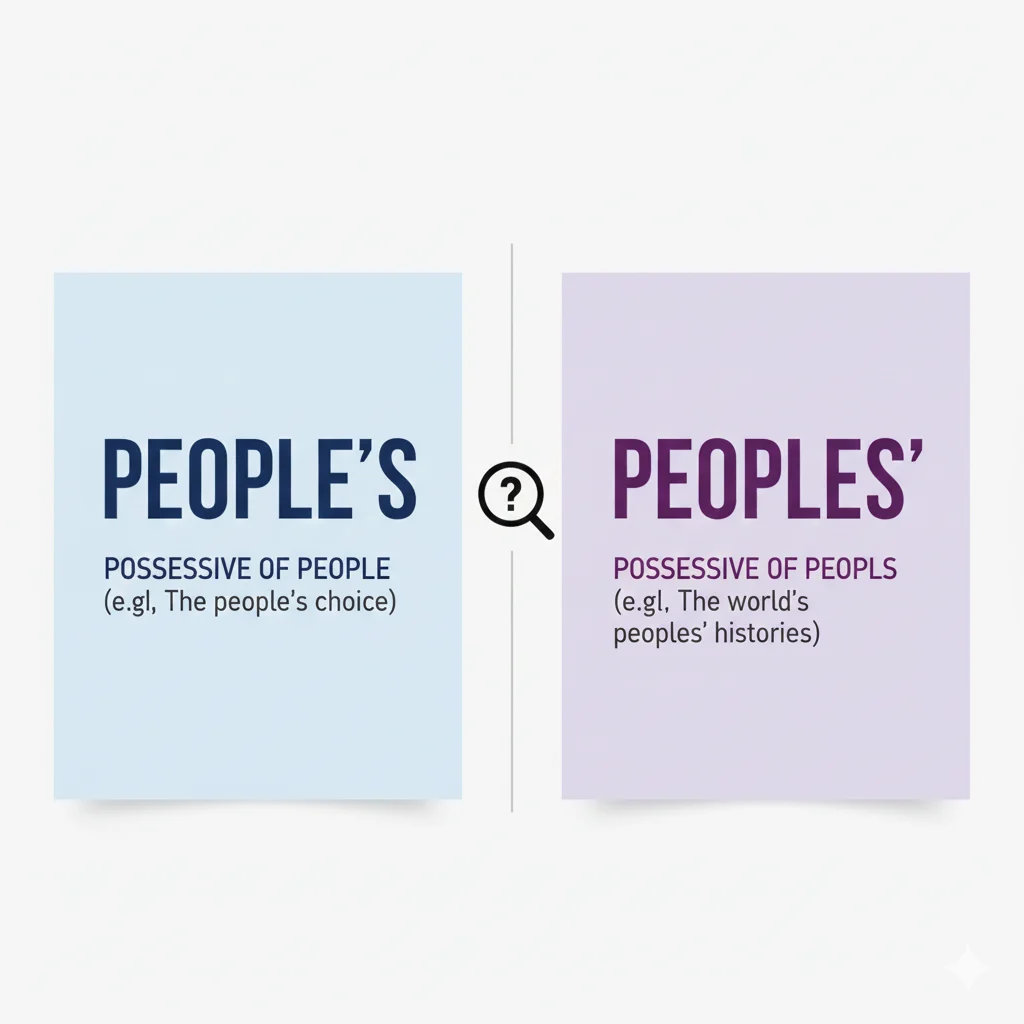
- The people’s choice was the new mayor.
- We should respect people’s feelings.
- The museum displayed the people’s history.
Mini Story:
Imagine a group of friends building a treehouse together. They call it the people’s treehouse — because it belongs to all of them! 🌳
✴️ Peoples’
Meaning: Belonging to different groups of people (plural of people).
Part of Speech: Possessive noun (plural).
Peoples’ is used when you’re talking about many groups — like different unions, nations, or cultures.
Examples:
- The peoples’ traditions across Africa are diverse.
- The museum celebrated the peoples’ heritage of Asia.
- The peoples’ voices united in peace.
Mini Story:
Think of many countries with their own customs and languages. Each has its own people. When we talk about all those peoples together, we say peoples’. 🌍
⚖️ The Key Difference Between People’s and Peoples’
Here’s a quick and easy comparison table 🧩
| Feature | People’s | Peoples’ |
|---|---|---|
| Meaning | Belonging to one group of people | Belonging to many groups of people |
| Form | Singular possessive | Plural possessive |
| Used for | Everyday situations | Cultural or global contexts |
| Example Sentence | The people’s voice matters. | The world’s peoples’ cultures are beautiful. |
💡 Quick Tip to Remember:
If you’re talking about just one group, use people’s.
If you’re talking about many groups or nations, use peoples’.
🚫 Common Mistakes and How to Avoid Them
Let’s fix some common mix-ups 🧠
❌ Wrong: The peoples’ opinions of our town matter.
✅ Right: The people’s opinions of our town matter.
(Only one community — use “people’s.”)
❌ Wrong: The people’s traditions of Africa are amazing.
✅ Right: The peoples’ traditions of Africa are amazing.
(Many cultural groups — use “peoples’.”)
👉 Grammar Tip:
If you can replace the word with “group of people,” use people’s.
If you can replace it with “different groups,” use peoples’.
🏫 When to Use “People’s”
Use people’s when you’re talking about:
- Opinions, choices, or belongings of a community.
- One group or society.
- General everyday topics.
Example Sentences:
- The people’s votes decided the winner.
- We admire the people’s courage.
- The government should protect the people’s rights.
- The people’s festival is held every spring.
- Teachers value the people’s trust in schools.
Memory Hack: 🧠
Think of “people’s” as “belonging to all of us together.”
🌍 When to Use “Peoples’”
Use peoples’ when talking about:
- Different nations, ethnic groups, or unions.
- Cultural or international topics.
- Global diversity or heritage.
Example Sentences:
- The peoples’ stories of the Amazon are fascinating.
- We celebrate the peoples’ music of the Pacific Islands.
- The United Nations honors the peoples’ freedom.
- The peoples’ beliefs differ across continents.
- The peoples’ histories shaped our modern world.
Memory Hack: 🌏
If it’s about many groups of people, just add an “s” and make it peoples’!
🔄 Quick Recap: People’s vs Peoples’
Let’s make this super easy to remember with a quick checklist:
✅ People’s = belongs to one group of people.
✅ Peoples’ = belongs to several groups of people.
✅ Both show possession.
✅ Apostrophe (‘) comes after the word it belongs to.
✅ Use the sentence test:
- One group → “people’s”
- Many groups → “peoples’”
📖 Advanced Tips and Fun Facts
🗓️ Origin:
- “People” comes from the Latin populus, meaning “a group or nation.”
- “Peoples” appeared later to describe multiple nations or races.
🧾 Formal Writing Tip:
In essays or history papers, use peoples’ when referring to many ethnic groups (e.g., the indigenous peoples’ rights).
💬 In Everyday English:
Most daily conversations use people’s because we usually talk about one community.
📱 Online Writing Caution:
Mixing them up can change meaning — for example:
- “People’s voices” = one nation’s citizens.
- “Peoples’ voices” = many nations’ citizens.
🧩 Mini Quiz — Test Your Grammar Skills!
Fill in the blanks with people’s or peoples’ 👇
- The _______ votes will decide the next leader.
- The museum celebrates the ancient _______ traditions.
- The _______ rights must always be respected.
- The world’s _______ music is full of color.
- The _______ stories inspired the whole country.
- The _______ cultures across continents are rich.
- The _______ opinions helped shape new rules.
(Answers: 1. people’s, 2. peoples’, 3. people’s, 4. peoples’, 5. people’s, 6. peoples’, 7. people’s) ✅
🌈 Conclusion
Understanding the difference between people’s and peoples’ makes your English clearer and more confident. 🌟
Remember — people’s means something belongs to one group, while peoples’ is for many groups. Practice using both in sentences about family, school, or global cultures. The more you use them, the more natural they’ll sound.
Keep learning a little every day — and soon, you’ll master English grammar like a pro! 💪✨
💬 FAQs
1. What is the main difference between people’s and peoples’?
“People’s” means belonging to one group; “peoples’” means belonging to many groups.
2. Is people’s or peoples’ used more often?
“People’s” is more common in daily use. “Peoples’” is mostly used in cultural or historical writing.
3. Can I use people’s for countries?
If you mean one country or community, yes! For many nations, use “peoples’.”
4. How can I remember which one to use?
Think: one group = people’s; many groups = peoples’.
5. Are both correct in grammar?
Yes, both are grammatically correct — just used in different situations.

Mira Loxley is a passionate language and writing expert at Definevs.com, turning tricky words and grammar into clear, engaging guides for every reader.