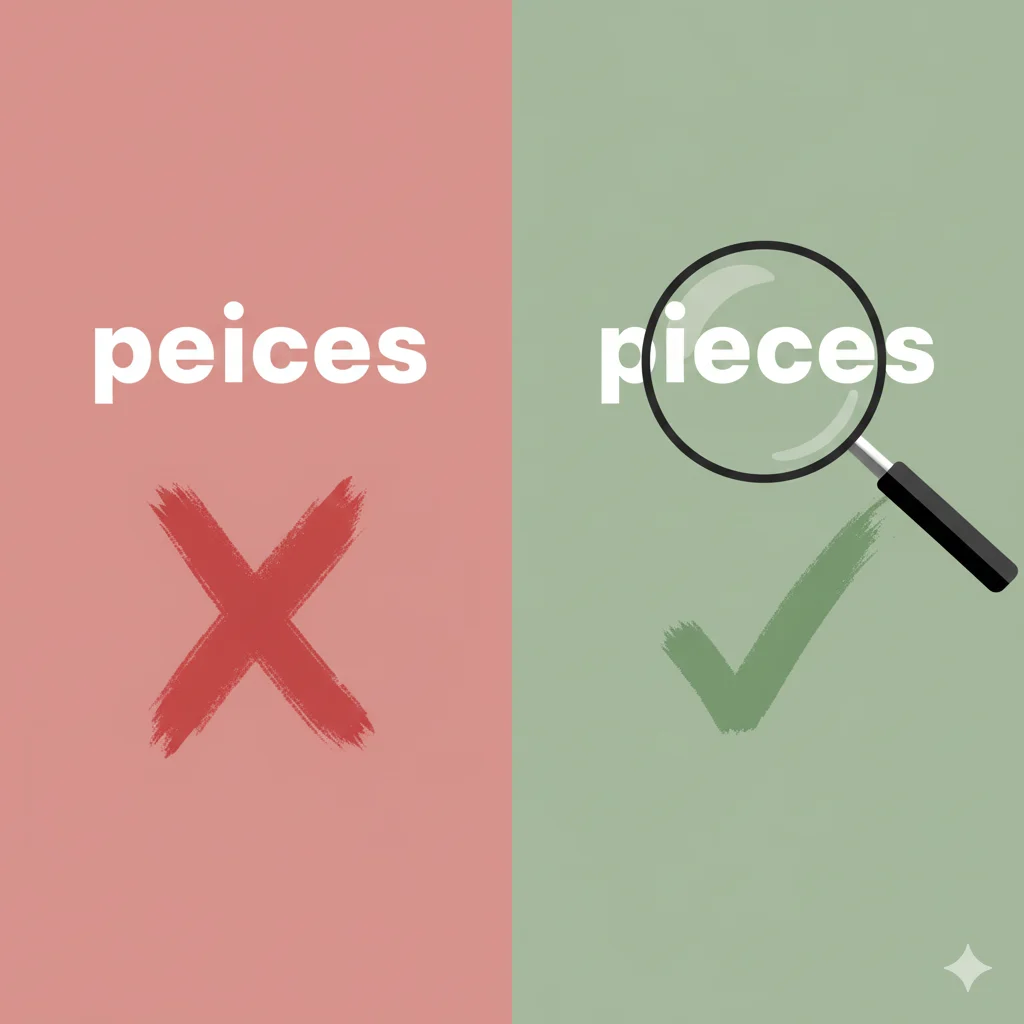
Have you ever written “peices” and then wondered if it looked a little strange? You’re not alone! Many people — even adults — get confused between peices and pieces because they sound exactly the same but only one is correct.
In this guide, we’ll explain the difference between “peices” and “pieces”, what each word means, and how to use the correct one in sentences. You’ll learn grammar tips, examples, and memory hacks that make spelling fun and easy! 🌈
By the end, you’ll never mix up these two words again — promise! Let’s dive in. 🚀
📖 What Does Each Word Mean?
Let’s start by understanding what each word means and why one of them doesn’t actually exist in English.
✅ Pieces (Correct Word)
Meaning: Small parts of a whole or broken sections of something.
Part of Speech: Noun
Examples:
- She cut the cake into small pieces.
- The vase broke into a hundred pieces.
- He picked up the pieces of paper on the floor.
💡 Think of “pieces” as parts of something bigger — like puzzle pieces! 🧩
❌ Peices (Incorrect Spelling)
Meaning: ⚠️ This is a misspelling of the word “pieces.”
Part of Speech: None — it’s not an official English word.
Examples (Incorrect):
- She cut the cake into peices. ❌
- The vase broke into peices. ❌
- I can’t find all the peices of the puzzle. ❌
Corrected:
✅ She cut the cake into pieces.
✅ The vase broke into pieces.
✅ I can’t find all the pieces of the puzzle.
Master of Science / Masters of Science: Secret Difference Revealed 🔍
⚖️ The Key Difference Between Peices and Pieces
Here’s a simple comparison table to make it crystal clear 👇
| Word | Meaning | Correct or Incorrect | Example Sentence |
|---|---|---|---|
| Pieces | Parts of something | ✅ Correct | She picked up the broken pieces of glass. |
| Peices | No meaning (wrong spelling) | ❌ Incorrect | ❌ She picked up the broken peices of glass. |
Quick Tip to Remember 🧠:
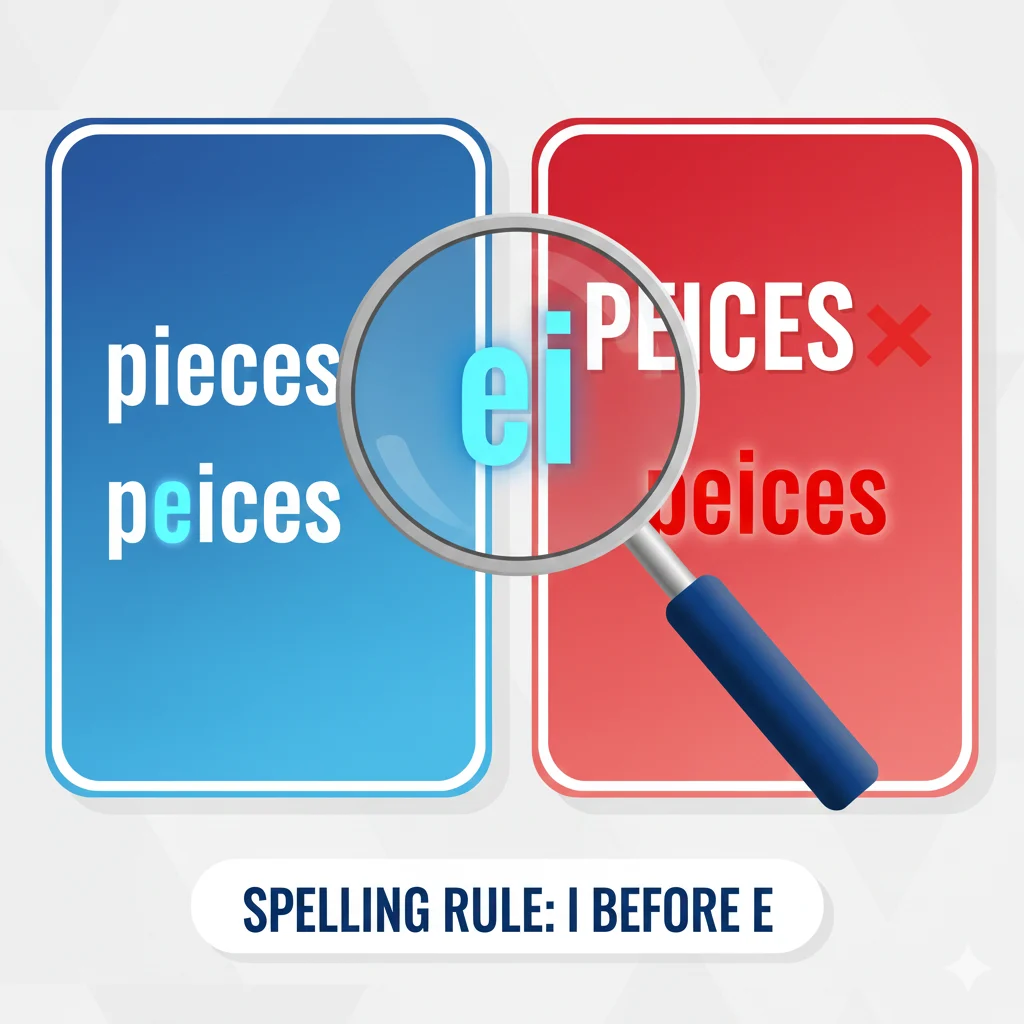
👉 “I before E except after C.”
But in pieces, the rule flips: the C comes before the E, so remember — C-E are best friends!
📌 Correct: pieces (p-i-e-c-e-s)
🚫 Wrong: peices
🚫 Common Mistakes and How to Avoid Them
It’s very common to write peices by mistake, especially when typing fast. Let’s look at a few examples:
| ❌ Wrong Sentence | ✅ Correct Sentence |
|---|---|
| The mirror fell into many peices. | The mirror fell into many pieces. |
| I lost some peices of the puzzle. | I lost some pieces of the puzzle. |
| Can you hand me the peices of chalk? | Can you hand me the pieces of chalk? |
Why the mistake happens:
Because the letters “ei” and “ie” sound the same in English, our brain mixes them up!
How to fix it:
Say this aloud: “Pie has pieces, not peices!” 🥧
🎯 When to Use “Pieces”
You should use pieces whenever you’re talking about parts of something — whether it’s food, an object, or even ideas.
Examples:
- She tore the paper into tiny pieces.
- The teacher divided the chocolate into equal pieces.
- The robot broke into pieces during the science fair.
- I gave him a few pieces of advice.
- Can I have two pieces of candy, please? 🍬
Memory Hack 💡:
Imagine a pie cut into slices — every slice is a piece. The word “pie” is inside pieces → P-I-E-C-E-S! 🥧✨
🚫 When to Use “Peices”
Never. 😅
The word “peices” is simply a spelling error. If you write it, spell checkers will underline it in red. Always correct it to pieces.
Fun Trick to Remember:
👉 “Peices” has E-I — and that combination doesn’t fit after “C.”
Remember the rhyme:
‘I before E, except after C — unless it’s wrong like peices!’ 😄
🔍 Quick Recap: Peices vs Pieces
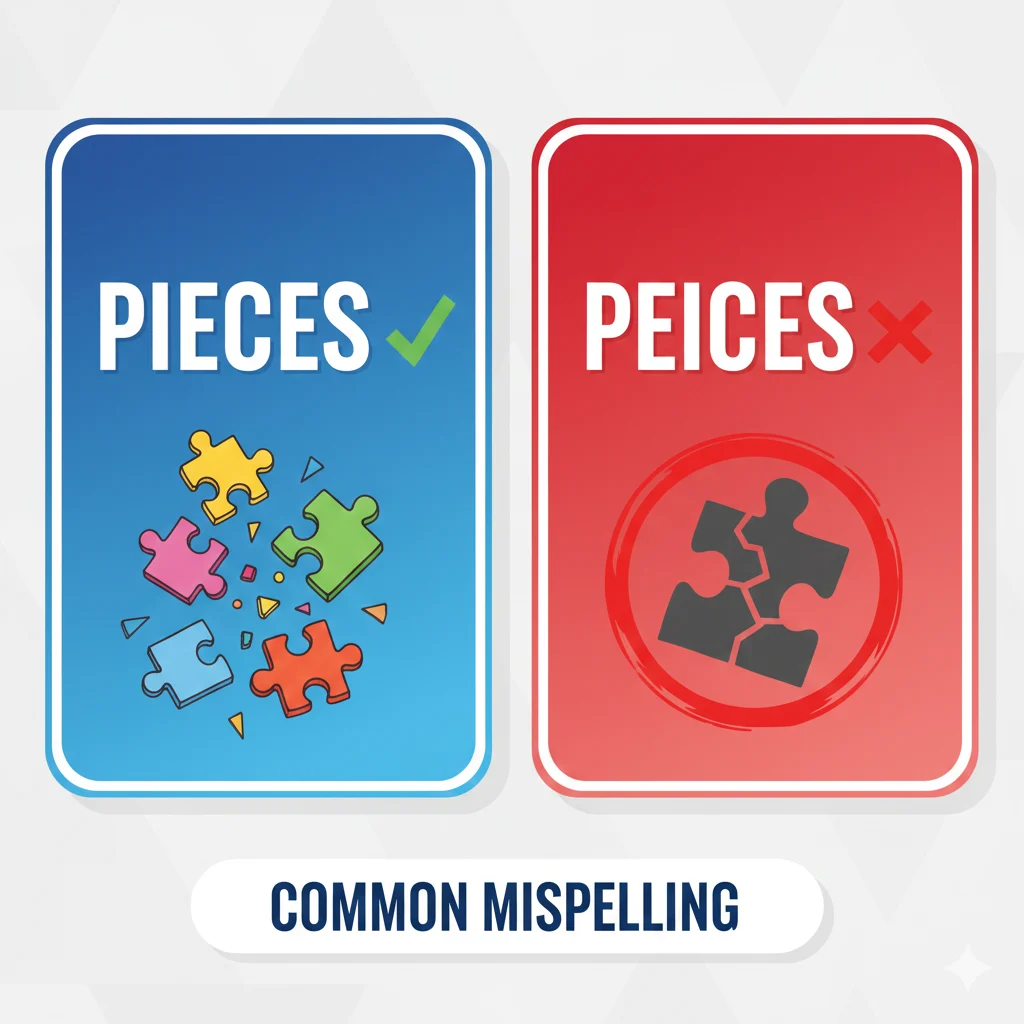
Here’s everything you need to remember in one glance:
- Pieces = ✅ Correct spelling. Means “parts of a whole.”
- Peices = ❌ Incorrect. A common typo.
- Use “pieces” when describing small parts, sections, or portions.
- Memory Tip: Think pie → pieces (P-I-E). 🍰
In short:
If it looks wrong, it probably is — choose pieces every time!
🌍 Advanced Tips and Interesting Facts
✨ Origin of the word “pieces”:
The word pieces comes from Old French “piece”, meaning a part or portion of something. It entered English around the 13th century and has been used the same way ever since!
📘 In writing and essays:
- Use “pieces” for both physical and non-physical things.
- Physical: pieces of wood, glass, fabric
- Abstract: pieces of advice, pieces of information
📱 In texting or online writing:
You might see people write peices out of habit or fast typing — but remember, autocorrect exists for a reason! Always double-check before sending that message.
🧠 Mini Quiz: Can You Choose the Correct Word?
Fill in the blanks with pieces or peices 👇
- She picked up the broken ______ of the cup.
- I need three ______ of chalk for the board.
- The puzzle is missing two ______.
- Grandma gave me two ______ of candy.
- The sculpture fell apart into several ______.
Answers: 1️⃣ pieces 2️⃣ pieces 3️⃣ pieces 4️⃣ pieces 5️⃣ pieces ✅
🌟 Conclusion
Now you know the truth — “pieces” is the right word, and “peices” is just a common mistake! Learning the difference helps you write with confidence and clarity. ✍️
Remember: language is like a puzzle. Each piece matters, and when you put them all together, you create something beautiful. 🧩 Keep practicing, keep reading, and you’ll master every tricky word in English one piece at a time! 🌻
Bachelor / Bachelor’s: The Tiny Detail Everyone Gets Wrong 😮
💬 FAQs
1. What is the difference between peices and pieces?
“Pieces” is correct and means parts of something. “Peices” is an incorrect spelling.
2. Is peices ever used in British or American English?
No. “Peices” is not used in any form of English — it’s always “pieces.”
3. How do I remember the correct spelling of pieces?
Think of “pie” → P-I-E → pieces. 🥧
4. Can pieces be used for ideas or advice?
Yes! You can say “a piece of advice” or “pieces of information.”
5. Why do people often type peices instead of pieces?
Because the sounds of ie and ei are similar — it’s an easy mix-up! Spell check can help fix it.

Kael Donovan is a language enthusiast and writer at Definevs.com, simplifying complex words and grammar rules into fun, easy-to-understand guides for readers.