Ever wondered whether to write parents’ night or parent’s night? 🤔
You’re not alone — this is one of the most common grammar mix-ups in English!
Both parents’ and parent’s look almost the same, but that tiny apostrophe changes the meaning completely. Many English learners (and even native speakers) get confused about where to place it — before or after the “s.”
In this simple guide, you’ll learn:
- The meaning of parent’s and parents’
- The difference between them
- Easy examples and real-life usage
- A quick memory trick so you’ll never mix them up again!
By the end, you’ll write them confidently — like a grammar pro. 🌟
📚 What Does Each Word Mean?
Let’s break down both words simply:
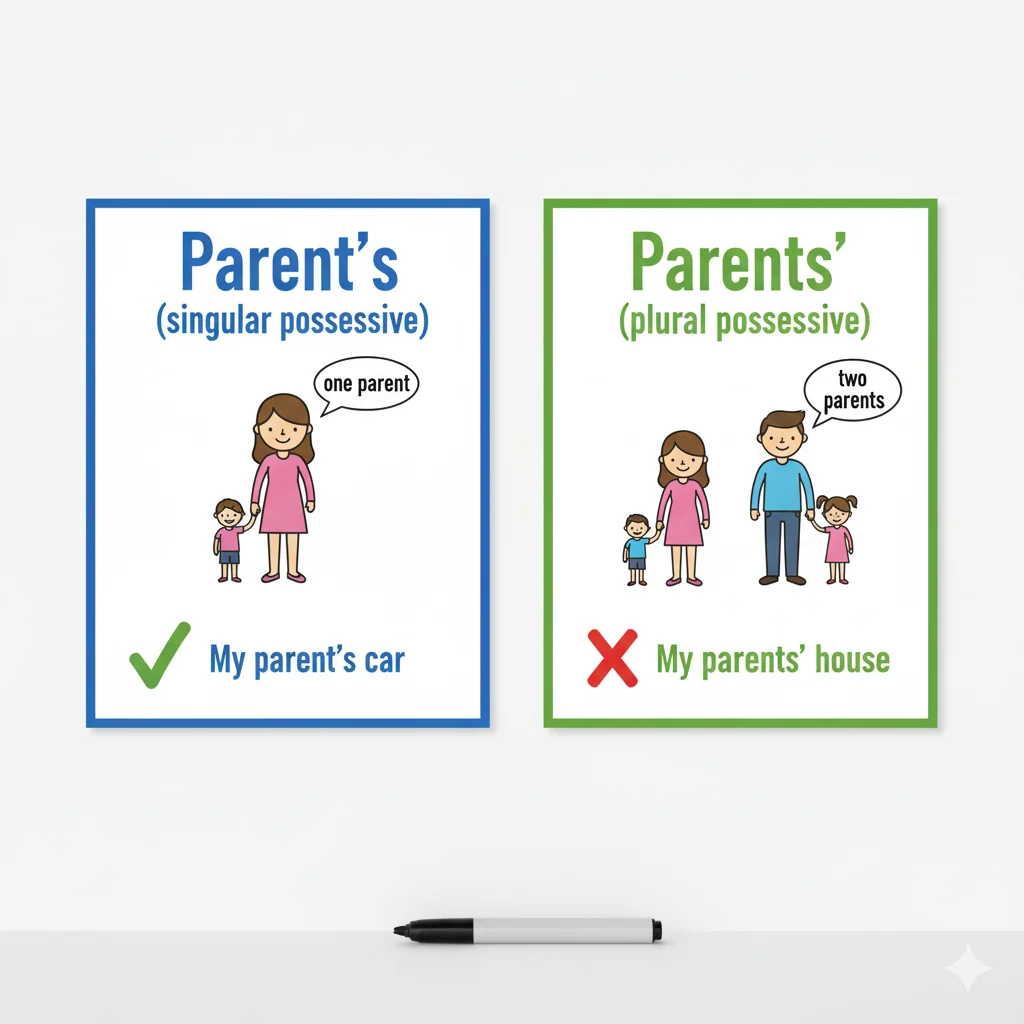
Parent’s — with the apostrophe before the s
Meaning: Belonging to one parent.
It’s singular possessive — showing ownership by one person (either your mother or father).
Examples:
- I borrowed my parent’s car. → (The car belongs to one parent.)
- My parent’s advice helped me a lot. → (Advice from one parent.)
- That’s my parent’s phone on the table. → (Only one parent’s phone.)
Parents’ — with the apostrophe after the s
Meaning: Belonging to both parents.
It’s plural possessive — showing ownership by more than one parent.
Examples:
- I stayed at my parents’ house last weekend. → (Belongs to both parents.)
- My parents’ love is unconditional. → (Love from both parents.)
- This is my parents’ anniversary gift. → (Gift for both mother and father.)
🔑 The Key Difference Between Parents’ and Parent’s
Here’s the simple rule:
| Word | Ownership Type | Meaning | Example Sentence |
|---|---|---|---|
| Parent’s | Singular possessive | Belonging to one parent | My parent’s signature is on the form. |
| Parents’ | Plural possessive | Belonging to both parents | My parents’ bedroom is upstairs. |
🧠 Quick Tip to Remember:
If you’re talking about one parent, put the apostrophe before the s → parent’s.
If you’re talking about two or more parents, put it after the s → parents’.
🚫 Common Mistakes and How to Avoid Them
Even advanced learners make these mistakes! Let’s see how they happen — and how to fix them.
❌ Mistake 1:
I met my parents’s friends yesterday.
✅ Correct:
I met my parents’ friends yesterday.
Why?
You can’t add another “s” after “parents” — just place the apostrophe after the existing s.
❌ Mistake 2:
My parent’s are going out tonight.
✅ Correct:
My parents are going out tonight.
Why?
This sentence isn’t about ownership — it’s just plural. No apostrophe needed.
❌ Mistake 3:
My parents’ car is old, and my parent’s advice is always right.
✅ Both are correct!
This shows the difference perfectly — first refers to both parents’ car, second refers to one parent’s advice.
🧍 When to Use Parent’s
Use parent’s when something belongs to one parent only.
You can often replace it with “my mom’s” or “my dad’s” to check if it fits.
Examples:
- I’m following my parent’s footsteps.
- My parent’s permission is required for the trip.
- The teacher called my parent’s number.
- That’s my parent’s office bag.
- I took my parent’s advice seriously.
Memory Hack:
Think of “parent’s” as one parent — one apostrophe before the “s.”
👨👩👦 When to Use Parents’
Use parents’ when something belongs to both parents together.
If you can replace it with “my mom and dad’s,” you know it’s plural.
Examples:
- My parents’ house is in another city.
- I love my parents’ cooking.
- Their parents’ meeting is on Friday.
- I respect my parents’ values.
- It’s my parents’ dream to travel abroad.
Memory Trick:
More than one parent? Add s first, then the apostrophe. → parents’
🧾 Quick Recap: Parent’s vs Parents’
Here’s a short summary to make it stick:
- Parent’s = One parent (singular possessive)
Example: My parent’s advice = advice from one parent. - Parents’ = Two or more parents (plural possessive)
Example: My parents’ home = home of both parents. - Parents (no apostrophe) = Just plural (no ownership).
Example: My parents are kind.
✅ Simple Rule:
“Parent’s” = ONE
“Parents’” = TWO OR MORE
Jesus’ or Jesus’s: The Tiny Grammar Detail Everyone Gets Wrong
💡 Advanced Tips
1. Historical Origin
The apostrophe (’) comes from Old English to show missing letters or ownership.
For example, the book of my parent became my parent’s book.
2. Formal Writing Tip
In essays or reports, using the correct possessive form makes writing clear and professional.
Example:
- Incorrect: The parents’s decision was final.
- Correct: The parents’ decision was final.
3. Texting & Online Use
Many people skip apostrophes in casual messages (e.g., “my parents house”).
That’s fine informally — but in school, exams, or professional writing, always include it.
🧠 Mini Quiz — Test Yourself!
Fill in the blanks with parent’s or parents’:
- My _______ permission is needed for the school trip.
- I forgot my _______ anniversary gift.
- The teacher met my _______ yesterday.
- I cleaned my _______ room today.
- My _______ advice always helps me.
Answers:
- parent’s
- parents’
- parents
- parents’
- parent’s
❓ 5 Common FAQs
1. What is the difference between parent’s and parents’?
Parent’s refers to one parent’s ownership; parents’ means both parents’ ownership.
2. Which one is correct — parents night or parent’s night?
If the event is for all parents, write parents’ night (plural possessive).
3. Do I need an apostrophe in parents meeting?
Yes — if it means a meeting belonging to parents, write parents’ meeting.
4. Is parents’ plural or singular?
It’s plural possessive — showing ownership by more than one parent.
5. How can I remember the difference easily?
👉 One parent = apostrophe before “s.”
👉 Two parents = apostrophe after “s.”
🏁 Conclusion
Now you know the clear difference between parent’s and parents’.
Remember:
- Parent’s = one parent
- Parents’ = two or more parents
Using the apostrophe correctly may seem small, but it shows strong grammar skills and attention to detail. Keep practicing these rules, and soon you’ll use them confidently — in essays, emails, or everyday writing.
Keep learning, keep improving, and be proud of your progress — for real! 🌟

Isla Merrin is a language and writing expert at Definevs.com, creating simple, engaging guides to help readers master words, grammar, and modern English usage.