Ever looked at parents’ and parent’s and wondered which one is right? 🤔 You’re not alone! Many learners — even adults — mix up these two little words. Both look almost the same, but that tiny apostrophe (‘) changes their meaning completely.
In this easy guide, we’ll explain what each word means, how to use them correctly, and give lots of fun examples. Whether you’re writing a school essay or a text to your teacher, this article will make the difference between parents’ and parent’s super clear. Let’s dive in and learn how to use both the right way! 🌈
📘 What Does Each Word Mean?
👩🦰 Parent’s — Singular Possessive
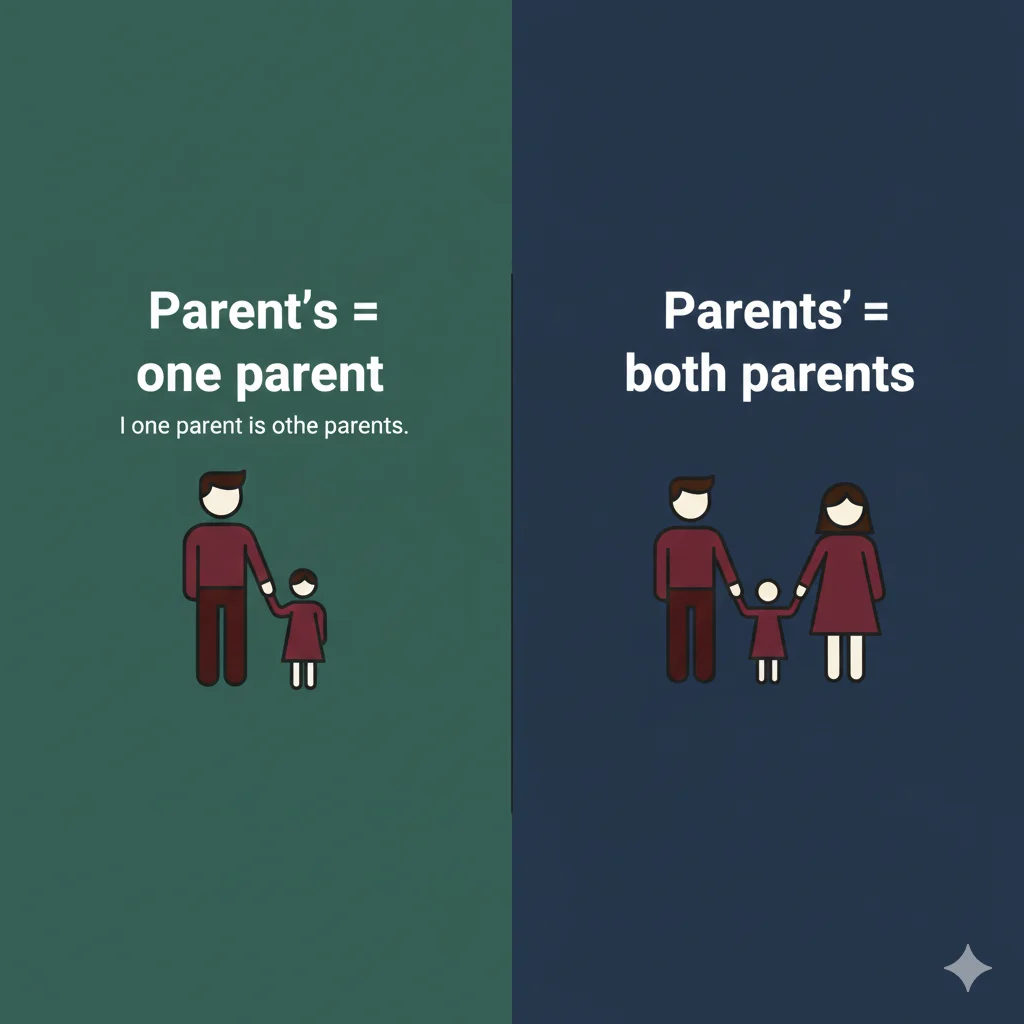
Parent’s means something that belongs to one parent.
The apostrophe (‘s) shows ownership.
Examples:
- My parent’s phone is on the table. (The phone belongs to one parent.)
- I took my parent’s advice seriously.
- My parent’s car is very old.
🧠 Tip: If you’re talking about one mom or dad, use parent’s with the apostrophe before the “s.”
👨👩👧 Parents’ — Plural Possessive
Parents’ means something that belongs to both parents (more than one).
The apostrophe goes after the “s” because the word parents is already plural.
Examples:
- My parents’ room is upstairs. (Belongs to both parents.)
- I followed my parents’ rules at home.
- The parents’ meeting starts at 10 a.m.
🧠 Tip: If you’re talking about mom and dad together, use parents’ with the apostrophe after the “s.”
Every One / Everyone: The Tiny Detail You’re Getting Wrong 🤯
🧾 The Key Difference Between Parent’s and Parents’
Here’s a simple table to help you remember the difference between parent’s and parents’ 👇
| Feature | Parent’s | Parents’ |
|---|---|---|
| Meaning | Belongs to one parent | Belongs to both parents |
| Apostrophe | Before “s” (‘s) | After “s” (s’) |
| Example Sentence | My parent’s signature is needed. | My parents’ permission is needed. |
| Used When | Talking about one mom or dad | Talking about both mom and dad |
💡 Quick Tip to Remember:
If it’s one person → parent’s
If it’s two people → parents’
It’s as simple as that! 😊

🚫 Common Mistakes and How to Avoid Them
❌ Mistake 1:
Incorrect: I signed my parents’s form.
Correct: I signed my parents’ form.
👉 Why: The word parents is already plural, so the apostrophe goes after “s.”
❌ Mistake 2:
Incorrect: My parent’s are waiting outside.
Correct: My parents are waiting outside.
👉 Why: You’re not showing possession here — it’s just plural, so no apostrophe is needed.
❌ Mistake 3:
Incorrect: I love my parents room.
Correct: I love my parents’ room.
👉 Why: The room belongs to both parents, so it’s parents’ with an apostrophe after “s.”
✨ Remember: Apostrophes don’t make words plural — they show possession (ownership).
🧍♀️ When to Use Parent’s
Use parent’s when you’re talking about something owned by one parent — maybe your mom, dad, or guardian.
Examples:
- My parent’s signature is on the report card.
- I borrowed my parent’s umbrella.
- My parent’s job is very interesting.
- I helped clean my parent’s office.
- My parent’s opinion matters to me.
🎯 Memory Hack:
If there’s only one person, the apostrophe hugs the “s” — parent’s.
👨👩👧 When to Use Parents’
Use parents’ when something belongs to both of your parents.
Examples:
- My parents’ anniversary is next week.
- The parents’ car broke down.
- I always respect my parents’ decisions.
- The parents’ meeting will begin soon.
- My parents’ love is endless. ❤️
🎯 Memory Trick:
If there are two or more parents, the apostrophe stays after the “s” — parents’.
🧩 Quick Recap: Parent’s vs Parents’
✅ Parent’s → One parent → Apostrophe before “s”
✅ Parents’ → Two or more parents → Apostrophe after “s”
Example Sentences for Quick Review:
- My parent’s car = One parent’s car
- My parents’ car = Both parents’ car
✨ Quick visual idea:
One 👩 → Parent’s
Two 👩👨 → Parents’
🌍 Advanced Tips for Grammar Lovers
Even though this seems simple, using apostrophes correctly shows good grammar and attention to detail — something teachers and employers both notice.
📖 In formal writing: Always double-check the apostrophe position. It changes the entire meaning!
- “Parent’s meeting” = meeting with one parent.
- “Parents’ meeting” = meeting with all parents.
📱 In texting or online writing: People often skip apostrophes (“parents meeting”), but in essays, homework, or exams, always include them to look professional.
💬 Fun Origin Fact:
The word parent comes from Latin parens, meaning “one who brings forth.” Add an apostrophe, and suddenly that person “owns” something in grammar!
🧠 Mini Quiz — Test Your Knowledge!
Fill in the blanks with parent’s or parents’ 👇
- My _______ house is near the park.
- I found my _______ keys on the sofa.
- The _______ meeting will be held on Friday.
- My _______ advice helped me win the contest.
- The _______ room was beautifully decorated.
- I went to my _______ office after school.
- My _______ car needs repair.
Answers:
- parents’
- parents’
- parents’
- parent’s
- parents’
- parent’s
- parent’s
✅ Great job if you got them all right!
💬 FAQs
1. What is the main difference between parent’s and parents’?
➡ Parent’s shows possession by one parent; parents’ shows possession by both.
2. Is parents’ plural or singular?
➡ Parents’ is plural possessive — more than one parent owns something.
3. How do you make parent plural without possession?
➡ Just write parents (no apostrophe). Example: My parents are kind.
4. Why is the apostrophe after “s” in parents’?
➡ Because parents is already plural — the apostrophe follows the “s.”
5. Can we use parent’s for both mother and father?
➡ No. Use parents’ when talking about both, and parent’s for only one.
Jesus’ / Jesus’s: The Tiny Grammar Detail Everyone Gets Wrong 😮
✨ Conclusion
Now you know the clear difference between parent’s and parents’ — one belongs to a single parent, the other to both parents. 🎉
This small punctuation mark can completely change the meaning of your sentence, so always look for the apostrophe position carefully.
Keep practicing with examples from your own life — your parent’s car, your parents’ home, or your parents’ advice. The more you practice, the easier it becomes to write English with confidence! 💪

Arwen Blythe is a passionate language and culture enthusiast, crafting clear, engaging guides on words, phrases, and modern English for Definevs.com readers.