Ever noticed the “or” symbol — sometimes written as |, ||, or ∨ — and wondered what it really means or when to use each one? 🤔
Don’t worry, you’re not alone. Many people get confused because “or” looks simple in everyday English but works differently in grammar, math, and computer logic.
In this easy guide, we’ll explain:
- What the “or” symbol means in English, logic, and computers
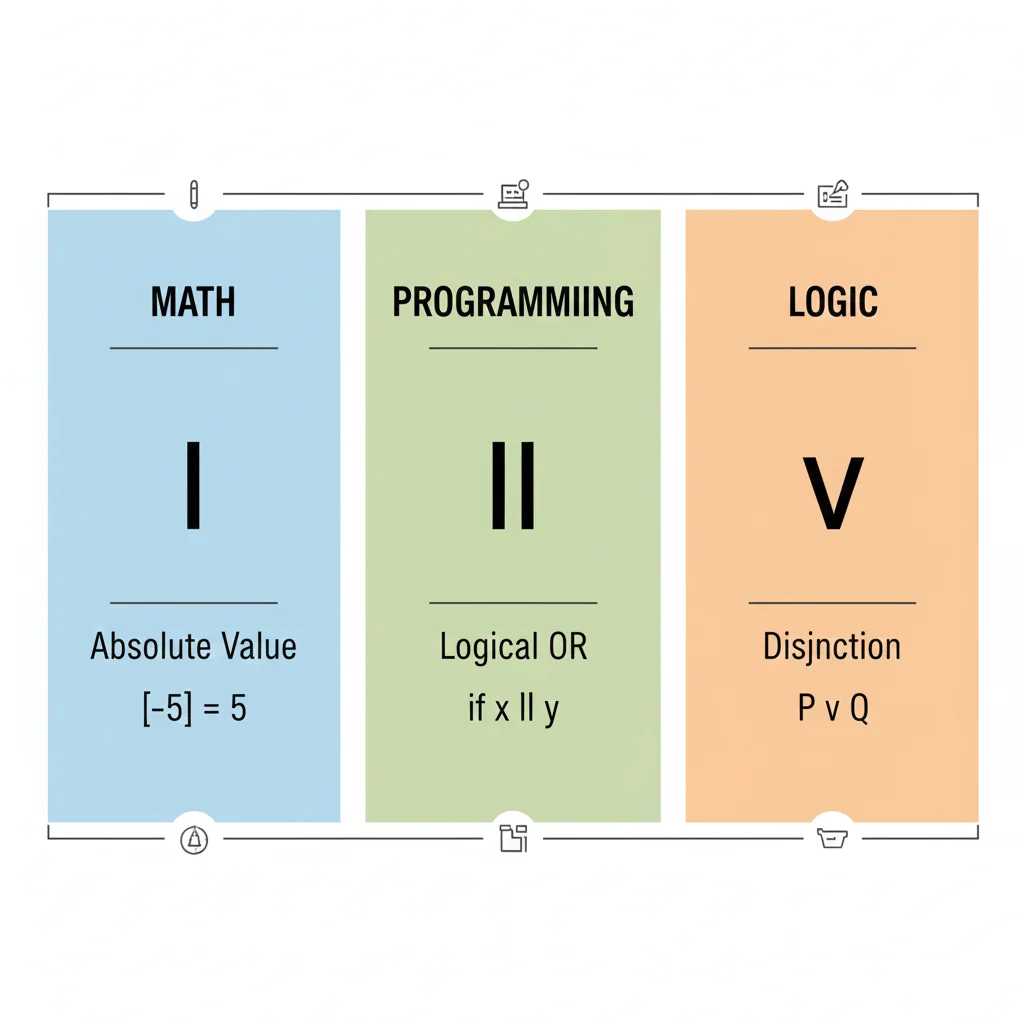
- The difference between |, ||, and ∨
- Examples of how to use them correctly
- Common mistakes and simple memory tricks
By the end, you’ll be able to tell exactly which “or” symbol to use — and why.
🧐 What Does Each “Or” Symbol Mean?
Let’s break down the main symbols people use for “or.”
| Symbol | Name | Used In | Meaning |
|---|---|---|---|
| ** | ** | Single vertical bar | Math / Logic |
| ** | ** | Double vertical bar | |
| ∨ | Logical disjunction symbol | Formal logic / Philosophy | Represents “or” between two propositions |
Now let’s explain them one by one in simple English.
1. The Single Bar ( | )
- Used in math and logic.
- It means either one or both things can be true.
- Sometimes it also shows absolute value in math (like |−3| = 3).
Examples:
- P | Q → Either P is true, or Q is true, or both.
- In set notation: A | B means “A or B.”
- |x| means “the distance of x from zero” — absolute value.
👉 Quick Tip: Think of | as “either-or” in logical or math expressions.
2. The Double Bar ( || )
- Used in computer programming (languages like C, Java, Python, JavaScript).
- It means a logical OR operation between two conditions.
- If either condition is true, the result is true.
Examples:
- In programming:
if (x > 5 || y < 10): print("Condition met")➤ Means: “If x is greater than 5 OR y is less than 10, do this.” True || False→ returns True
👉 Quick Tip: Think of || as the computer’s way of saying “or.”
3. The Logical “Or” Symbol ( ∨ )
- Used in formal logic, math proofs, and philosophy.
- It means logical disjunction — one or both statements are true.
- Common in symbolic logic and truth tables.
Examples:
- P ∨ Q = “P or Q”
- (Rain ∨ Snow) → “It’s raining or snowing.”
Truth Table Example:
| P | Q | P ∨ Q |
|---|---|---|
| T | T | T |
| T | F | T |
| F | T | T |
| F | F | F |
👉 Quick Tip: If at least one thing is true, ∨ is true.
⚖️ The Key Difference Between |, ||, and ∨
Here’s a simple comparison table to make it crystal clear:
| Symbol | Meaning | Field | Example | Spoken As |
|---|---|---|---|---|
| ** | ** | “Or” (mathematical or bitwise) | Math / Logic | P |
| ** | ** | Logical OR | Programming | |
| ∨ | Logical disjunction | Logic / Philosophy | P ∨ Q | “P or Q” |
🧠 Memory Hack:
- | → One bar → Math or Logic.
- || → Two bars → Computer code.
- ∨ → Triangle shape → Formal logic symbol.
🚫 Common Mistakes and How to Avoid Them
Mistake 1:
Using | instead of || in programming.
❌
if (x > 5 | y < 10)
✅if (x > 5 || y < 10)
Why: The single bar performs a bitwise operation, not logical comparison.
Mistake 2:
Confusing ∨ with “v” or “check mark.”
❌ P v Q (as letters)
✅ P ∨ Q (as logic symbol)
Mistake 3:
Assuming “or” always means only one thing is true.
In logic, “or” (inclusive OR) means one or both can be true.
For exclusive OR, we use ⊕.
✏️ When to Use Each Symbol
✅ When to Use “|”
Use it for:
- Math expressions
- Bitwise OR in programming
- Set notation
Examples:
- |x| = 5
- A | B → “A or B”
- 7 | 21 → “7 divides 21” (in divisibility notation)
✅ When to Use “||”
Use it in computer programming to connect two logical conditions.
Examples:
if (age > 18 || hasPermission)→ Passes if either is true.True || False→ Returns Truex > 10 || x == 0→ Checks if one condition works.
✅ When to Use “∨”
Use it in logic, philosophy, or symbolic reasoning.
Examples:
- P ∨ Q → Either P or Q (or both)
- (Hot ∨ Cold) → “It’s hot or cold.”
- ∨ appears in truth tables, logical proofs, and reasoning systems.
🔍 Quick Recap: The “Or” Symbol Explained Simply
- | = Used in math and bitwise logic
- || = Used in programming for logical OR
- ∨ = Used in formal logic and philosophy
🧩 Easy Memory Trick:
Think of the number of bars as layers of complexity:
- 1 bar → Math
- 2 bars → Coding
- Symbol (∨) → Logic
📘 Advanced Tips
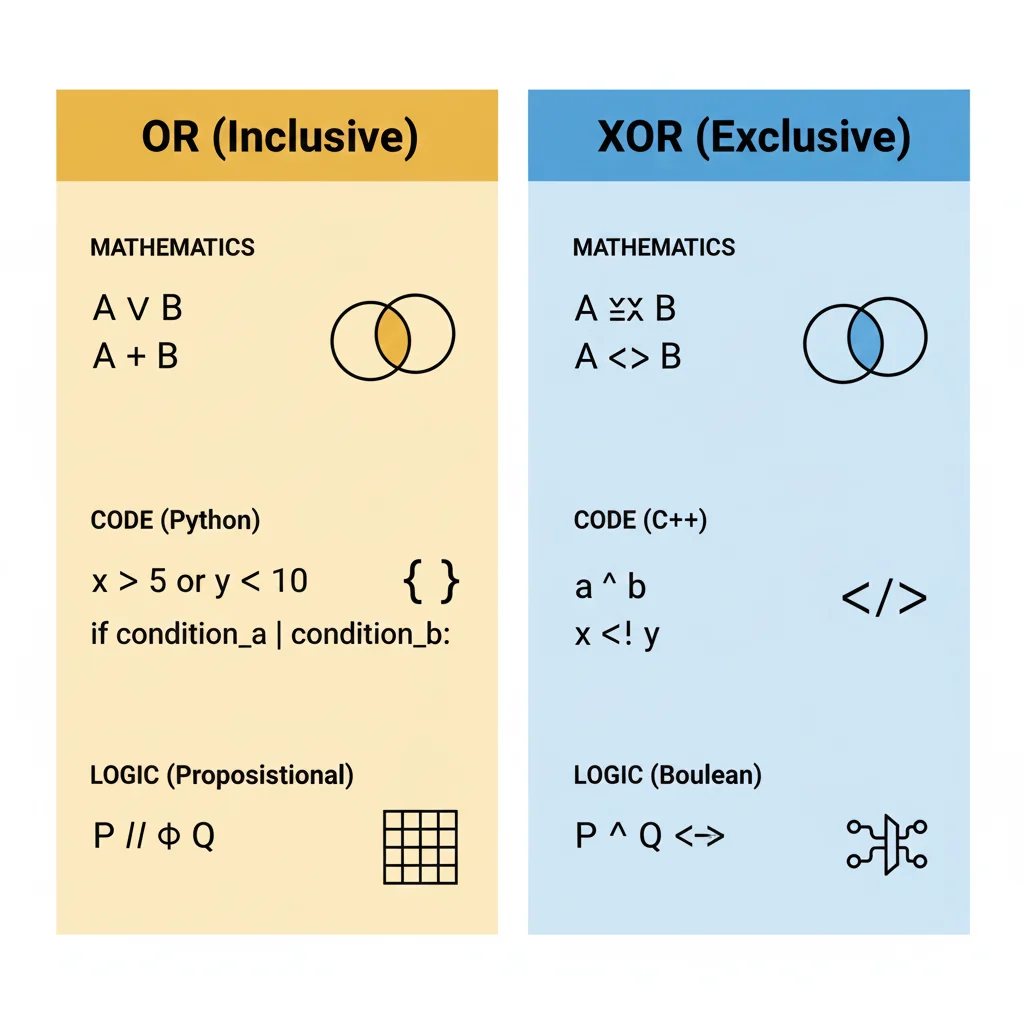
- In mathematical logic, “or” is inclusive (P ∨ Q is true if either or both are true).
- Exclusive OR (XOR) means only one is true, not both — written as ⊕.
- In everyday English, “or” can be ambiguous. For example:
- “You can have tea or coffee” (exclusive)
- “You can bring your phone or tablet” (inclusive).
👉 Context helps you understand which type of “or” is meant.
🧩 Mini Quiz — Test Yourself!
Fill in the blanks with the correct “or” symbol:
- P ___ Q (Logic)
- if (a ___ b) then run code (Programming)
- |x| = 7 (Math absolute value)
- (Rain ___ Snow) means either can happen.
- if (x == 5 ___ y == 10) → “Either is true.”
(Answers: 1. ∨, 2. ||, 3. |, 4. ∨, 5. ||)
❓ FAQs
1. What is the meaning of the “or” symbol?
The “or” symbol means that one or both conditions can be true. It’s used in math (|), programming (||), and logic (∨).
2. What’s the difference between | and ||?
“|” is used for bitwise operations or math, while “||” is used for logical conditions in programming.
3. What does ∨ mean in logic?
“∨” means logical disjunction — it shows that either statement is true or both are true.
4. Is “or” always inclusive?
In logic, yes. But in everyday English, “or” can be inclusive or exclusive, depending on context.
5. How can I remember which symbol to use?
Use 1 bar for math, 2 bars for code, and ∨ for logic — easy!
🧾 Conclusion
The “or” symbol may look simple, but its meaning changes depending on where it’s used.
- In math, it’s written as |.
- In programming, it’s ||.
- In logic, it’s ∨.
Now that you know how each symbol works, you can confidently use the correct one — for real!
Keep learning little grammar and logic details every day — they make big differences in understanding English and reasoning.

Isla Merrin is a language and writing expert at Definevs.com, creating simple, engaging guides to help readers master words, grammar, and modern English usage.