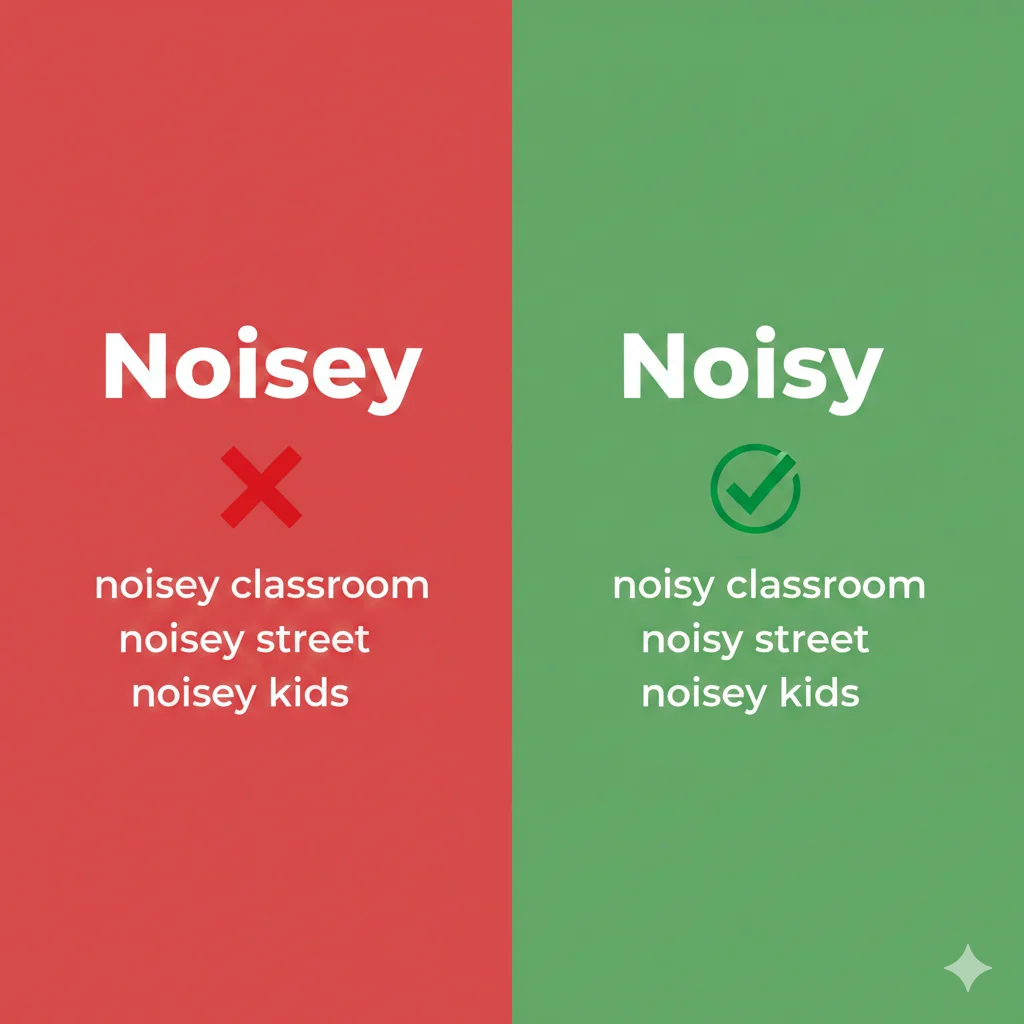
The correct spelling is “noisy.”
“Noisey” is always wrong and is only seen as a misspelling.
Use noisy when describing something that makes a lot of noise, like a loud room, a busy street, or a barking dog.
Many people get confused between “noisey” or “noisy.” These two spellings look almost the same, and because the word ends with the letter “s,” some think it should follow the “add-ey” pattern seen in a few English words. But in this case, only one spelling is correct. And using the wrong one can make your writing look unprofessional—especially in school assignments, essays, or online posts.
In this simple and friendly guide, you’ll learn the correct meaning, the right spelling, easy examples, common mistakes, and memory tricks to help you never mix them up again. Everything is explained in clear, plain English so even a fourth-grade student can understand it. By the end, you’ll know exactly when and how to use the correct spelling with confidence.
Let’s start!
✨ What Does Each Word Mean?

1. Noisy (Correct Spelling)
Part of Speech: Adjective
Meaning: Something that makes a lot of noise or loud sounds.
Simple Examples:
- The noisy children were running around the playground.
- Our street gets very noisy at night.
- The classroom became noisy when the bell rang.
Mini-Story
Imagine you are trying to study, but your siblings are laughing, singing, and jumping. Your room suddenly becomes noisy. This is the correct word to describe loud sounds.
2. Noisey (Incorrect Spelling)
Part of Speech: ❌ Not a real English word
Meaning: None — it is a misspelling of “noisy.”
Examples:
(All incorrect)
✘ The noisey dog barked all night.
✘ My fan is very noisey.
✘ This room is too noisey.
Remember:
⭐ “Noisey” is always wrong. You should never use it.
🔍 The Key Difference Between Noisey and Noisy
| Feature | Noisy (✔ Correct) | Noisey (✘ Incorrect) |
|---|---|---|
| Meaning | Loud; full of noise | No meaning |
| Part of Speech | Adjective | Not a real word |
| Usage | Everyday English | Never used |
| Example | “The bus is noisy.” | “The bus is noisey.” (wrong) |
💡 Quick Tip to Remember
When a word ends with -se, like “noise,” you drop the “e” and add “y.”
Noise → Noisy
NOT: Noise → Noisey

🚫 Common Mistakes and How to Avoid Them
❌ Mistake 1: Thinking English words ending in “e” keep the “e”
Incorrect: Noisey kids kept shouting.
Correct: Noisy kids kept shouting.
Why it happens:
Learners think it follows the pattern of words like “money → moneyed” or “grey → greyish.”
How to fix it:
Remember the simple rule:
👉 Drop the “e” before adding “y.”
❌ Mistake 2: Spell-check doesn’t catch it
Incorrect: My keyboard is noisey today.
Correct: *My keyboard is noisy today.
Why it happens:
Phones sometimes “guess” spellings, but that doesn’t make them correct.
Fix:
Always trust the rule, not random autocorrect.
❌ Mistake 3: People see “noisey” online and assume it’s correct
Incorrect: This café is too noisey.
Correct: *This café is too noisy.
Fix:
Only rely on standard dictionaries (Oxford, Cambridge, Merriam-Webster).
🎯 When to Use “Noisy” (Correct Word)
Use noisy whenever you want to describe something loud, disturbing, or full of sound.
✔ Here are simple examples:
- The classroom was noisy during lunch break.
- My neighbor has a noisy motorcycle.
- The party next door is very noisy tonight.
- Our fan becomes noisy when it’s dirty.
- The birds outside are noisy in the morning.
Real-Life Uses
– Describing sounds at home
– Talking about a busy street
– Writing school essays
– Telling a friend about a loud place
⭐ Memory Hack
Think of the word “noise.”
Remove the “e” → add “y.”
Noise → Noisy
Simple!
❌ When to Use “Noisey”
You should never use “noisey.”
It is always incorrect, no matter the sentence or context.
Visual Trick
Write this once and remember:
NOISEY = ❌
NOISY = ✔
📌 Quick Recap: Noisey vs Noisy
- Noisy = correct spelling
- Noisey = wrong spelling
- Noisy describes loud sounds
- Drop the “e” in “noise” before adding “y”
- Never use “noisey” in formal or informal writing
📘 Advanced Tips (For Curious Readers)
⭐ Word Origin
“Noisy” comes from the Old French word noise, meaning “quarrel” or “bustle.” Over time, it evolved to mean loud sounds.
⭐ Use in Formal Writing
In essays, reports, and exams, use “noisy” to describe:
– environments
– crowds
– machines
– animals
– classrooms
Example:
“The machine became noisy due to friction.”
⭐ Online Writing Tip
People often type fast and accidentally write “noisey,” but this lowers writing quality on social media, blogs, and emails.
🧠 Mini Quiz: Test Yourself!
Fill in the blanks with noisy or noisey:
- The bus was very ______ today.
- My dog becomes ______ when he wants food.
- This restaurant is too ______ for studying.
- I couldn’t sleep because of the ______ neighbors.
- The word “______” is not correct.
- The playground was full of ______ kids.
- Please avoid using the spelling “______.”
✔ Quiz Answers
- noisy
- noisy
- noisy
- noisy
- noisey
- noisy
- noisey
❓ 5 Helpful FAQs
1. Which is correct: noisey or noisy?
Noisy is the only correct spelling. “Noisey” is always wrong.
2. Is noisey a real English word?
No. It has no meaning and is not found in any dictionary.
3. Why is “noisy” spelled without an “e”?
Because the spelling rule says: “Drop the ‘e’ before adding ‘y.’”
Noise → Noisy.
4. Can I use “noisey” in informal writing?
No. Even in casual writing or texting, it is still incorrect.
5. How do I remember the correct spelling?
Think: Noise – the “e” falls off – add “y.”
Noise → Noisy.
🏁 Conclusion
Choosing between “noisey or noisy” is actually very simple—because only one spelling is correct. The word noisy is the proper way to describe loud sounds or environments, while “noisey” is just a common mistake. By understanding the basic spelling rule (drop the “e” before adding “y”), you can avoid this error forever. Whether you’re writing a school assignment, an email, or a social media post, using the correct word will make your English clearer and more polished. Keep practicing, keep learning, and your writing will get stronger every day.

Isla Merrin is a language and writing expert at Definevs.com, creating simple, engaging guides to help readers master words, grammar, and modern English usage.