Have you ever typed “nevermind” and then wondered if it should be “never mind” instead? You’re not alone!
These two look almost the same, sound the same, and are often used in similar situations — which is why so many people get confused.
In this simple guide, you’ll learn:
✅ What “never mind” and “nevermind” actually mean
✅ The difference between the two
✅ When and how to use each one correctly
✅ Common mistakes to avoid
✅ Real-life examples and easy memory tips
By the end, you’ll never mix them up again — for real!
📝 What Does Each Word Mean?
Let’s start by understanding what each form means and how it’s used.
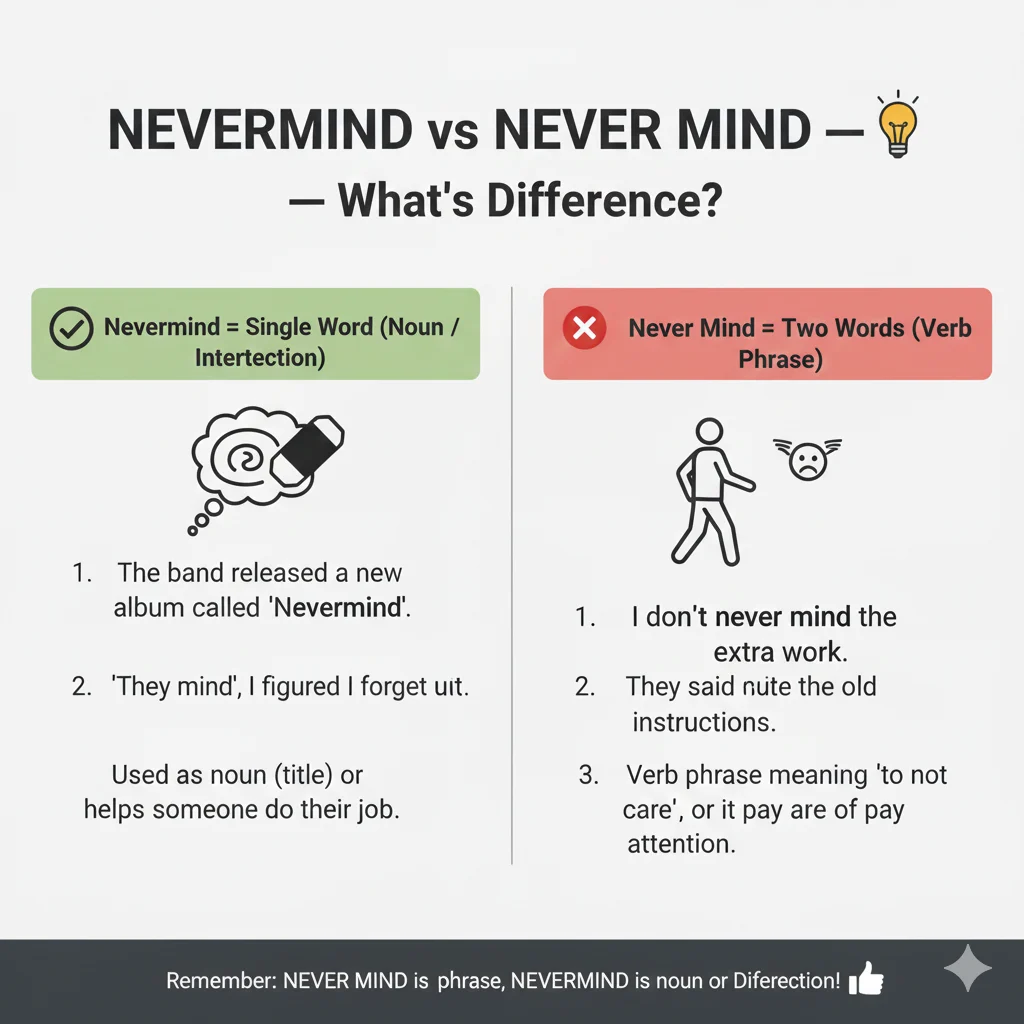
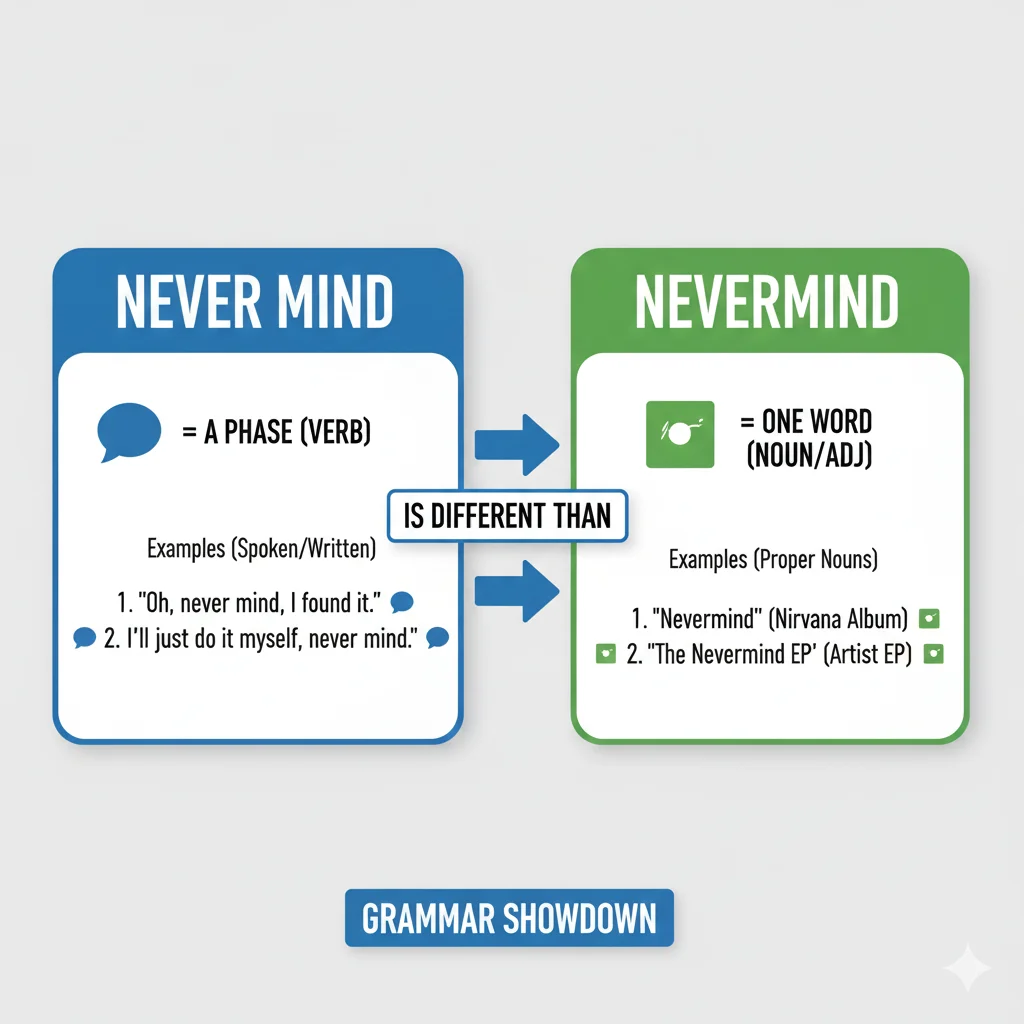
1. Never Mind (Two Words)
Part of Speech: Phrase (verb + noun)
Meaning: Used to tell someone to ignore something or to say it’s not important anymore.
Think of it as saying: “Forget it” or “It’s okay, don’t worry.”
✅ Examples:
- Never mind, I’ll do it myself.
- Oh, never mind what I said earlier.
- Never mind the mess, just come in.
💡 Quick explanation:
“Never mind” is a polite way to cancel or dismiss something — like when you change your mind mid-conversation.
2. Nevermind (One Word)
Part of Speech: Noun (informal or artistic use)
Meaning: It’s a noun that means something not worth attention or no importance.
It’s also famously used as the title of the 1991 Nirvana album “Nevermind.”
✅ Examples:
- He treats criticism as a nevermind.
- Nevermind became a famous music album by Nirvana.
- That’s just a nevermind — don’t bother about it.
💡 Quick explanation:
“Nevermind” is not used in everyday conversation to replace “never mind.” It’s mostly seen in titles, art, or rare formal writing.
🔍 The Key Difference Between Nevermind and Never Mind
Here’s a quick and easy way to remember their difference:
| Feature | Never Mind | Nevermind |
|---|---|---|
| Type | Phrase (verb + noun) | Noun |
| Meaning | “Ignore it” / “Don’t worry about it” | “Something unimportant” / Title use |
| Common Usage | Everyday conversation, texting | Music title, creative writing |
| Example Sentence | “Never mind, I’ll call later.” | “He dismissed it as a nevermind.” |
| Formality | Informal and polite | Rare, formal, or artistic |
| Popularity | Widely used in modern English | Rare outside of specific contexts |
💡 Quick Tip to Remember:
If you’re talking to someone — use “never mind.”
If you’re naming something or writing poetry — you might use “nevermind.”
❌ Common Mistakes and How to Avoid Them
Mistake 1:
❌ Nevermind, I found it.
✅ Never mind, I found it.
👉 Why: You’re telling someone to ignore something — that needs “never mind.”
Mistake 2:
❌ Oh, nevermind about the food.
✅ Oh, never mind about the food.
👉 Why: It’s an instruction or polite cancellation — again, “never mind.”
Mistake 3:
❌ I love Nirvana’s Never Mind album.
✅ I love Nirvana’s Nevermind album.
👉 Why: The album title is spelled one word — “Nevermind.”
💡 Memory Trick:
If you can say “forget it,” use never mind.
If you’re talking about the Nirvana album, use nevermind.
📚 When to Use “Never Mind”
You should use “never mind” in daily conversation when:
- You want to say ignore it
- You want to change the topic
- You don’t want someone to worry
- You correct yourself mid-sentence
✅ Examples:
- Never mind, I’ll handle it later.
- Never mind, I thought you were someone else.
- Never mind, it’s not that important.
- Never mind about the rain — let’s still go out.
- Never mind, I already ordered food.
👀 In real life:
If you ask someone for help and then fix the problem yourself, saying “never mind” politely ends the conversation.
🎨 When to Use “Nevermind”
Use “nevermind” only when:
- You’re referring to the Nirvana album
- You’re writing something creative or artistic
- You’re using it as a noun meaning “something trivial”
✅ Examples:
- Nirvana’s “Nevermind” is one of the best albums of all time.
- He brushed off her apology as a nevermind.
- That’s just a nevermind — don’t waste your time.
💡 Memory Hack:
If it’s part of a title, it’s probably one word.
Otherwise, always write “never mind.”
🧾 Quick Recap: Nevermind vs Never Mind
- “Never mind” = “Ignore it” or “Don’t worry.” (✅ Correct for everyday use)
- “Nevermind” = A noun or title, rarely used in modern writing.
- Tip: 99% of the time, “never mind” is the correct choice.
- Only use “nevermind” when referring to something named “Nevermind.”
🧩 Advanced Tips and Grammar Notes
- Origin:
“Never mind” first appeared in English in the 1700s, meaning don’t concern yourself.
“Nevermind” came later, mostly used by poets and artists for stylistic reasons. - Formal writing:
Always use “never mind” in emails, essays, or reports.
Example: Never mind the delay; we’ll fix it tomorrow. - In texting or social media:
People often type “nevermind” by mistake — it’s become a common typo.
But if you want to sound grammatically correct, always type “never mind.”
🧠 Mini Quiz: Test Yourself!
Fill in the blanks with the correct form — never mind or nevermind.
- ______, I’ll take care of it later.
- Did you listen to Nirvana’s album ______?
- Oh, ______ what I said earlier.
- She treated his mistake as a simple ______.
- ______, it’s not that serious.
Answers: 1. Never mind, 2. Nevermind, 3. Never mind, 4. Nevermind, 5. Never mind.
Flammable Materials / Alcohol: The Hidden Danger You Missed 🔥
❓FAQs About “Nevermind” vs “Never Mind”
1. What is the main difference between nevermind and never mind?
“Never mind” means “ignore it” and is used in conversation. “Nevermind” is a noun or title, rarely used in daily speech.
2. Which one is correct in grammar — nevermind or never mind?
“Never mind” (two words) is correct in almost all cases.
3. Why do people confuse nevermind and never mind?
Because they sound the same and look similar, people often think they’re interchangeable — but they’re not.
4. Can I use nevermind in texting?
You can, but it’s technically incorrect. Use never mind to stay grammatically right.
5. Is “Nevermind” only used for Nirvana’s album?
Mostly, yes. Outside of that, it’s rare in standard English.
✨ Conclusion
Now you know the difference between “never mind” and “nevermind.”
Remember:
- Use “never mind” when you want to say “forget it” or “it’s okay.”
- Use “nevermind” only for titles or artistic expressions.
Practice using them in real sentences, and soon you’ll never second-guess yourself again!
Keep learning small grammar details like this — every word you master makes your English stronger.

Kael Donovan is a language enthusiast and writer at Definevs.com, simplifying complex words and grammar rules into fun, easy-to-understand guides for readers.