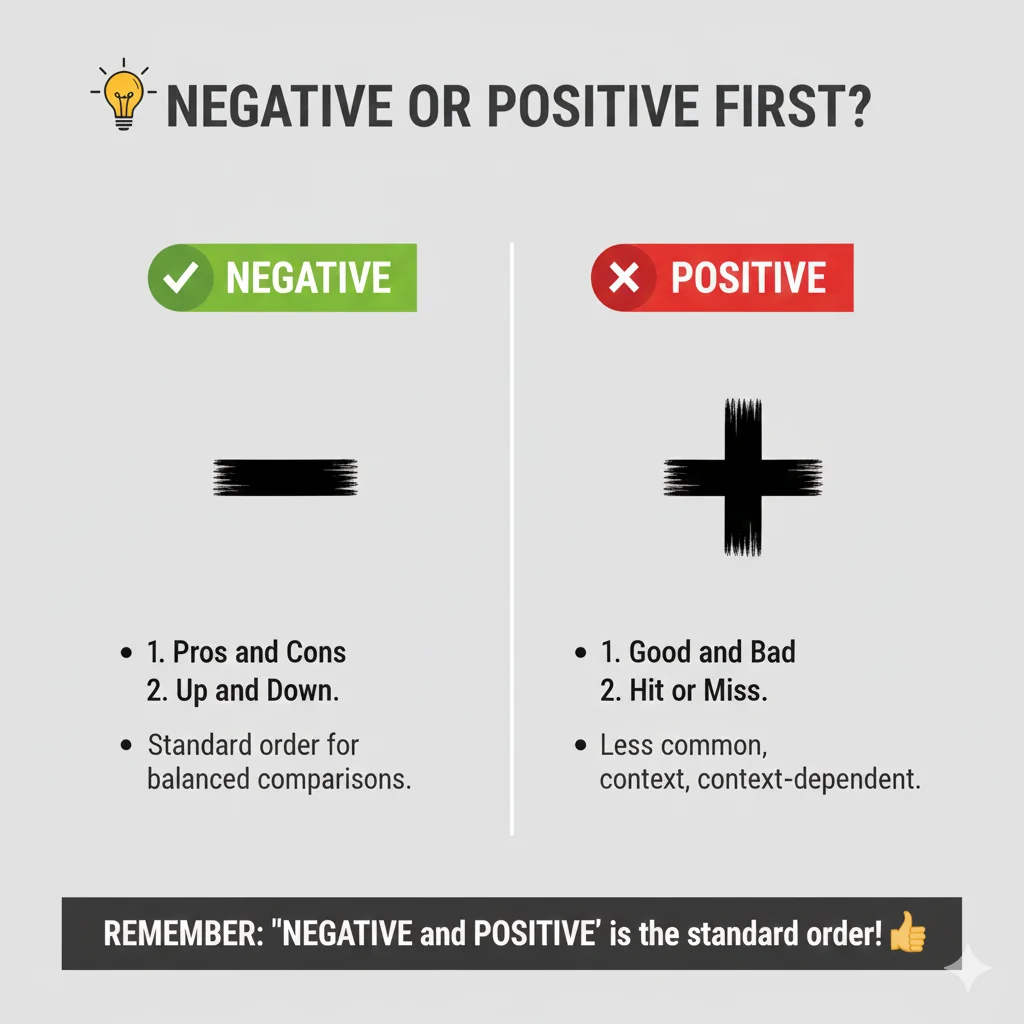
Have you ever heard someone ask, “Should I say the negative or positive first?” and wondered what that means? You’re not alone!
This question often comes up when writing, giving feedback, or doing math or science problems. People get confused about whether to start with the negative or the positive part — especially in sentences, reviews, or equations.
In this simple guide, you’ll learn:
- The meaning of “negative first” and “positive first”
- The difference between the two
- When to use each one correctly
- Examples from grammar, feedback, and science
- Easy tips to remember which comes first
💡 What Does “Negative or Positive First” Mean?
The phrase “negative or positive first” can have different meanings depending on context.
It usually refers to the order in which negative and positive ideas, words, or values appear in speech, writing, or mathematics.
Let’s break it down into two main meanings 👇
1️⃣ In Grammar and Communication
- “Negative first” means starting with criticism or bad news before saying something nice.
- “Positive first” means starting with praise or good news before giving criticism.
Example (Negative First):
“Your essay has too many spelling errors, but your ideas are creative.”
Example (Positive First):
“Your ideas are creative, but there are some spelling errors.”
2️⃣ In Math or Science
- “Negative first” means writing or calculating the negative value before the positive.
- “Positive first” means starting with the positive side or number.
Example:
In a number line or voltage reading, you may list –5 before +5 depending on what you’re measuring.
📘 The Key Difference Between “Negative First” and “Positive First”
Here’s a simple comparison table to help you see the difference between negative and positive first in both grammar and logic:
| Feature | Negative First | Positive First |
|---|---|---|
| Meaning | Starting with something bad, critical, or less favorable | Starting with something good, kind, or favorable |
| Used In | Feedback, reviews, discussions, equations | Feedback, motivation, compliments |
| Example (Grammar) | “You’re late again, but your work is improving.” | “Your work is improving, but you were late again.” |
| Tone | Can sound harsh or direct | Sounds polite and encouraging |
| Memory Trick | Think of “minus before plus” | Think of “smile before frown” |
🧠 Quick Tip:
If you want to encourage someone, start positive first.
If you want to show contrast or emphasize a problem, start negative first.
🚫 Common Mistakes and How to Avoid Them
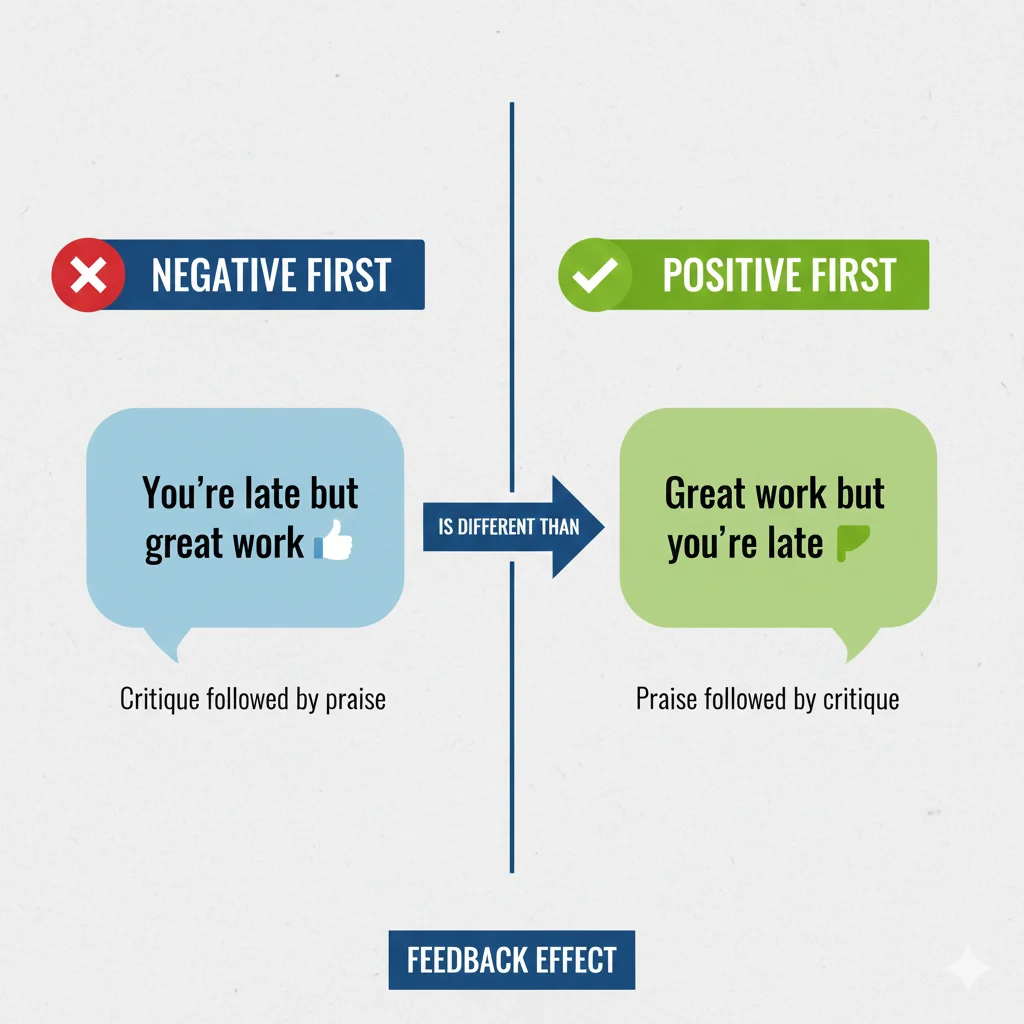
Many people mix up which tone to use first — especially when giving feedback.
Here are a few common mistakes and how to fix them 👇
| ❌ Wrong | ✅ Correct | Why |
|---|---|---|
| “That drawing isn’t neat, but you tried.” | “You tried really hard, but your drawing could be neater.” | Starting with praise keeps motivation high. |
| “The experiment failed, but the idea was good.” | “The idea was good, though the experiment didn’t work.” | Ending negative lowers mood — flip it! |
| “Your answer is wrong, but nice effort.” | “Nice effort, but your answer is incorrect.” | Positive-first sounds kinder and more constructive. |
Tip: If you want to correct someone without hurting their feelings, use the “Positive–Negative Sandwich” — start positive, mention the negative, then end with encouragement.
✨ When to Use “Negative First”
Use negative first when you need to highlight a problem, contrast, or warning.
This approach is more logical or analytical than emotional.
✅ Examples of “Negative First”:
- “It’s not easy, but it’s possible.”
- “You didn’t pass this time, but you improved a lot.”
- “That wasn’t your best work, but I see effort.”
- “The weather isn’t great, but the view is amazing.”
- “No, I can’t go today, but maybe tomorrow.”
🧠 Memory Hack:
Think of ‘no’ before ‘yes’ — sometimes we use “negative first” to prepare someone for contrast or bad news gently.
🌞 When to Use “Positive First”
Use positive first when you want to be kind, encouraging, or polite — especially in teaching, parenting, or professional feedback.
This method focuses on what went well before discussing improvements.
✅ Examples of “Positive First”:
- “You did a great job, but there’s still room for growth.”
- “That’s a good start, though you could explain more.”
- “I liked your confidence, but your tone could be softer.”
- “The plan sounds great, but the budget might be tight.”
- “Good news first — your grades improved! Now, let’s work on attendance.”
💡 Visual Trick:
Imagine a smiley face before a sad face 🙂🙁 — that’s positive first. It helps balance communication.
🔁 Quick Recap: Negative vs Positive First
Here’s a short summary to make it stick:
- Negative First:
- Starts with criticism, warning, or challenge.
- Good for contrast or analysis.
- Use in serious or logical discussions.
- Positive First:
- Starts with praise, encouragement, or optimism.
- Builds motivation and trust.
- Best for teaching, teamwork, and feedback.
🧠 Simple Rule:
➡️ If your goal is kindness → Positive first.
➡️ If your goal is clarity or contrast → Negative first.
📚 Advanced Tips
✏️ 1. Origin and Psychology
The idea of “positive-first” feedback comes from psychology and education, where starting with good news improves motivation.
The “negative-first” structure is common in logic, mathematics, and scientific writing, where order of signs matters.
💼 2. In Formal Writing or Exams
In essays or debates, the “negative-first” order is used to show contrast:
“Although it wasn’t perfect, the attempt was impressive.”
In motivational writing, “positive-first” sounds warmer:
“The results were great, but more research is needed.”
📱 3. In Daily Talk and Texting
People naturally choose positive-first when chatting with friends:
“That’s funny, but kinda weird.”
It makes speech sound friendly and relaxed.
🧩 Mini Quiz: Test Yourself!
Fill in the blanks with negative or positive first 👇
- When giving compliments, it’s better to start with ____________.
- In math problems, we often write the ____________ number before the positive one.
- To sound kind in feedback, use ____________ first.
- “The cake wasn’t perfect, but tasty” — this is an example of ____________ first.
- “Great idea, but too long” — this is ____________ first.
Answers:
- Positive | 2. Negative | 3. Positive | 4. Negative | 5. Positive
Joined / Joined or Die: The Hidden Meaning Everyone Misses 🔍
❓ FAQs
1. What does “negative or positive first” mean?
It means deciding whether to mention the negative or positive part of a sentence, feedback, or situation first.
2. Which is better — negative first or positive first?
It depends on your goal. Use positive first to sound kind, and negative first to emphasize contrast or logic.
3. How can I remember the difference easily?
Think: “Smile before frown = Positive first.”
4. Do I use negative first in writing essays?
Yes, if you’re showing contrast or analyzing a topic. Otherwise, use positive-first for encouragement or appreciation.
5. Why do people get confused about this?
Because both forms are grammatically correct — it’s more about tone and impact than grammar rules.
🎯 Conclusion
Now you know the real difference between negative first and positive first!
Starting with the right tone can completely change how your message feels — in writing, speech, or even math.
So next time you give feedback or write a message, ask yourself:
👉 “Do I want to sound kind or clear?”
Your answer will tell you which one to choose — negative or positive first!
Keep practicing, and soon this choice will come naturally.

Arwen Blythe is a passionate language and culture enthusiast, crafting clear, engaging guides on words, phrases, and modern English for Definevs.com readers.