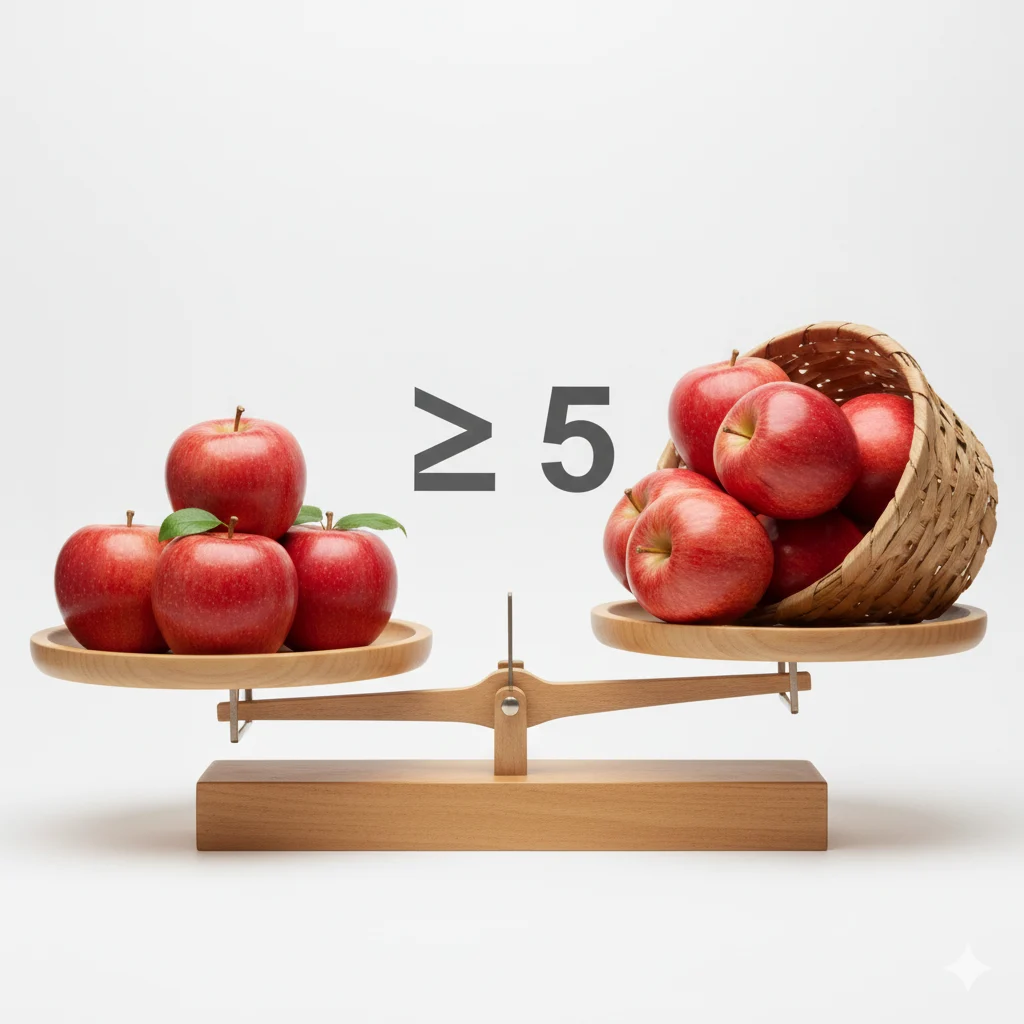
Have you ever seen the symbol ≥ and wondered what it really means? 🤔
Many students get confused between “greater than (>)” and “more than or equal to (≥)” — they look similar but have slightly different meanings in math.
This simple guide explains:
- What the “more than or equal to” sign means
- How it’s different from “greater than”
- When and how to use it in math, real-life problems, and comparisons
- Easy examples, memory tricks, and a mini quiz at the end!
Whether you’re a beginner, a parent helping with homework, or a learner brushing up on basics, this guide makes the concept super simple to understand.
🧩 What Does the “More Than or Equal To” Sign Mean?
The “more than or equal to” sign (≥) is a mathematical comparison symbol.
It shows that a number is either greater than or exactly equal to another number.
🔹 Meaning:
If A ≥ B, it means A is greater than B OR A is equal to B.
🧮 Simple Examples:
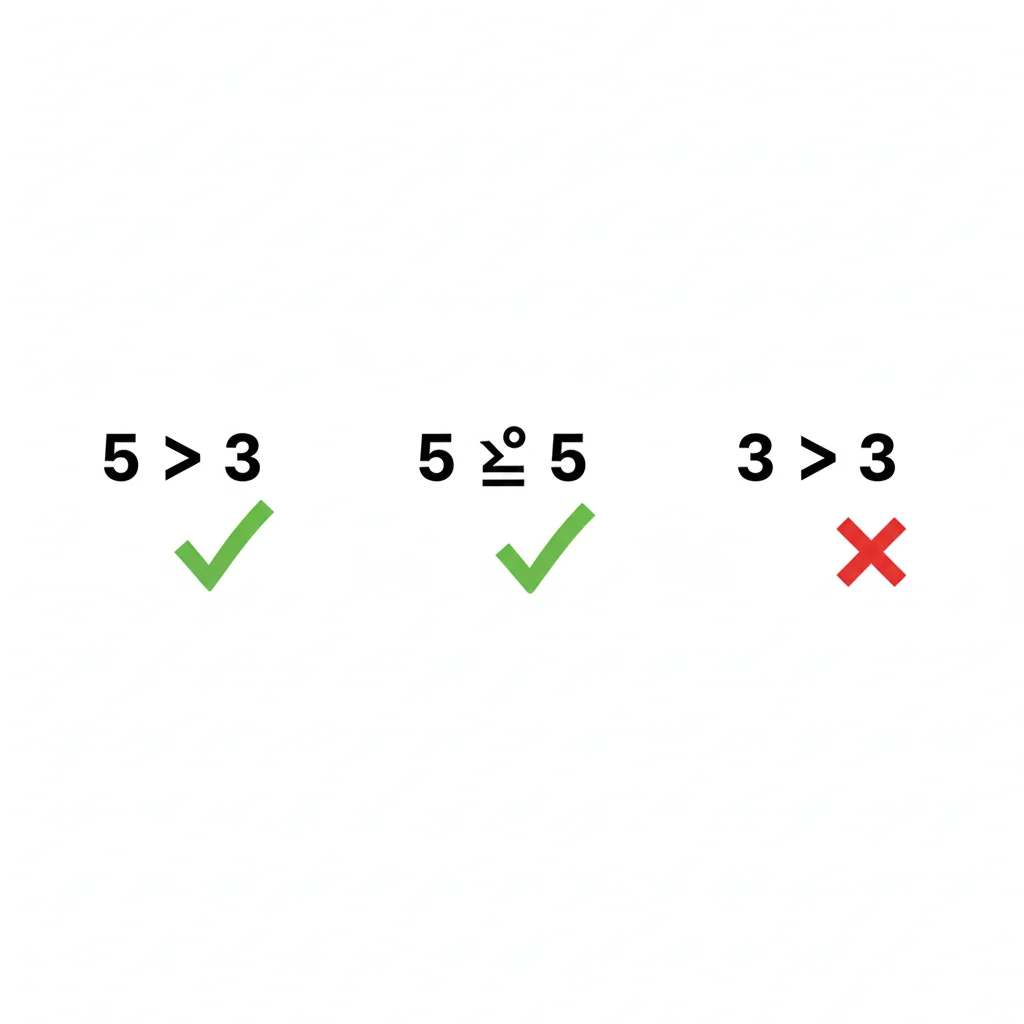
- 8 ≥ 5 → 8 is more than 5 ✅
- 6 ≥ 6 → 6 is equal to 6 ✅
- 4 ≥ 7 → 4 is NOT more than or equal to 7 ❌
So, the “more than or equal to” sign combines two meanings in one — “greater than” and “equal to.”
📖 What Does the “Greater Than” Sign Mean?
The greater than sign (>) only shows that one number is larger than another — not equal.
🔹 Meaning:
If A > B, it means A is strictly greater than B — no equality included.
🧮 Examples:
- 10 > 3 → True ✅
- 5 > 5 → False ❌ (because they’re equal, not greater)
- 9 > 4 → True ✅
Quick tip:
The “greater than” sign never allows equality — it’s only about being bigger.
🔢 The Key Difference Between “Greater Than” and “More Than or Equal To”
| Concept | Symbol | Meaning | Example | True or False |
|---|---|---|---|---|
| Greater Than | > | Left number is bigger than right | 6 > 3 | ✅ True |
| More Than or Equal To | ≥ | Left number is bigger or equal | 6 ≥ 6 | ✅ True |
| Equal To | = | Both are the same | 5 = 5 | ✅ True |
💡 Quick Memory Tip:
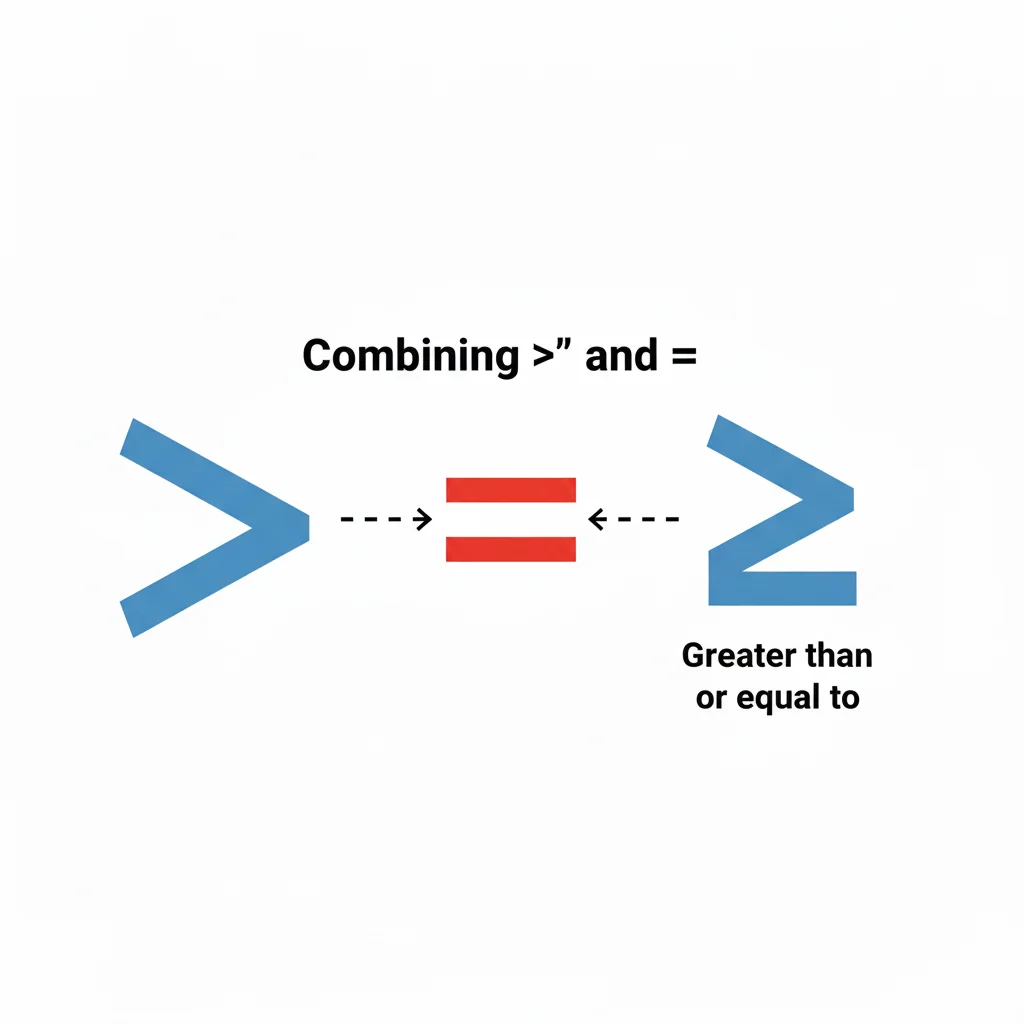
The extra line under ≥ represents “equal to.”
So whenever you see ≥, think:
“It’s greater… but also equal if needed.”
📸 Visual Suggestion:
Add a simple chart showing how the “≥” sign combines both “>” and “=.”
❌ Common Mistakes and How to Avoid Them
Let’s look at some common mix-ups students make:
| Incorrect Example | Why It’s Wrong | Correct Form |
|---|---|---|
| 4 > 4 | False — 4 is not greater than itself | 4 ≥ 4 |
| 3 ≥ 5 | False — 3 is smaller | 3 ≤ 5 |
| 7 = 7 ≥ 5 | Misused equality | 7 ≥ 5 |
How to avoid mistakes:
- Remember: ≥ includes equality, > does not.
- When comparing same numbers, always use ≥.
- Read it aloud — “7 is more than or equal to 5.” If that makes sense, you’re using it right!
✋ When to Use the “Greater Than” Sign (>)
Use the greater than sign (>) when you want to show that one value is larger than another — without equality.
✅ Examples:
- Ali has 8 apples, Sara has 6.
→ 8 > 6 - Temperature is 30°C today, 25°C yesterday.
→ 30 > 25 - Your score (92) > class average (80).
→ You scored higher.
📘 Memory Hack:
The “>” sign opens toward the bigger number.
Think of it as a hungry alligator’s mouth that always eats the larger number! 🐊
🤝 When to Use the “More Than or Equal To” Sign (≥)
Use ≥ when the first number can be bigger or the same.
✅ Examples:
- You must be 18 years old or older to vote.
→ Age ≥ 18 - A student passes if they score 40 or more.
→ Marks ≥ 40 - The machine works when pressure ≥ 10 psi.
→ Works at 10 or above. - Temperature must stay ≥ 0°C to avoid freezing.
→ 0°C counts too.
📘 Memory Hack:
Think: “≥” means good enough or above — just like meeting a minimum requirement.
🧠 Quick Recap: Greater Than vs More Than or Equal To
- > (Greater than): Only when one number is larger.
- ≥ (More than or equal to): When one number is larger OR the same.
- Equal sign (=) means exactly the same.
Easy to remember:
“≥” = “>” + “=” → More than OR equal.
💡 Advanced Tips & Fun Facts
- The ≥ symbol was first introduced in the 17th century by mathematician Thomas Harriot to simplify comparison statements.
- In coding and programming, you’ll often see it as
>=because the keyboard doesn’t have a built-in “≥” key. - In real-life writing, it often appears in math, science, and statistics — for example:
- “Speed must be ≥ 60 km/h.”
- “Temperature ≥ 37°C indicates fever.”
- On a calculator, you might find it under comparison or logic functions.
📝 Mini Quiz: Test Yourself!
Fill in the blanks with the correct symbol (> or ≥)
- 10 ___ 7
- 5 ___ 5
- 4 ___ 8
- Marks must be ___ 50 to pass.
- You need age ___ 18 to drive.
Answers:
- 2. ≥ 3. < 4. ≥ 5. ≥
Equal or Less Than Sign: The Hidden Rule Everyone Gets Wrong 😮
🧾 5 FAQs About the “More Than or Equal To” Sign
1. What does the “more than or equal to” sign mean?
It means one number is either greater than or exactly equal to another (≥).
2. What’s the difference between “>” and “≥”?
“>” means greater only; “≥” includes both greater and equal.
3. How can I type the “≥” symbol on a keyboard?
On Windows: press Alt + 242, or type >= in coding. On Mac: Option + >.
4. Is “≥” used outside math?
Yes! It’s used in science, programming, and logic to show minimum limits or thresholds.
5. What’s the opposite of “≥”?
The opposite is ≤ — the “less than or equal to” sign.
🏁 Conclusion
Now you know the difference between “greater than” (>) and “more than or equal to” (≥) — two tiny symbols that make a big difference in math and logic!
Whenever you see ≥, remember it means “bigger or the same.”
Practice comparing numbers every day, and soon these signs will feel as easy as reading words.
Keep learning, keep practicing, and you’ll master every math symbol — for real!

Mira Loxley is a passionate language and writing expert at Definevs.com, turning tricky words and grammar into clear, engaging guides for every reader.