Have you ever written “more then” instead of “more than” and wondered if it’s correct? 🤔
You’re not alone! Many English learners — even native speakers — confuse these two phrases because they sound similar but have different meanings.
This simple guide will help you understand:
- What “more than” and “more then” really mean
- The difference between them
- When and how to use each correctly
- Common mistakes (and how to fix them)
- Real-life examples, grammar tips, and a quick quiz
By the end, you’ll never mix them up again — for real!
💡 What Does Each Phrase Mean?
Let’s look at both phrases one by one in plain English.
🟢 “More Than” — Meaning and Examples
“More than” is a comparison phrase.
It means a larger amount, number, or degree than something else.
Part of speech: phrase combining “more” (adjective/adverb) + “than” (conjunction)
Examples:
- She has more than three pets. 🐶🐱
- I love pizza more than burgers. 🍕
- Today is more than just another day — it’s your birthday! 🎂
👉 Tip: “More than” always compares quantity, quality, or degree.
🔵 “More Then” — Meaning and Examples
The phrase “more then” is not usually correct together.
It only makes sense if “more” and “then” belong to different parts of the sentence.
“Then” means “at that time” or “next.” It talks about time or sequence.
Examples (when used correctly):
- He worked hard and then relaxed.
- First we studied, then we played games.
- If it rains, then we’ll stay inside.
✅ Correct: He wanted more, then he stopped asking.
❌ Incorrect: He wanted more then she did. (Should be “more than she did.”)
⚖️ The Key Difference Between “More Than” and “More Then”
| Feature | More Than | More Then |
|---|---|---|
| Meaning | Used for comparison — showing a greater amount, number, or degree | Refers to sequence or time (“after that”) |
| Part of Speech | “More” (adjective/adverb) + “than” (conjunction/preposition) | “More” (modifier) + “then” (adverb of time) |
| Example | She is more than happy to help. | We studied, then we watched TV. |
| Usage | Used in comparisons | Used to show order or time |
| Grammar Note | Always use with “than” when comparing | Use “then” when describing time |
💭 Quick Tip to Remember:
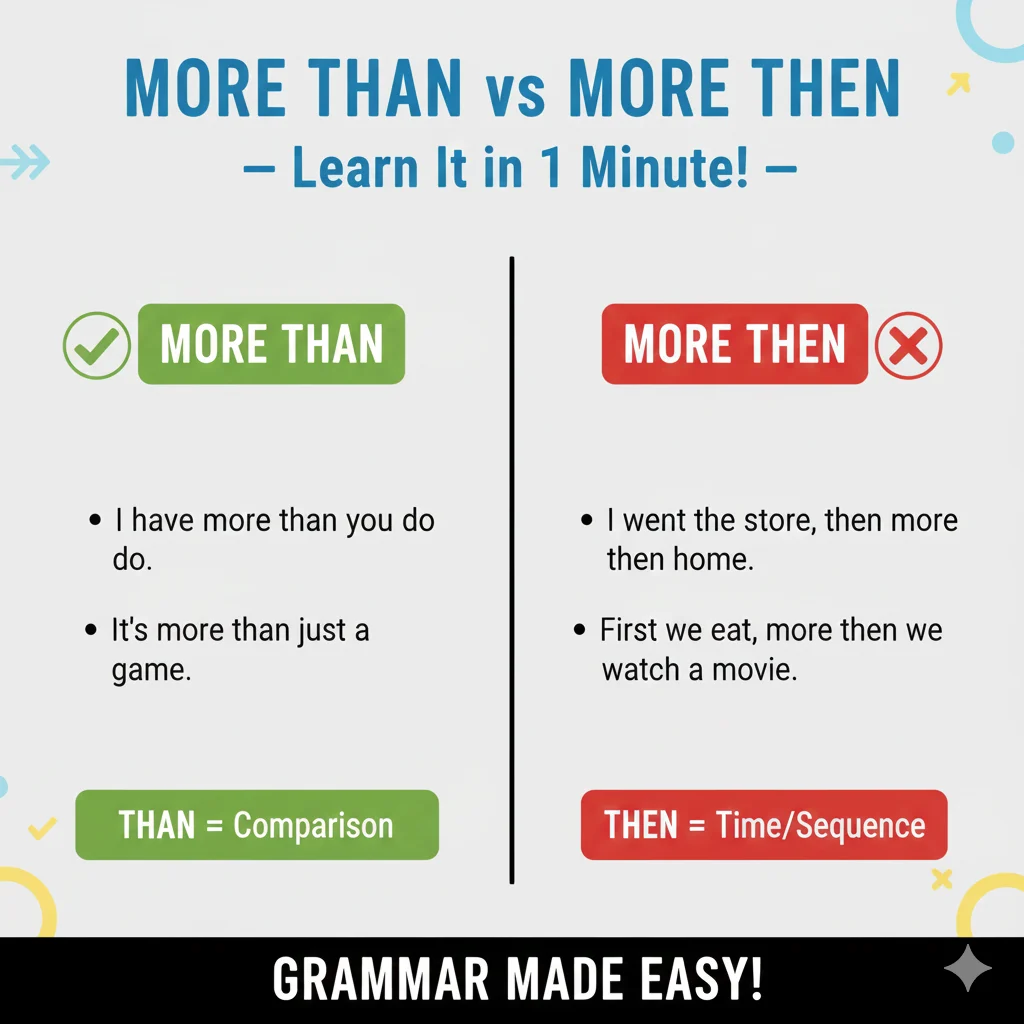
If you’re comparing → use “more than.”
If you’re talking about time → use “then.”
🚫 Common Mistakes and How to Avoid Them
Let’s fix the most frequent mix-ups!
❌ Mistake 1: Using “then” instead of “than”
- Incorrect: I have more friends then you.
- Correct: ✅ I have more friends than you.
👉 Remember: You’re comparing friends, so use “than.”
❌ Mistake 2: Using “more then” as one phrase
- Incorrect: He wanted more then anything.
- Correct: ✅ He wanted more than anything.
❌ Mistake 3: Confusing meaning in long sentences
- Incorrect: She’s more nice then kind.
- Correct: ✅ She’s more nice than kind.
How to avoid it:
When you’re showing comparison, think of “than.”
When you’re showing time, think of “then.”
Say the sentence out loud — does it sound like a comparison or an order in time?
🟩 When to Use “More Than”
Use “more than” when you are:
- Comparing numbers or amounts
- Comparing qualities
- Showing something is greater or higher
- Expressing strong emotion or emphasis
Examples:
- This book costs more than that one. 💰
- She studies more than her brother. 📚
- I like morning walks more than coffee. ☀️
- He’s more than a teacher — he’s a mentor. 👨🏫
- The trip was more than worth it! ✈️
Memory Hack:
🧠 If you can replace “more than” with “greater than” or “better than,” it’s correct!
🟦 When to Use “More Then”
Use “then” when you’re talking about:
- Sequence of events
- Time order (what happens next or at that moment)
Examples:
- We ate lunch, then went shopping. 🛍️
- Study hard now, then rest later.
- I’ll call you, then send the email.
- Back then, things were simpler.
- She smiled and then left the room.
Memory Trick:
🕓 “Then” = Time (both have a “t”).
So if your sentence is about time, use “then.”
🧾 Quick Recap: More Than vs More Then
- “More than” → used for comparison.
Example: She earns more than I do. - “Then” → used for time or order.
Example: We’ll eat dinner, then go for a walk. - Never write “more then” together unless the words are in separate clauses.
🔹 Summary Table
| Rule | Correct Phrase | Example |
|---|---|---|
| Comparison | more than | I have more than five books. |
| Time/Sequence | more … then | I’ll do more work, then rest. |
| Common Error | ❌ more then | He worked more then me. (wrong) |
| Fix | ✅ more than | He worked more than me. (right) |
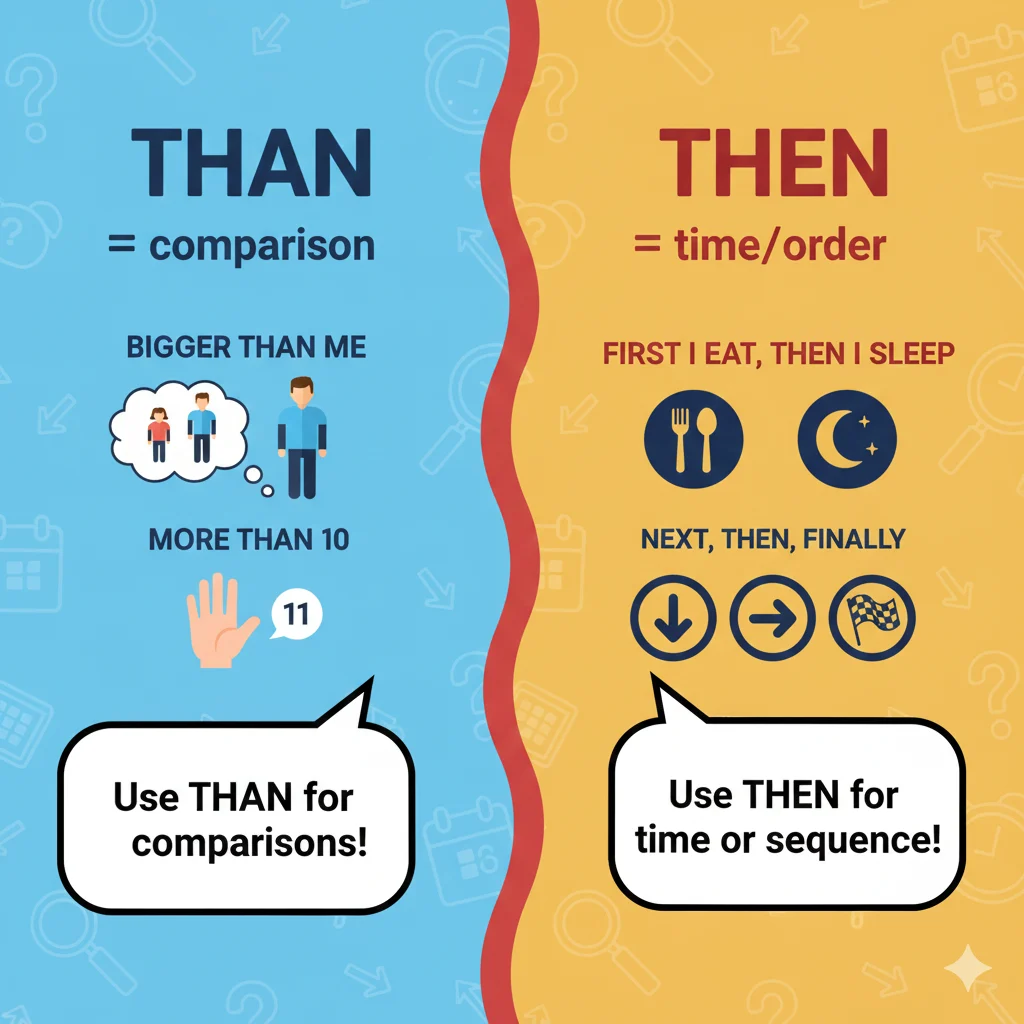
📸 Visual suggestion: Simple infographic showing “THAN = comparison” vs. “THEN = time/order.”
🧠 Advanced Tips: Grammar & History
- “Than” comes from Old English “þonne”, used for comparisons.
- “Then” comes from “þa”, meaning “at that time.”
So they’ve always had different roots and meanings — even though they sound similar.
In Formal Writing
Use “more than” in essays or reports when comparing statistics:
“The company earned more than $2 million in 2025.”
Avoid “then” in comparisons — it can change your meaning completely.
In Everyday Texting
People often type fast and write “more then” by mistake.
Autocorrect might not fix it — so double-check before hitting send! 📱
🧩 Mini Quiz: Test Your Understanding
Fill in the blanks with than or then.
- She’s taller ______ her brother.
- We finished dinner, ______ watched a movie.
- He scored higher ______ anyone in class.
- Back ______, we didn’t have smartphones.
- I’d rather walk ______ take the bus.
- First read the question, ______ answer it.
- This cake tastes better ______ the one yesterday.
(Answers: 1 than | 2 then | 3 than | 4 then | 5 than | 6 then | 7 than)
❓ FAQs About “More Than” vs “More Then”
1. What is the difference between “more than” and “more then”?
“More than” shows comparison. “Then” refers to time or sequence. They’re not interchangeable.
2. Is “more then” ever correct?
Only when the words appear separately, like “He wanted more, then he left.”
Otherwise, use “more than.”
3. Why do people confuse “then” and “than”?
Because they sound alike (homophones) and both appear after “more.” But their meanings are different — one is about comparison, the other about time.
4. How can I remember the difference easily?
Think: “Than compares — both have an ‘A.’”
“Then shows time — both have an ‘E.’”
5. Can I use “more than” in formal writing?
Yes! It’s grammatically correct in essays, emails, and professional writing. Just avoid the common typo “more then.”
🏁 Conclusion
Now you know the clear difference between “more than” and “more then.”
- Use “more than” for comparisons (greater, better, larger).
- Use “then” for time (next, after that).
Practice writing your own examples, and soon you’ll use both phrases correctly — with confidence and clarity!
✨ Remember: A little practice each day makes your English more fluent than yesterday!

Mira Loxley is a passionate language and writing expert at Definevs.com, turning tricky words and grammar into clear, engaging guides for every reader.