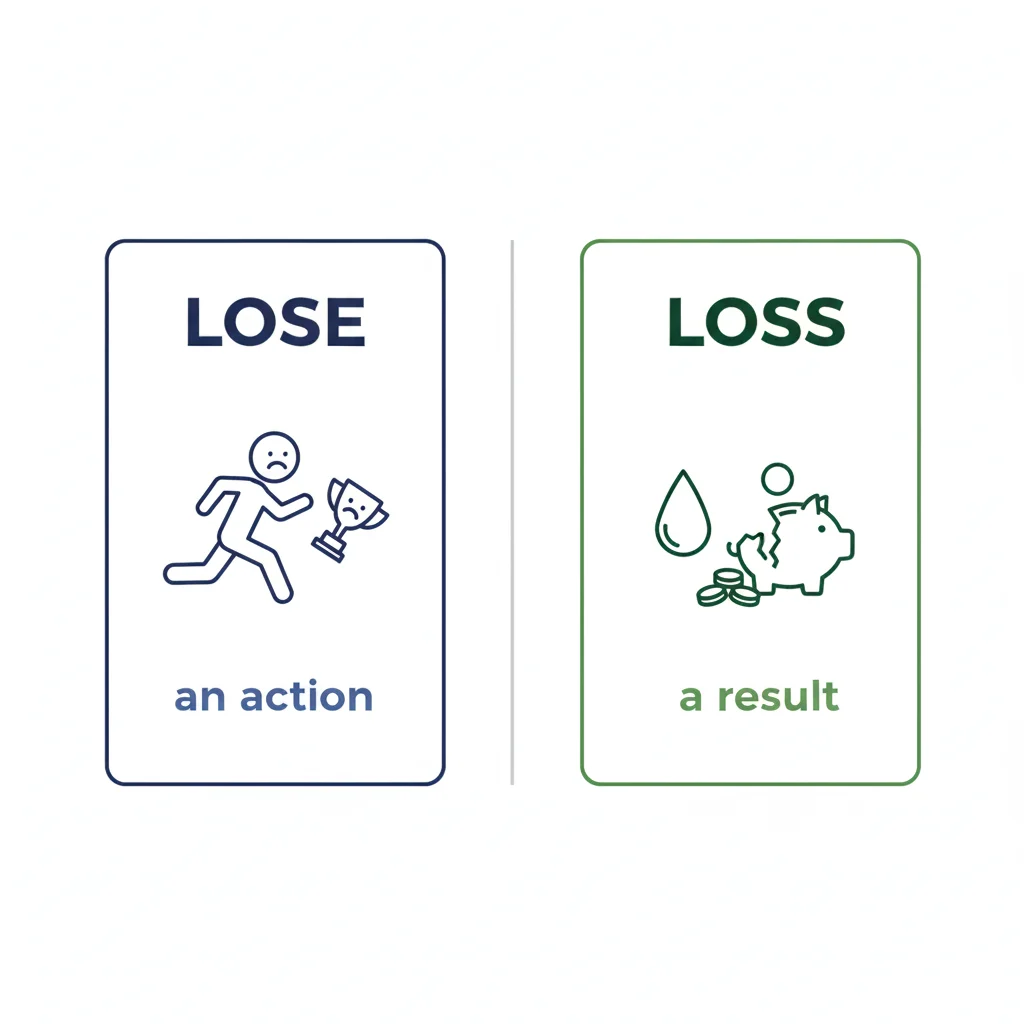
Lose = verb (action)
Loss = noun (thing or result)
Examples:
- I don’t want to lose this game.
- That game was a hard loss.
- She wants to lose weight.
- Her weight loss is impressive.
If you can add “to” before the word, use lose.
If you can add “a” or “the,” use loss.
English learners and native speakers both struggle with lose vs loss. You may see it in emails, social posts, school papers, or even news headlines. The confusion happens because both words come from the same root and deal with the same idea: not having something anymore.
People also ask:
- How to use lose and loss?
- Is it loss or lose a match?
- Lose vs loss weight — which is correct?
The problem is simple. One word shows an action. The other shows a result. When you mix them up, your sentence sounds wrong or unclear.
This article gives a quick answer, then a deep explanation, and finally real examples. You will learn spelling, grammar, pronunciation, and usage. By the end, you will never confuse lose vs loss again.
The Origin of Lose vs Loss
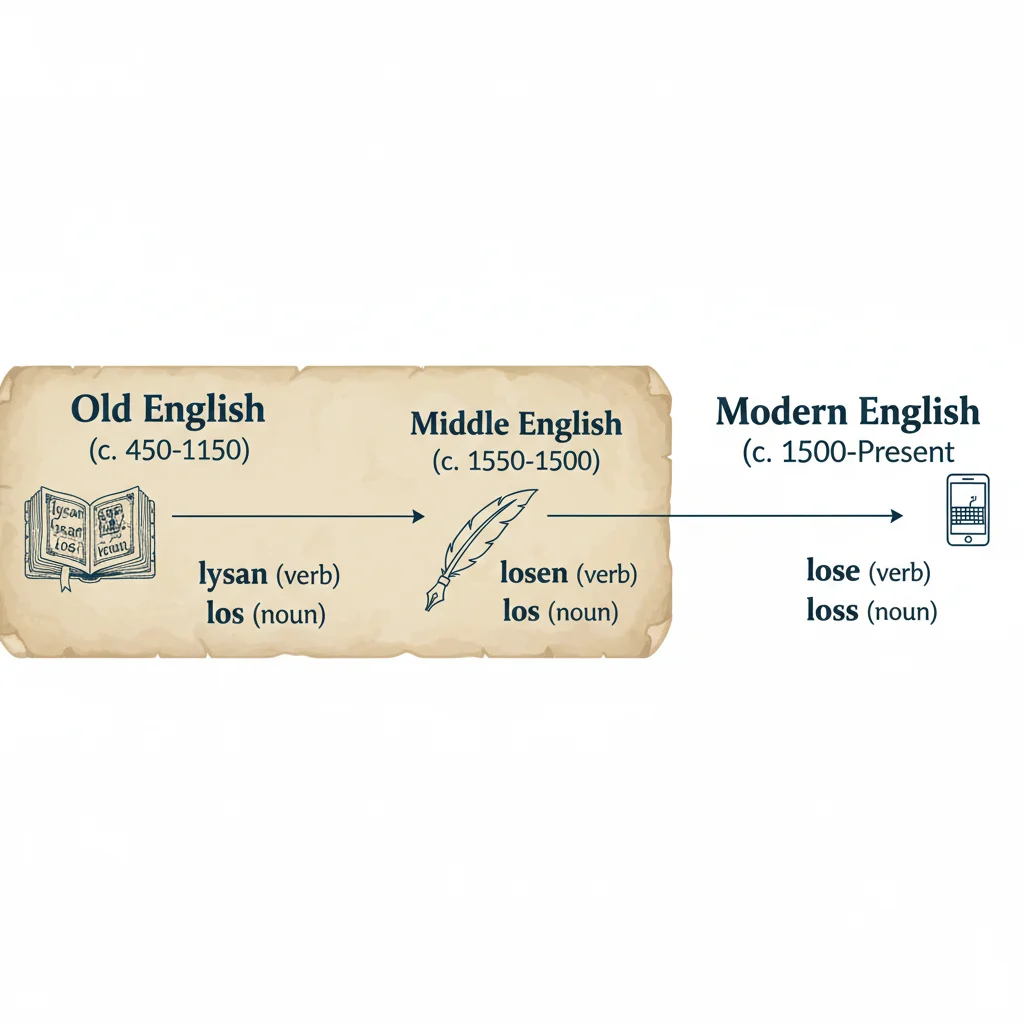
Both words come from Old English.
- Lose comes from losian, meaning “to perish or be destroyed.”
- Loss comes from los, meaning “destruction or ruin.”
Over time, English split actions and results into different forms. That is why spelling differences exist. Many English words follow this pattern:
- Choose → Choice
- Believe → Belief
- Lose → Loss
This history explains why people still confuse lose vs loss today.
British English vs American English Spelling
There is no spelling difference between British and American English for lose vs loss. Both follow the same rules.
Examples:
- US: The company will lose money.
- UK: The company will lose money.
Comparison Table
| Word | Part of Speech | US English | UK English |
|---|---|---|---|
| Lose | Verb | Lose | Lose |
| Loss | Noun | Loss | Loss |
So no matter where you live, the rule stays the same.
i.e. vs e.g.: This Simple Fix Instantly Improves Writing ✨
Which Spelling Should You Use?
Choose based on sentence role, not location.
- US audience: Follow grammar rules.
- UK/Commonwealth: Same rule applies.
- Global audience: Keep it simple. Verb = lose. Noun = loss.
If your readers are professionals or students, correct usage matters a lot.
Common Mistakes with Lose vs Loss
Here are frequent errors and fixes:
❌ I had a big lose yesterday.
✅ I had a big loss yesterday.
❌ He will loss the match.
✅ He will lose the match.
❌ She wants to loss weight.
✅ She wants to lose weight.
❌ The team faced many loses.
✅ The team faced many losses.
Lose vs Loss in Everyday Examples
Emails
- Please don’t lose the document.
- The loss of data caused delays.
News
- The market may lose value.
- The company reported a major loss.
Social Media
- You lose some, you win some.
- That was a tough loss.
Formal Writing
- Failure to comply may lose funding.
- Financial loss is expected.
Lose vs Loss – Google Trends & Usage Data
Search data shows lose vs loss is popular worldwide. It spikes during:
- Sports seasons
- Weight loss trends
- Exam results
- Obituaries and news reports
Popular by Country
- USA: weight loss, lose a game
- UK: job loss, financial loss
- India: lose vs loose confusion
- Global: grammar learning
People also search for lose vs loose, which adds to the confusion.
Lay vs Lie: The Wrong Word That Ruins Credibility 🚫
Lose vs Loss Comparison Table
| Feature | Lose | Loss |
|---|---|---|
| Type | Verb | Noun |
| Shows | Action | Result |
| Example | Lose a match | A match loss |
| Weight | Lose weight | Weight loss |
| Past form | Lost | Loss (noun) |
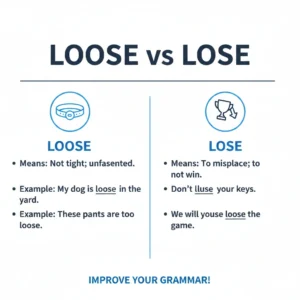
Lose vs Loose (Important Note)
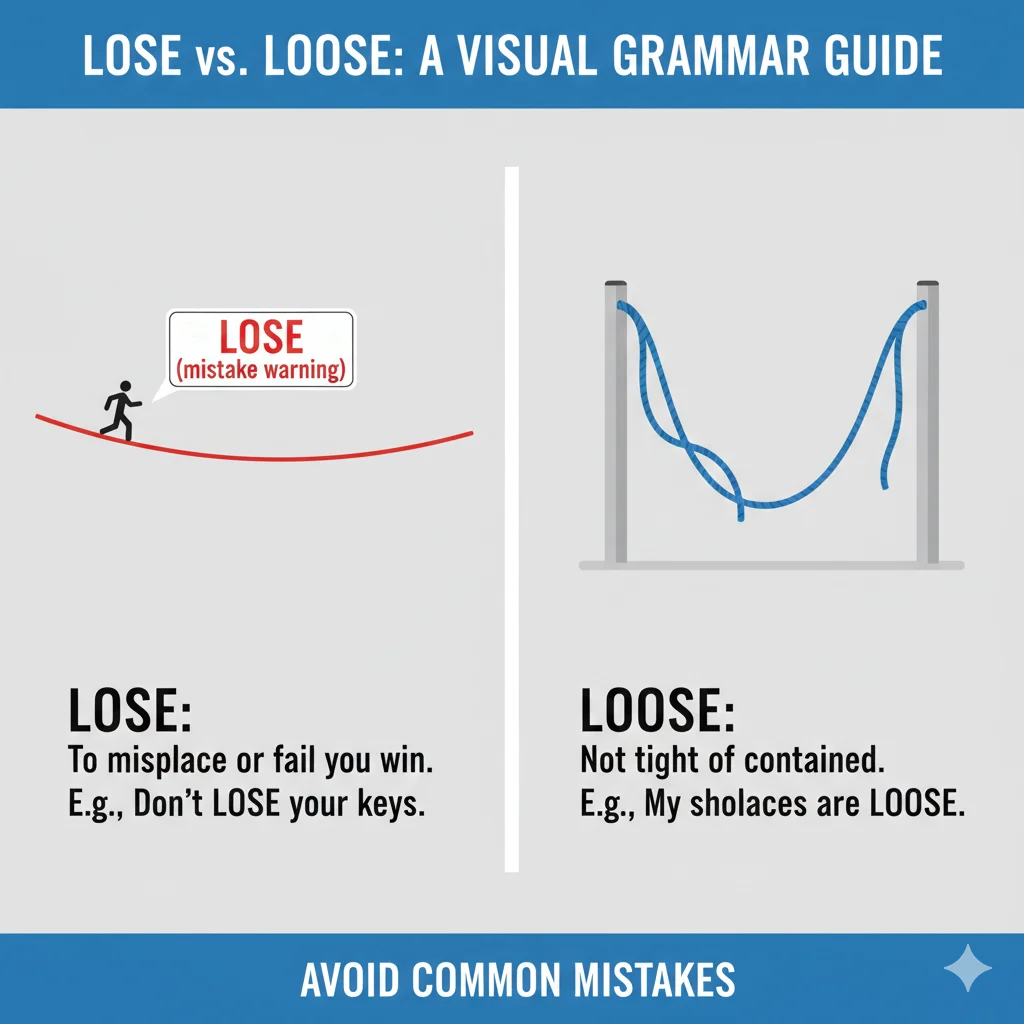
- Lose: to fail to keep
- Loose: not tight
Example:
- I don’t want to lose my phone.
- My shoes are loose.
This is one of the top “People also search for” topics.
Lose vs Loss Sentences
- I may lose my job.
- The job loss was sudden.
- Don’t lose hope.
- Hope loss hurts deeply.
Win or Lose or Loss
Correct phrases:
- Win or lose (verbs)
- A win or a loss (nouns)
Lost or Loss in Death
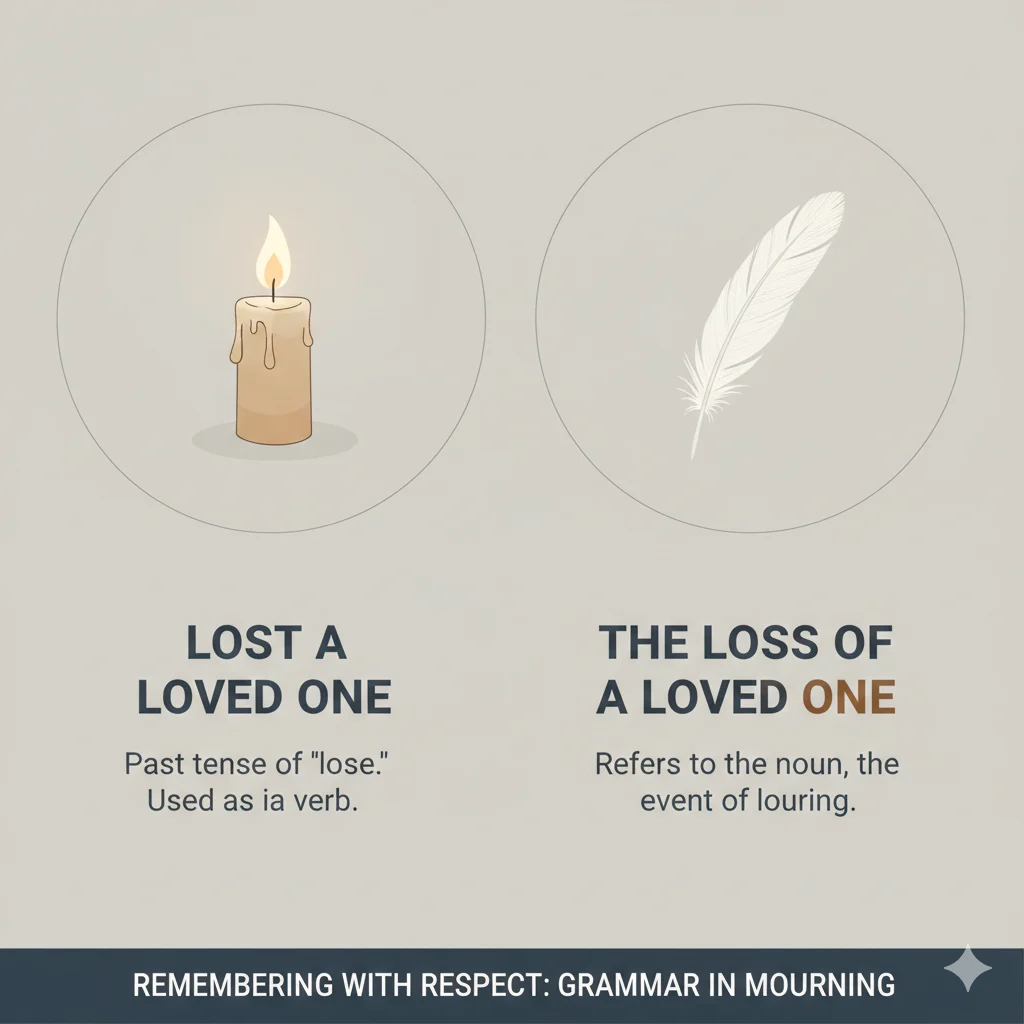
- Lost is a verb or adjective.
- Loss is a noun.
Examples:
- We lost a loved one.
- The loss of her father was painful.
Lose or Loss Someone
- You lose someone (verb).
- You feel the loss of someone (noun).
Lose vs Loss Weight
- Correct: lose weight
- Correct: weight loss
- Wrong: loss weight
Lose and Loss Pronunciation
- Lose: /looz/ (long “oo”)
- Loss: /los/ or /laws/
Sound difference helps memory.
FAQs: Lose vs Loss
1. How to use lose and loss?
Use lose for actions. Use loss for results.
2. Which is correct, lose or loses?
Both are correct. “Loses” is third person singular.
3. Which is correct, losses or loses?
Losses is plural noun. Loses is a verb form.
4. Is it loss or lose a match?
You lose a match. The result is a loss.
5. Is weight lose or weight loss correct?
Correct phrase is weight loss.
6. Why do people confuse lose vs loss?
They sound similar and share meaning.
7. Is lose vs loose the same issue?
Yes. Both cause spelling confusion.
Conclusion
The difference between lose vs loss is simple once you see it clearly. Lose is a verb. It shows an action. Loss is a noun. It shows a result. This rule works in every context: sports, weight, money, emotions, and formal writing.
If you remember one thing, remember this:
👉 You lose something.
👉 You feel a loss.
This article covered origin, spelling rules, mistakes, examples, pronunciation, and real-world use. It also answered common questions people ask online. With this knowledge, your writing will sound clear, confident, and professional.
Practice using both words daily. Soon, choosing between lose vs loss will feel natural.

Isla Merrin is a language and writing expert at Definevs.com, creating simple, engaging guides to help readers master words, grammar, and modern English usage.