Have you ever seen the symbol “≤” and wondered what it really means? Or confused “less than” (<) with “less than or equal to” (≤) while solving a math problem? You’re not alone!
Many students and even adults mix up these two because they look and sound almost the same. But they actually mean two different things — one shows something is smaller, while the other shows it is smaller or the same.
In this guide, you’ll learn:
✅ What “less than” and “less than or equal to” mean
✅ The difference between the two
✅ How to use them correctly in math and real life
✅ Common mistakes and how to avoid them
✅ Easy memory hacks and examples
🧮 What Does Each Term Mean?
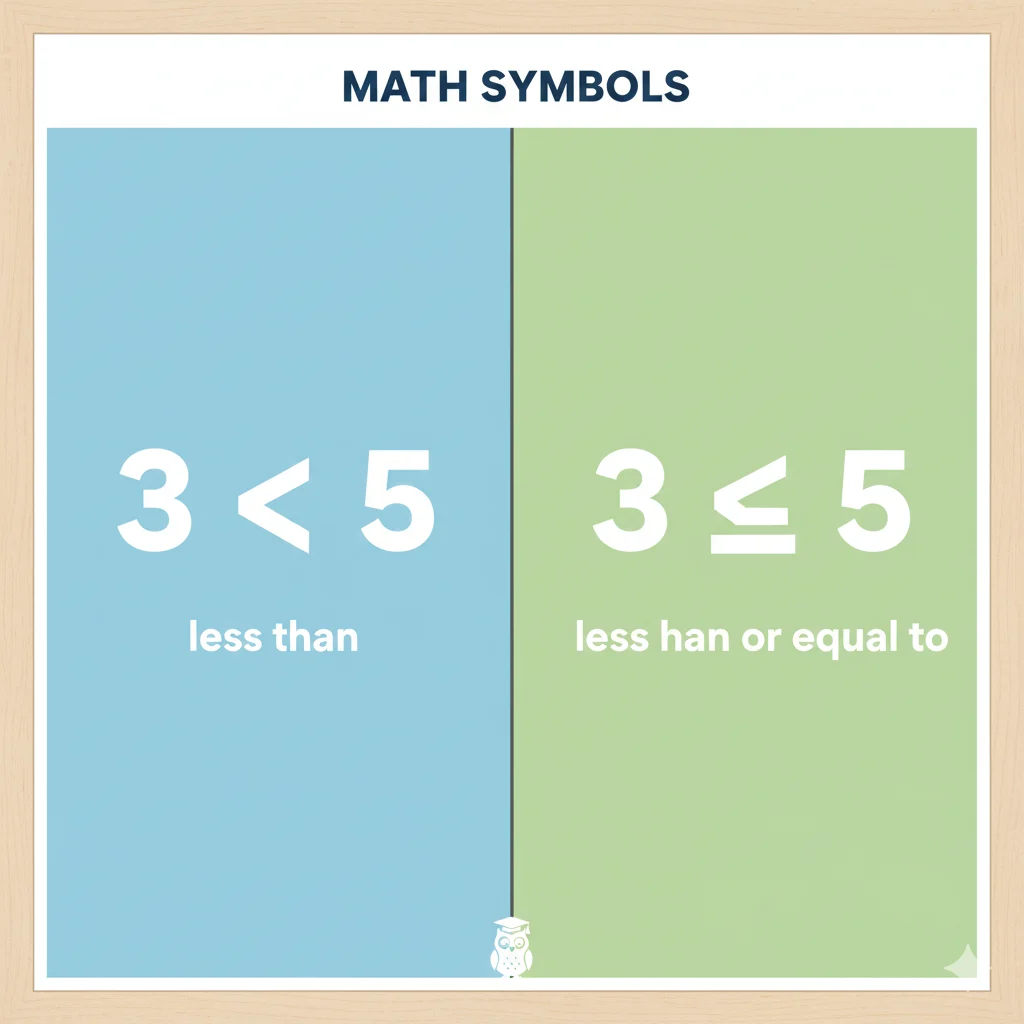
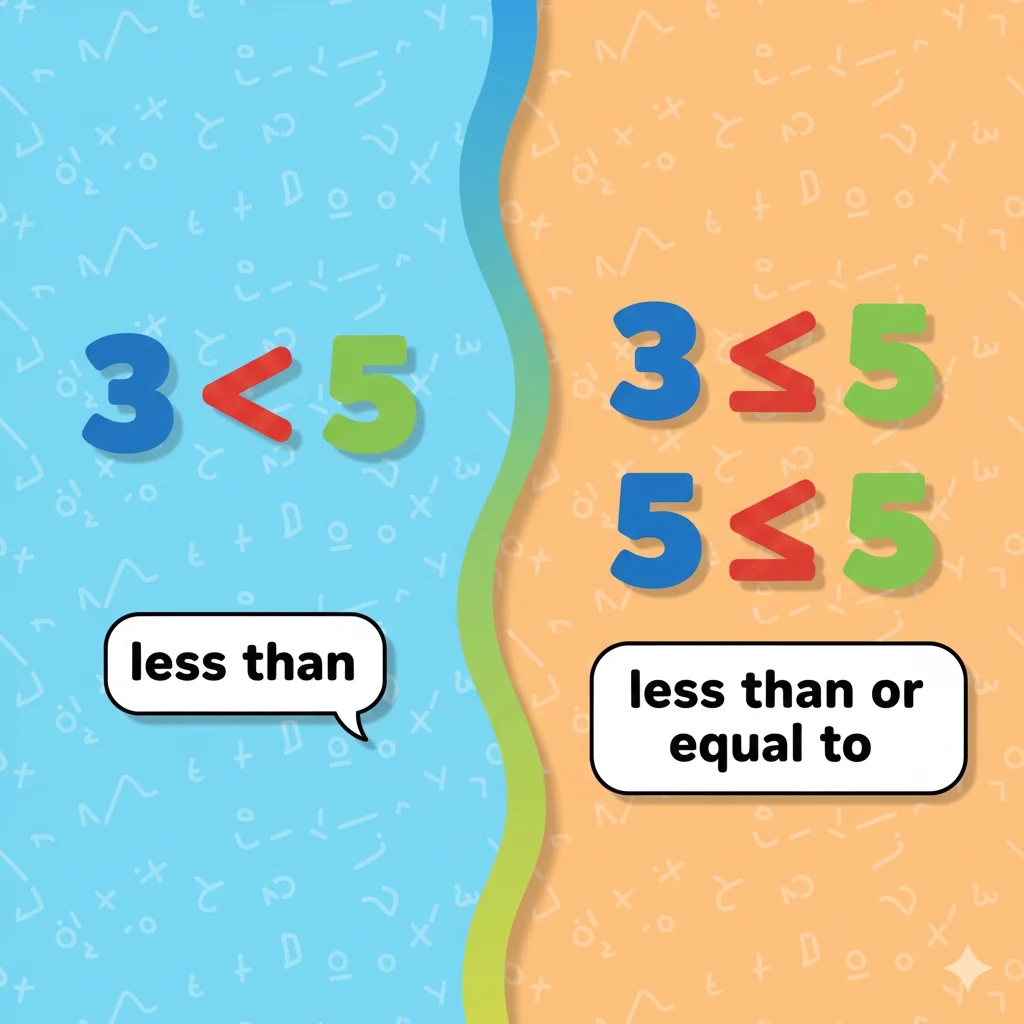
1. Less Than (<)
Meaning:
“Less than” means one number is smaller than another number.
It’s used to compare two values where the first number is not equal to the second.
Symbol: <
Examples:
- 3 < 5 (Three is less than five.)
- 8 < 10 (Eight is smaller than ten.)
- 2 < 4 (Two is less than four.)
👉 Tip: The “<” sign looks like an arrow pointing to the smaller number.
2. Less Than or Equal To (≤)
Meaning:
“Less than or equal to” means one number is either smaller than or exactly equal to another number.
It’s a combination of two ideas — less than and equal to.
Symbol: ≤
Examples:
- 3 ≤ 5 (Three is less than five, so it’s true.)
- 5 ≤ 5 (Five is equal to five, so it’s also true!)
- 7 ≤ 10 (Seven is less than ten, so it’s true.)
👉 Tip: The “≤” sign is like saying, “It’s okay if it’s smaller or the same.”
⚖️ The Key Difference Between “Less Than” and “Less Than or Equal To”
Here’s a simple table to help you remember the difference:
| Term | Symbol | Meaning | Example | True or False? |
|---|---|---|---|---|
| Less Than | < | First number is smaller only | 4 < 4 | ❌ False |
| Less Than or Equal To | ≤ | First number is smaller or equal | 4 ≤ 4 | ✅ True |
💡 Quick Tip:
If equality (the same number) is possible, use ≤.
If equality is not possible, use <.
🚫 Common Mistakes and How to Avoid Them
❌ Mistake 1: Using “<” instead of “≤” when numbers can be equal.
- Wrong: Students ≤ 18 means under 18.
- Right: Students ≤ 18 means 18 and younger.
❌ Mistake 2: Thinking both mean the same thing.
They don’t! “Less than” excludes equality; “less than or equal to” includes it.
✅ Fix: Remember — the line under the ≤ symbol stands for “equal.”
📘 When to Use “Less Than” (<)
Use less than when something is strictly smaller or lower in number, value, or amount.
Examples:
- 3 < 10 (Three is smaller than ten.)
- Your grade must be < 90 to retake the test.
- The temperature is < 0°C (below zero).
- He ran < 5 kilometers today.
- The price is < $100.
👩🏫 Real-Life Example:
If a store says “for customers under 18,” it means only people less than 18 years old — not 18 exactly.
📗 When to Use “Less Than or Equal To” (≤)
Use less than or equal to when something can be smaller OR the same.
Examples:
- You must be ≤ 18 to enter the contest. (18 is allowed!)
- x ≤ 10 means x can be any number from 10 or below.
- You can take ≤ 3 items from the shelf.
- The speed limit is ≤ 60 mph (60 is okay, but not more).
- The marks must be ≤ 100.
🧠 Memory Hack:
Think of ≤ as “less than PLUS equal to.” The line below reminds you that equal counts too!
🧩 Quick Recap: Less Than vs. Less Than or Equal To
- < means less than → only smaller
- ≤ means less than or equal to → smaller or the same
- The line under ≤ means equality is included
- < excludes the equal value; ≤ includes it
📊 Shortcut Memory Trick:
“If equal is okay — use ≤. If not — use <.”
🌍 Advanced Tips: Using “Less Than or Equal To” in Real Life and Writing
1. In Mathematics:
You’ll see ≤ used in inequalities, formulas, and conditions like:
- x ≤ 10
- y ≤ 2x + 3
It defines a range or limit for possible numbers.
2. In Science:
Used to describe measurements or limits.
Example: “The boiling point is ≤ 100°C.”
3. In Everyday Life:
- “Children ≤ 12 get free entry.” (12-year-olds are included.)
- “Spend ≤ $50 for free delivery.”
4. In Exams:
Students often lose marks for mixing up these symbols, so always read the question carefully.
5. Origin (Bonus Insight):
The “≤” symbol was first used in mathematics in the 16th century and later became standard in algebra and science.
🧠 Mini Quiz: Test Your Understanding
Fill in the blanks with “<” or “≤.”
- 4 ___ 5
- x ___ 10 (x can be 10 or smaller)
- The speed must be ___ 80 km/h.
- You can buy ___ 3 items.
- 7 ___ 7
Answers:
- < 2. ≤ 3. ≤ 4. ≤ 5. ≤
❓ FAQs: Less Than or Equal To — Explained Simply
1. What does “less than or equal to” mean?
It means one number is either smaller than or the same as another number. The symbol is ≤.
2. What’s the difference between “<” and “≤”?
“<” means only smaller, while “≤” means smaller or equal.
3. How do you say “≤” in words?
You say “less than or equal to.” Example: “x ≤ 5” is read as “x is less than or equal to five.”
4. When should I use ‘less than or equal to’?
Use it when equality is possible — like “You can bring ≤ 2 guests.”
5. What’s an easy way to remember?
Think: “Line means equal.” The line under ≤ reminds you that equal is included.
🎯 Conclusion
Now you know the clear difference between “less than” (<) and “less than or equal to” (≤).
Remember — < means smaller only, while ≤ means smaller or the same.
Understanding this small difference can make a big impact in math, science, and even everyday life.
Keep practicing, and soon you’ll never mix them up again — for real!

Kael Donovan is a language enthusiast and writer at Definevs.com, simplifying complex words and grammar rules into fun, easy-to-understand guides for readers.