Have you ever paused while writing and thought, “Wait… should I say laying down or lying down?” 🤔
You’re not alone — “laying” and “lying” are two of the most confusing words in English. They sound similar, are spelled almost the same, and both talk about resting or placing something.
But here’s the secret: their meanings are completely different!
In this simple guide, you’ll learn:
- The meaning of each word
- The difference between laying and lying
- How to use them correctly with examples
- Common mistakes and how to fix them
- A quick recap and mini quiz to test yourself
🧠 What Does Each Word Mean?
Let’s break them down simply:
1. Laying
“Laying” is the present participle of “lay.”
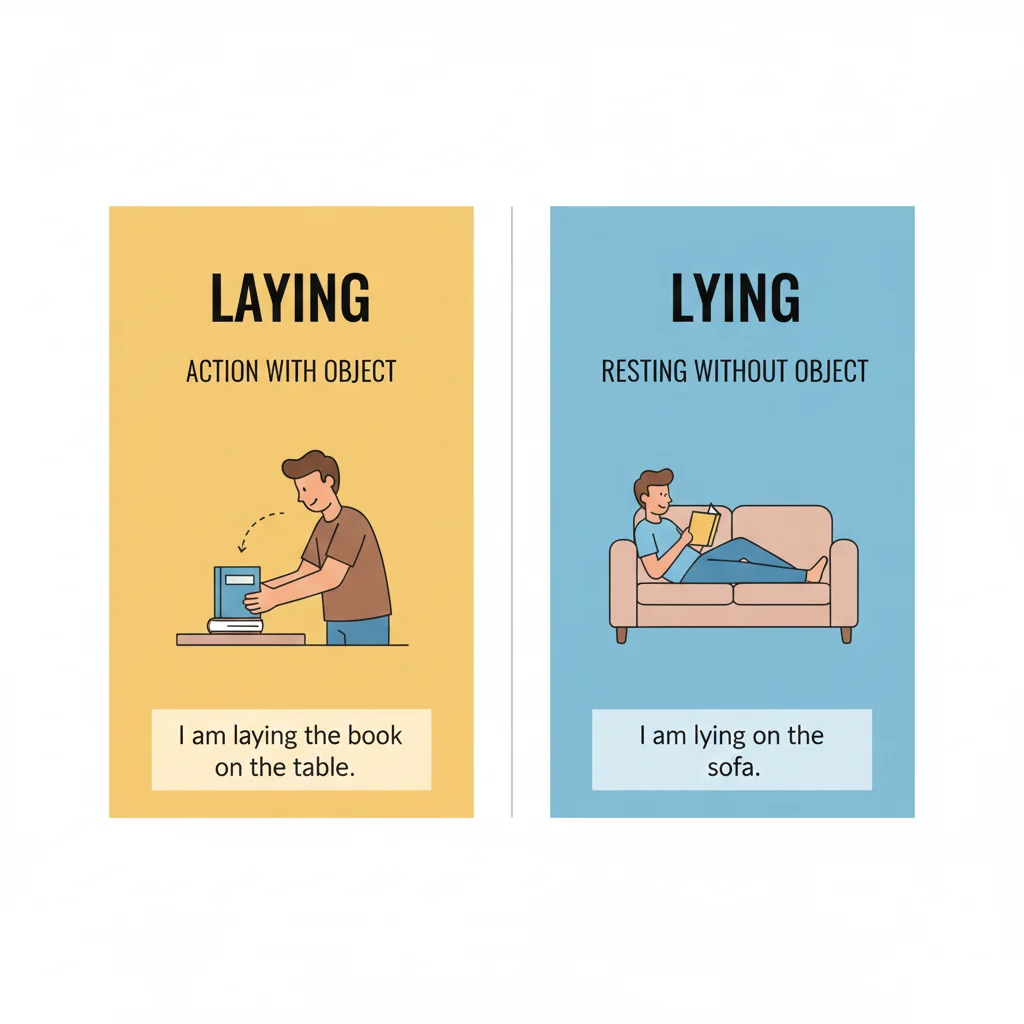
It means to put or place something down carefully.
👉 You must have an object — something being laid down.
Part of Speech: Verb (an action word that needs an object)
Examples:
- The hen is laying eggs in the nest.
- She is laying the books on the table.
- He is laying the mat on the floor.
🪶 Quick memory tip: If you can add a thing (like “an egg,” “a book,” or “a mat”) after it — use laying.
2. Lying
“Lying” is the present participle of “lie.”
It means to rest or recline — to be in a flat or horizontal position.
👉 You do not need an object.
Part of Speech: Verb (an action that does not take an object)
Examples:
- The cat is lying on the sofa.
- I am lying in bed because I’m tired.
- He was lying under the tree enjoying the breeze.
🛏️ Quick memory tip: If the subject is just resting or relaxing — use lying.
⚖️ The Key Difference Between Laying and Lying
| Feature | Laying | Lying |
|---|---|---|
| Root Verb | Lay | Lie |
| Meaning | To put or place something down | To rest or recline |
| Object Needed? | ✅ Yes (you lay something) | ❌ No (you lie yourself) |
| Example | She is laying the baby in the crib. | The baby is lying in the crib. |
| Past Tense | Laid | Lay |
| Present Participle | Laying | Lying |
💡 Quick Tip to Remember:
If there’s an object after it → laying.
If it’s just the person or thing resting → lying.

🚫 Common Mistakes and How to Avoid Them
❌ Mistake 1:
“I’m laying on the couch.”
✅ Correction: “I’m lying on the couch.”
👉 You are not placing anything; you are resting.
❌ Mistake 2:
“She is lying the baby down.”
✅ Correction: “She is laying the baby down.”
👉 The baby is the object being placed.
❌ Mistake 3:
“The books are laying on the table.”
✅ Correction: “The books are lying on the table.”
👉 The books are resting, not being placed.
🧩 Why do these mistakes happen?
Because both “lay” and “lie” change forms in confusing ways — especially their past tenses:
- Lay → laid → laying
- Lie → lay → lying
Yes, “lie” turns into “lay” in the past tense — and that’s what confuses most people!
🪶 When to Use “Laying”
Use “laying” when you are putting something down.
There’s always an object involved — something being laid.
Examples:
- She is laying her clothes neatly on the bed.
- The builder is laying bricks for the new wall.
- They are laying the table for dinner.
- The hen is laying eggs every morning.
- I’m laying the foundation for my new project.
✨ Memory Hack: “Laying = placing.” If you can replace it with placing, it’s correct!
😴 When to Use “Lying”
Use “lying” when something or someone is resting or in a flat position.
There’s no object after it.
Examples:
- I am lying on the grass watching clouds.
- The keys are lying on the counter.
- He was lying in bed all day.
- The dog is lying near the door.
- She is lying down because she feels tired.
🧠 Memory Hack: “Lying = resting.” If you can replace it with resting, it’s correct!
🔁 Quick Recap: Laying vs Lying
✅ Laying → You lay something down (needs an object).
✅ Lying → You lie down (no object).
Easy to remember:
If you can name what’s being placed → use laying.
If it’s just resting → use lying.
Examples:
- “I’m laying my phone on the desk.” (object = phone)
- “I’m lying on the desk.” (no object = just you)
🌍 Advanced Tips: Origin, Grammar, and Formal Use
Both “lay” and “lie” come from Old English roots:
- Lay (lecgan) meant to place.
- Lie (licgan) meant to rest.
In formal writing, such as essays or reports, using the correct form shows your grammar accuracy.
For example:
- Formal: “The documents are lying on the manager’s desk.”
- Informal but correct: “I’m just lying down for a nap.”
In texting or online writing, many people type “laying” when they mean “lying.” While common, it’s still grammatically incorrect — so use the right one when writing professionally or for school.
🧩 Mini Quiz: Test Your Understanding!
Fill in the blanks with laying or lying.
- The baby is ___ in the crib.
- She is ___ the blanket on the bed.
- The cat is ___ near the fireplace.
- I’m tired; I’ll be ___ down for a while.
- They are ___ new tiles on the floor.
- The keys were ___ on the counter all day.
- The hen is ___ eggs again!
Answers:
- lying
- laying
- lying
- lying
- laying
- lying
- laying
❓ FAQs
1. What is the difference between laying and lying?
“Laying” means to place something down, while “lying” means to rest or recline.
2. How can I remember when to use laying or lying?
If there’s an object, use “laying.” If not, use “lying.”
3. Is it correct to say “I’m laying down”?
No. It should be “I’m lying down.” You’re not placing anything.
4. What is the past tense of lie?
The past tense of “lie” is “lay.” Example: “Yesterday, I lay on the sofa.”
5. Why is laying vs lying so confusing?
Because “lie” turns into “lay” in the past tense, which sounds like the present form of “lay.”
📝 Conclusion
Now you know the clear difference between laying and lying!
- Use laying when you’re placing something down.
- Use lying when you’re resting or reclining.
With these easy tips, you’ll never mix them up again — for real! Keep practicing with your own examples every day, and soon you’ll use them naturally and confidently.

Arwen Blythe is a passionate language and culture enthusiast, crafting clear, engaging guides on words, phrases, and modern English for Definevs.com readers.