Ever wondered whether you should write Jesus’ or Jesus’s?
You’re not alone — this is one of the most common grammar confusions in English, even among native speakers. Both look correct, both sound similar, but only one is right in certain situations.
In this guide, you’ll learn:
- The meaning and usage of “Jesus’” and “Jesus’s”
- The difference between them
- When to use each correctly
- Common mistakes, examples, and memory tricks to make it simple
By the end, you’ll know exactly which one to write in school essays, church writing, or everyday English.
✨ What Does Each Form Mean?
Let’s start by understanding both words clearly.
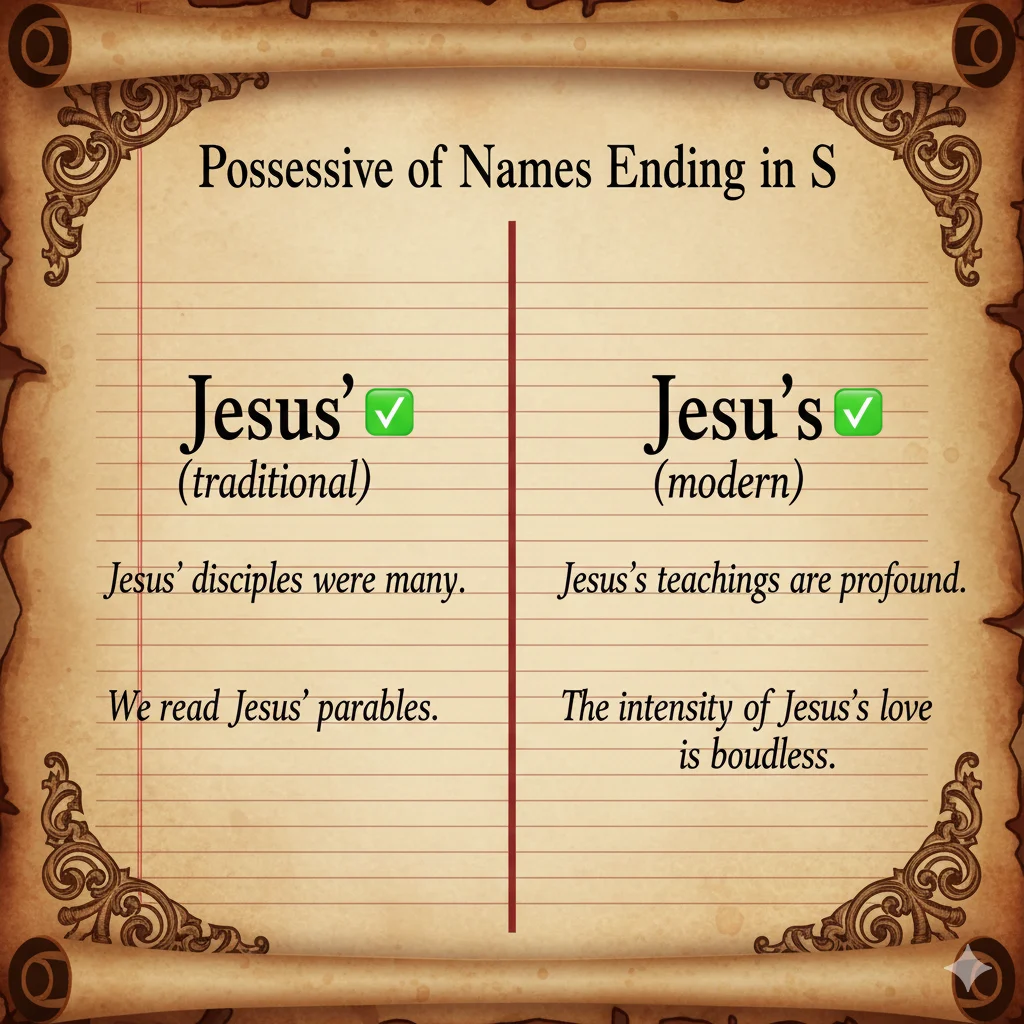
1. Jesus’ (with only an apostrophe)
- Part of speech: Possessive noun
- Used for: Showing ownership when a name already ends with -s.
- Meaning: Something that belongs to Jesus.
✅ Examples:
- We celebrate Jesus’ resurrection at Easter.
- The church honors Jesus’ teachings every Sunday.
- That painting shows Jesus’ compassion for others.
This form is more traditional and biblical — often used in religious writing or formal texts.
2. Jesus’s (with apostrophe + s)
- Part of speech: Possessive noun
- Used for: Showing ownership following standard English possessive rules (add ’s to singular nouns).
- Meaning: Also means something that belongs to Jesus.
✅ Examples:
- Jesus’s disciples followed him faithfully.
- We learned about Jesus’s parables in class.
- The choir sang Jesus’s favorite hymn.
This form follows modern grammar rules — common in academic writing, modern books, and everyday English.
⚖️ The Key Difference Between Jesus’ and Jesus’s
Both forms show possession — the difference lies in style and pronunciation.
| Feature | Jesus’ | Jesus’s |
|---|---|---|
| Meaning | Belonging to Jesus | Belonging to Jesus |
| Grammar Rule | Used when a singular noun ends with “s” | Standard possessive for all singular nouns |
| Common In | Religious or traditional texts | Modern or academic writing |
| Pronunciation | Often said as “JEE-zus” (one syllable) | Pronounced “JEE-zus-iz” (two syllables) |
| Example | Jesus’ sacrifice saved many. | Jesus’s kindness inspired us all. |
💡 Quick Tip:
If your teacher or church style guide prefers traditional English, use Jesus’.
If you follow modern grammar (like in essays or school writing), use Jesus’s.
🚫 Common Mistakes and How to Avoid Them
❌ Mistake 1: Forgetting the apostrophe altogether
Incorrect: Jesuss teachings inspire millions.
✅ Correct: Jesus’ teachings inspire millions.
❌ Mistake 2: Mixing both styles in one text
Incorrect: Jesus’s birth and Jesus’ resurrection are both important.
✅ Correct: Use one style consistently — either Jesus’s OR Jesus’.
❌ Mistake 3: Thinking one form is wrong
Both forms are correct — just follow the style guide or context you’re writing in.
✍️ Cancelled or Canceled: What’s the Difference and Which Is Correct?
📖 When to Use “Jesus’”
Use Jesus’ when:
- You’re writing religious texts, Bible studies, or church documents.
- The style feels more traditional or formal.
- The pronunciation naturally ends with “-s” (you don’t say the extra “-iz” sound).
✅ Examples:
- Christians believe in Jesus’ miracles.
- Jesus’ name is often mentioned in prayers.
- The Bible describes Jesus’ followers with devotion.
- The story of Jesus’ birth is told every Christmas.
- We celebrate Jesus’ victory over death at Easter.
📘 Memory Hack:
If you’re reading or writing something biblical, think “short and sacred” → Jesus’ (no extra s).
✍️ When to Use “Jesus’s”
Use Jesus’s when:
- You’re following modern English grammar rules (like The Chicago Manual of Style).
- Writing essays, articles, or general English pieces.
- You prefer clarity and complete pronunciation.
✅ Examples:
- Jesus’s message of love inspires millions.
- Jesus’s life teaches forgiveness and faith.
- Many artists depict Jesus’s compassion in paintings.
- We studied Jesus’s miracles in Sunday school.
- The teacher discussed Jesus’s parables in class.
🎯 Memory Hack:
If it’s modern, academic, or conversational, add ’s — like any other name (e.g., Chris’s car, James’s book, Jesus’s love).
🔁 Quick Recap: Jesus’ vs. Jesus’s
- Both mean “belonging to Jesus.”
- Jesus’ → Traditional, biblical, often in religious or older texts.
- Jesus’s → Modern, follows general grammar rules.
- Both are correct — just be consistent in your writing.
✅ Easy Rule:
If unsure, add ’s — modern style accepts it everywhere.
📚 Advanced Tips: Grammar, Style, and Pronunciation
🕊️ Origin and Grammar Rule
In Old English, possessives always added ’s (like God’s will or Thomas’s book).
Later, writers dropped the extra “s” after names ending with “s” — mostly for religious respect and ease of pronunciation.
That’s why older Bible translations and traditional churches still prefer Jesus’, while modern style guides like Chicago and APA recommend Jesus’s.
📖 Formal Writing Tip
If you’re writing an essay, research paper, or modern blog, use Jesus’s — it shows grammatical accuracy.
If you’re writing hymns, sermons, or Bible commentary, use Jesus’ — it fits the tone and tradition.
📱 In Online Writing or Texting
Both are rarely used in casual chat, but if you ever need to type it (like a quote or post), pick one and stick to it.
Example: “Jesus’s words always bring me peace. ❤️”
🧩 Mini Quiz: Test Yourself
Choose the correct form in each sentence 👇
- _______ birth is celebrated on December 25.
- The choir sang about _______ love and mercy.
- We learned about _______ disciples in class.
- The teacher talked about _______ miracles.
- Christians follow _______ teachings.
✅ Answers:
- Jesus’ / Jesus’s
- Jesus’ / Jesus’s
- Jesus’ / Jesus’s
- Jesus’ / Jesus’s
- Jesus’ / Jesus’s
(Both correct — depending on your style choice!)
❓ FAQ Section
1. What’s the difference between Jesus’ and Jesus’s?
Both show possession. “Jesus’” is traditional; “Jesus’s” is modern. The choice depends on the style guide or context.
2. Which is grammatically correct: Jesus’ or Jesus’s?
Both are correct. Modern English prefers Jesus’s (with ’s), while older or religious writing uses Jesus’.
3. How do you pronounce Jesus’s?
Pronounced “JEE-zus-iz,” with an extra syllable at the end. “Jesus’” is pronounced just “JEE-zus.”
4. Is Jesus’ outdated?
Not at all — it’s still widely used in church, biblical, and traditional writing styles.
5. Can I use both forms in the same essay?
No. Pick one and stay consistent throughout your writing.
🏁 Conclusion
Now you know the difference between Jesus’ and Jesus’s — and when to use each!
Remember: both show ownership, but Jesus’ is traditional while Jesus’s is modern and widely accepted today.
Whether you’re writing a Bible study, an essay, or a personal note, the key is consistency.
Keep practicing, keep learning, and soon you’ll use possessives like a grammar pro! ✨

Kael Donovan is a language enthusiast and writer at Definevs.com, simplifying complex words and grammar rules into fun, easy-to-understand guides for readers.