
Many people get confused when writing names that already end in “s”, like Jesus, James, or Moses. Should we write Jesus’ or Jesus’s when showing something that belongs to Him? 🧐
Don’t worry — you’re not alone! The difference between Jesus’ and Jesus’s has puzzled even native English speakers. But once you understand the rule, it’s super simple!
In this guide, we’ll explain the meaning, difference, and correct usage of Jesus’ vs Jesus’s — with clear examples, grammar tips, and easy memory tricks. By the end, you’ll know exactly when to use each form, just like a grammar pro. 🌟
📖 What Does Each Form Mean?
Let’s start by understanding both words.
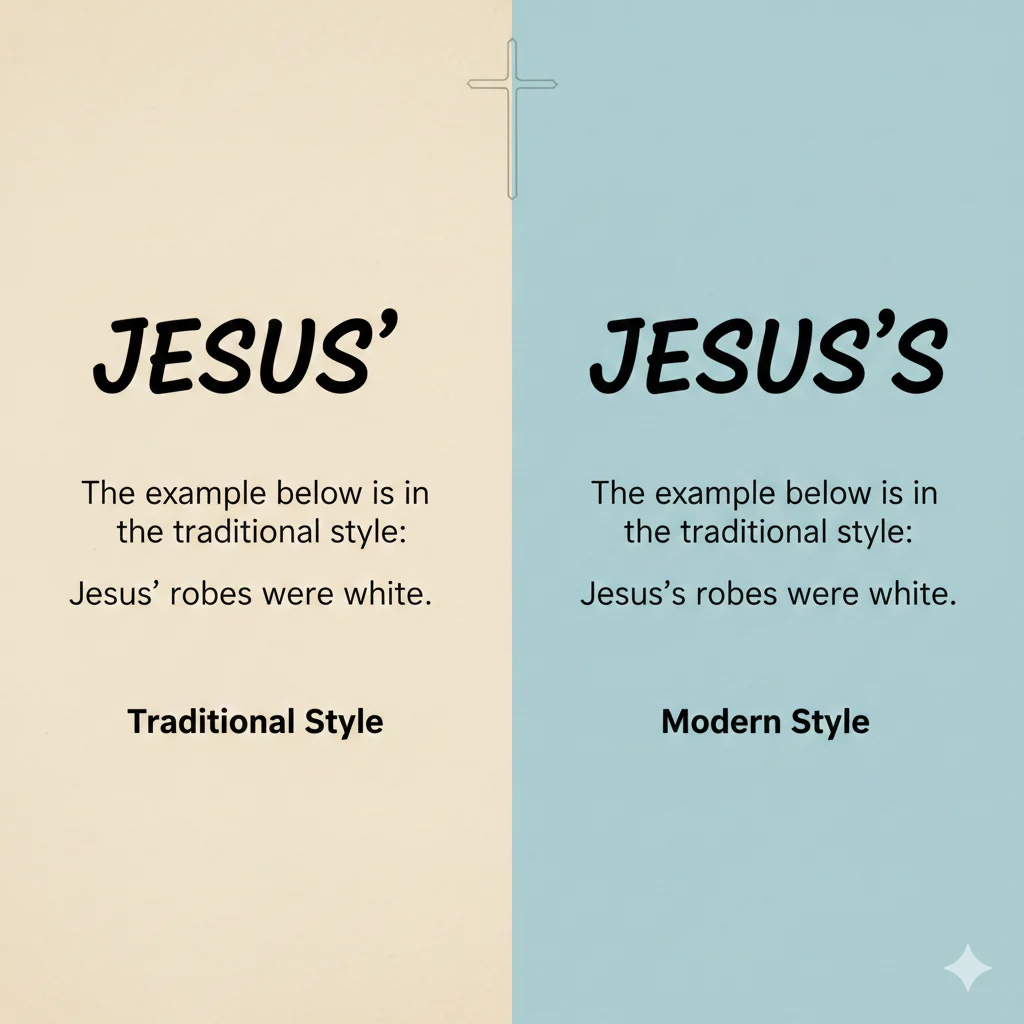
✝️ Jesus’
This is a possessive form of the name Jesus, showing that something belongs to Him — like Jesus’ disciples or Jesus’ teachings.
Some style guides (like the Bible tradition and Associated Press) prefer this shorter form when the name already ends in “s.”
Examples:
- Jesus’ followers spread His message.
- The church honors Jesus’ sacrifice.
- We read about Jesus’ miracles in class.
🙏 Jesus’s
This is also a possessive form, but it adds ’s even though the name already ends in “s.”
This style is supported by the Chicago Manual of Style and is often used in modern or academic writing.
Examples:
- Jesus’s love is endless.
- We celebrated Jesus’s birth at Christmas.
- The painting shows Jesus’s compassion for people.
All of a Suddenly / All of the Sudden: What You’re Saying Wrong ❗
⚖️ The Key Difference Between Jesus’ and Jesus’s
Here’s a quick and clear comparison you can remember easily 👇
| Feature | Jesus’ | Jesus’s |
|---|---|---|
| Meaning | Shows possession (something belongs to Jesus) | Also shows possession |
| Grammar Type | Possessive noun | Possessive noun |
| Preferred In | Religious, traditional, or journalistic writing (AP Style) | Academic, literary, or formal writing (Chicago Style) |
| Example | Jesus’ teachings are inspiring. | Jesus’s teachings are inspiring. |
| Pronunciation | Sounds like “Jesus” | Sounds like “Jesus-iz” |
💡 Quick Tip:
If you’re writing for religious or news-related work, use Jesus’.
If you’re writing a book, essay, or academic paper, use Jesus’s.
Both are correct — it just depends on your style choice. ✅
🚫 Common Mistakes and How to Avoid Them
Even though both forms are correct, here are common errors people make 👇
❌ Incorrect: Jesuses teachings were powerful.
✅ Correct: Jesus’ teachings were powerful.
❌ Incorrect: Jesus miracles amazed everyone.
✅ Correct: Jesus’s miracles amazed everyone.
👉 Why it happens:
People often forget to add the apostrophe (’) to show ownership. Without it, the word looks plural instead of possessive.
✍️ When to Use “Jesus’”
Use Jesus’ when you’re following traditional or religious style — especially in:
- Church writing ✝️
- Bible studies 📖
- News articles 📰
- Religious essays
Examples:
- The story of Jesus’ resurrection gives people hope.
- We prayed in Jesus’ name.
- The choir sang about Jesus’ love.
- The pastor spoke about Jesus’ forgiveness.
- Jesus’ message of peace still inspires us today.
Memory Trick:
👉 If your topic feels spiritual or religious, use Jesus’.
🕊️ When to Use “Jesus’s”
Use Jesus’s when following modern grammar or academic style, like:
- Essays or school papers 🏫
- Books or literature 📚
- Formal writing ✍️
Examples:
- Jesus’s teachings influence Western philosophy.
- We admire Jesus’s courage and kindness.
- The movie portrayed Jesus’s final days beautifully.
- Jesus’s story changed the course of history.
- The students discussed Jesus’s parables in class.
Memory Trick:
👉 If your writing feels modern or academic, use Jesus’s.
🔁 Quick Recap: Jesus’ vs Jesus’s
Here’s a short summary to help you remember fast 👇
✅ Both forms show possession (belonging).
✅ Jesus’ — used in traditional or religious writing.
✅ Jesus’s — used in modern or academic writing.
✅ Both are grammatically correct.
✅ The choice depends on the style guide you follow.
📘 Example Reminder:
- “Jesus’ love never ends.” (religious)
- “Jesus’s kindness inspires me.” (academic)
🧠 Advanced Grammar Tips
✨ Origin:
The possessive rule comes from Old English. Adding ’s after a singular noun shows ownership — even if the word ends in “s.”
✨ Formal Writing:
In school essays or reports, it’s safer to use Jesus’s, because it follows modern grammar rules.
✨ Religious Context:
Churches, hymnals, and Bibles often use Jesus’, out of respect and tradition.
✨ Online Writing:
If you’re unsure which one to choose, check your target audience. For blogs or casual writing, either form is accepted — just stay consistent.
Every One / Everyone: The Tiny Detail You’re Getting Wrong 🤯
🧩 Mini Quiz — Test Your Grammar!
Fill in the blanks with Jesus’ or Jesus’s 👇
- _____ love is the greatest example of kindness.
- We prayed in _____ name during the ceremony.
- The story of _____ birth is told every Christmas.
- Many admire _____ teachings about compassion.
- The artist painted _____ miracles in beautiful colors.
- The movie showed _____ final days on earth.
- Everyone was moved by _____ forgiveness.
(Answers: 1. Jesus’s, 2. Jesus’, 3. Jesus’s, 4. Jesus’s, 5. Jesus’s, 6. Jesus’s, 7. Jesus’)
🌟 Conclusion
Now you know the difference between Jesus’ and Jesus’s — both show that something belongs to Jesus, but your choice depends on writing style. Whether you write Jesus’ compassion or Jesus’s compassion, both are grammatically correct!
Keep practicing, notice how different sources use them, and choose the one that fits your writing best. Every time you learn a new grammar rule, your English becomes stronger and clearer. 💪📖
💬 FAQs
1. Is Jesus’ correct?
Yes! It’s the traditional possessive form used in religious or journalistic writing.
2. Is Jesus’s wrong?
No, Jesus’s is also correct — it’s the modern possessive form preferred by many grammar guides.
3. Which one should I use in school essays?
Use Jesus’s — it follows modern English grammar rules.
4. Why do both forms exist?
Different style guides (AP, Chicago, etc.) prefer different forms — but both mean the same thing.
5. How do you pronounce Jesus’s?
It’s pronounced “Jesus-iz.”

Mira Loxley is a passionate language and writing expert at Definevs.com, turning tricky words and grammar into clear, engaging guides for every reader.