Is sand homogeneous or heterogeneous?
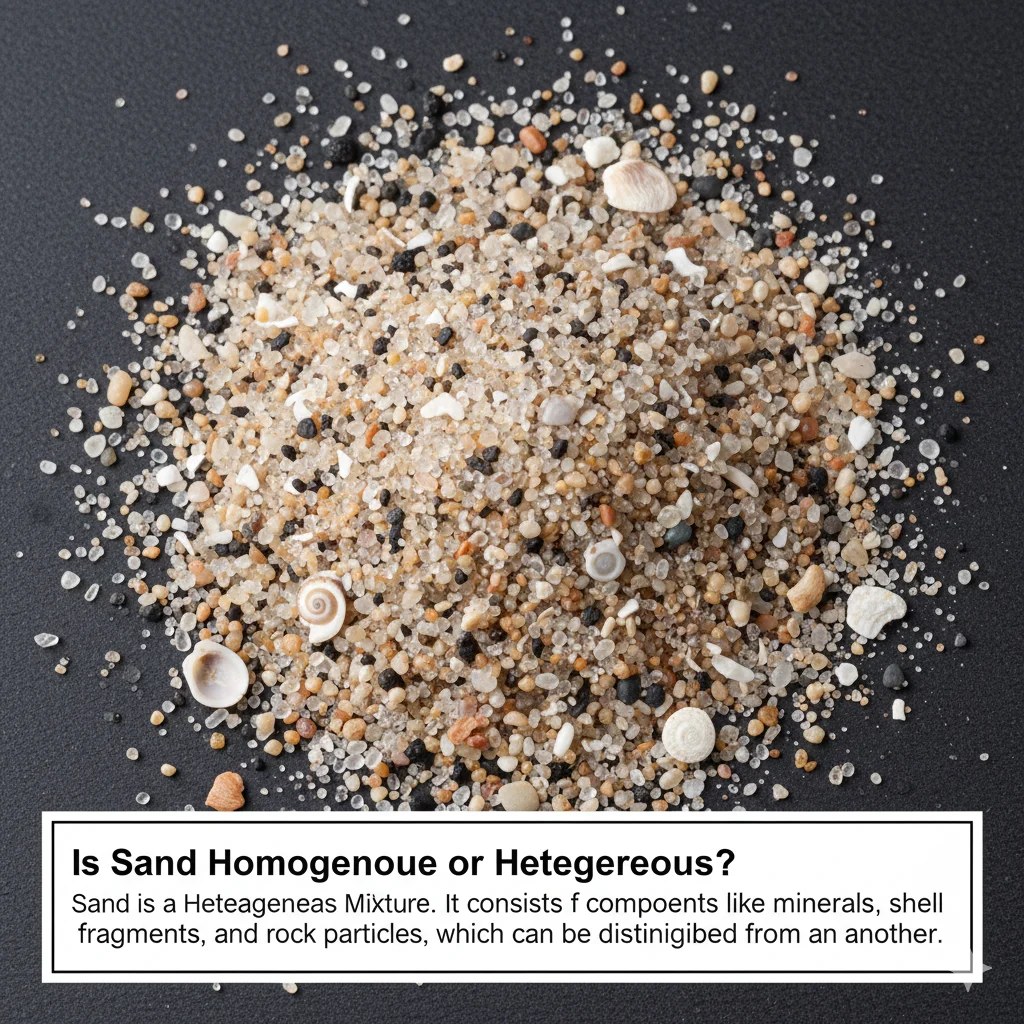
👉 Sand is heterogeneous because its particles are different in size, shape, and often color, and they are not evenly mixed.
Many students, parents, and even adults often ask: is sand homogeneous or heterogeneous?
This confusion happens because sand looks simple at first glance. It feels the same in your hand, so people think it must be uniform. But science looks deeper than just appearance.
In this easy guide, you will learn what homogeneous and heterogeneous mean, how they are different, and why sand is classified as heterogeneous. We will use simple words, short sentences, and real-life examples so even a 4th-grade student can understand without stress.
By the end of this article, you will clearly know:
- The meaning of homogeneous and heterogeneous
- The difference between homogeneous and heterogeneous mixtures
- The correct answer with examples, a table, visuals, and a fun quiz
Let’s make this topic simple and clear 😊
What Does Each Word Mean?

Meaning of Homogeneous
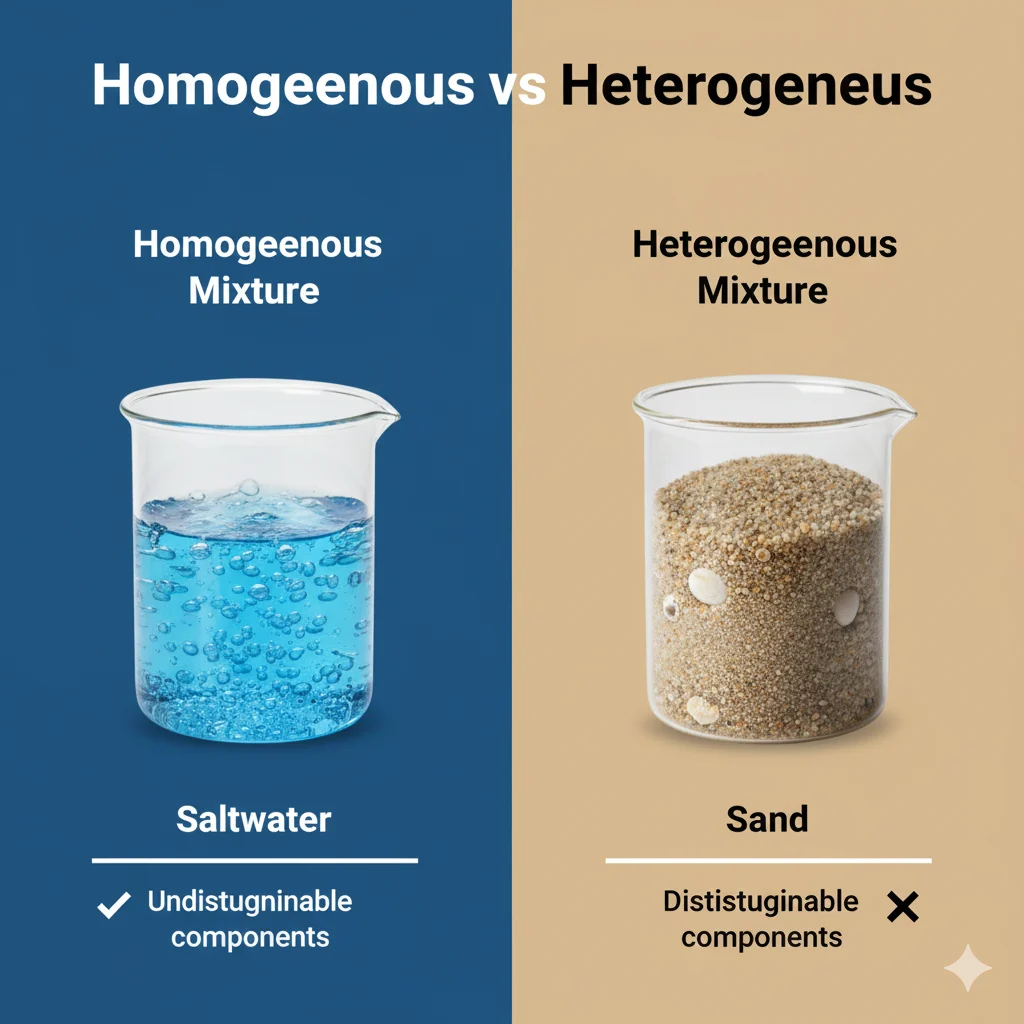
Homogeneous means everything is the same throughout.
- You cannot see different parts.
- Every portion looks and feels the same.
Easy examples:
- Salt mixed in water
- Sugar dissolved in tea
- Air around us
Mini story:
If you pour sugar into milk and stir it well, you cannot see the sugar anymore. That mixture is homogeneous.
Part of science:
Homogeneous is used to describe mixtures.
Meaning of Heterogeneous
Heterogeneous means different parts are mixed but not the same everywhere.
- You can see different pieces.
- Parts may look different in size, color, or shape.
Easy examples:
- Fruit salad
- Pizza
- Sand
Mini story:
When you eat a fruit salad, you can see apples, bananas, and grapes. That makes it heterogeneous.
Part of science:
Heterogeneous also describes mixtures.
The Key Difference Between Homogeneous and Heterogeneous
Difference Between Homogeneous and Heterogeneous (Table)
| Feature | Homogeneous | Heterogeneous |
|---|---|---|
| Meaning | Same everywhere | Different parts |
| Appearance | Uniform | Non-uniform |
| Can you see parts? | No | Yes |
| Example | Salt water | Sand |
| Easy clue | Smooth look | Mixed look |
Quick Tip to Remember:
👉 “Homo” means same
👉 “Hetero” means different
Is Sand Homogeneous or Heterogeneous?
Now let’s answer the main question clearly.
Why Sand Is Heterogeneous
Sand is made of:
- Different sized particles
- Different shapes
- Sometimes different colors
- Bits of rocks, shells, and minerals
When you look closely at sand:
- Some grains are big
- Some are tiny
- Some are light
- Some are dark
Because sand is not the same throughout, the correct answer is:
✅ Sand is heterogeneous
Even if sand looks similar from far away, under a microscope or close view, it shows clear differences.
Common Mistakes and How to Avoid Them
❌ Mistake 1: “Sand looks the same, so it must be homogeneous”
✔️ Correction:
Looks can be tricky. Science checks inside, not just outside.
❌ Mistake 2: “All mixtures are homogeneous”
✔️ Correction:
Some mixtures are homogeneous (salt water).
Some are heterogeneous (sand).
❌ Mistake 3: “Only colorful things are heterogeneous”
✔️ Correction:
Even same-colored items can be heterogeneous if parts are different.
How to avoid mistakes:
Ask yourself:
- Can I see different parts?
- Are all particles the same size?
If the answer is no, it is heterogeneous.
When Is a Mixture Homogeneous?
Use homogeneous when:
- Everything is evenly mixed
- You cannot separate parts easily
- Every spoonful looks the same
Examples:
- Lemon juice without pulp
- Salt dissolved in water
- Clear soda
- Vinegar
- Air
Real-life example:
When your mom mixes sugar in tea and it disappears, the tea becomes homogeneous.
When Is a Mixture Heterogeneous?
Use heterogeneous when:
- Parts are visible
- Sizes are different
- Mixing is uneven
Examples:
- Sand
- Soil
- Vegetable soup
- Trail mix
- Rice and beans
Memory Hack:
👉 If you can pick out pieces, it’s heterogeneous.
Quick Recap: Homogeneous vs Heterogeneous
- Homogeneous: Same everywhere
- Heterogeneous: Different parts
- Sand: Heterogeneous
- Salt water: Homogeneous
- Key trick: Visible differences = heterogeneous
Advanced Tips
Word History
- Homogeneous comes from Greek meaning “same kind”
- Heterogeneous comes from Greek meaning “different kind”
In Exams & Writing
- Always explain why sand is heterogeneous
- Mention particle size and composition
In Texting & Online Writing
Using the wrong term can:
- Lose marks in exams
- Change meaning in science answers
So accuracy matters ✨
Mini Quiz: Test Your Understanding
Fill in the blanks:
- Sand is a __________ mixture.
- Salt water is __________.
- A fruit salad is __________.
- If parts look the same everywhere, the mixture is __________.
- If parts are different and visible, the mixture is __________.
- Soil is usually __________.
Quiz Answers:
- Heterogeneous
- Homogeneous
- Heterogeneous
- Homogeneous
- Heterogeneous
- Heterogeneous
FAQs
1. Is sand homogeneous or heterogeneous?
Sand is heterogeneous because its particles are different in size and composition.
2. Why is sand not homogeneous?
Sand is not uniform. You can see different grains and materials.
3. Is beach sand homogeneous?
No. Beach sand is also heterogeneous.
4. Can sand ever be homogeneous?
In real life, no. Natural sand always has mixed particles.
5. Is soil homogeneous or heterogeneous?
Soil is heterogeneous, just like sand.
Conclusion
Now you clearly know the answer to is sand homogeneous or heterogeneous. Sand is heterogeneous because it contains different particles that are not evenly mixed. You learned the meanings, differences, examples, common mistakes, and even tested yourself with a quiz.
Understanding simple science words like homogeneous and heterogeneous builds strong basics. Keep observing things around you—food, drinks, soil, and mixtures. The more you practice, the better your understanding becomes.
🌟 Learning science can be simple and fun—one small concept at a time!

Kael Donovan is a language enthusiast and writer at Definevs.com, simplifying complex words and grammar rules into fun, easy-to-understand guides for readers.