Have you ever seen the words “ingrained” and “engrained” and wondered if they mean the same thing? You’re not alone! These two words look almost identical — and even sound the same — which makes many English learners confused about which one is correct.
In this easy guide, you’ll learn:
- The simple meanings of both words
- The difference between ingrained and engrained
- When and how to use each correctly
- Real-life examples and memory tricks to help you remember
By the end, you’ll know exactly which one to use in your writing — for real, for school, or even in professional English!
🧠 What Does Each Word Mean?
Let’s break down both words one by one, in simple terms.
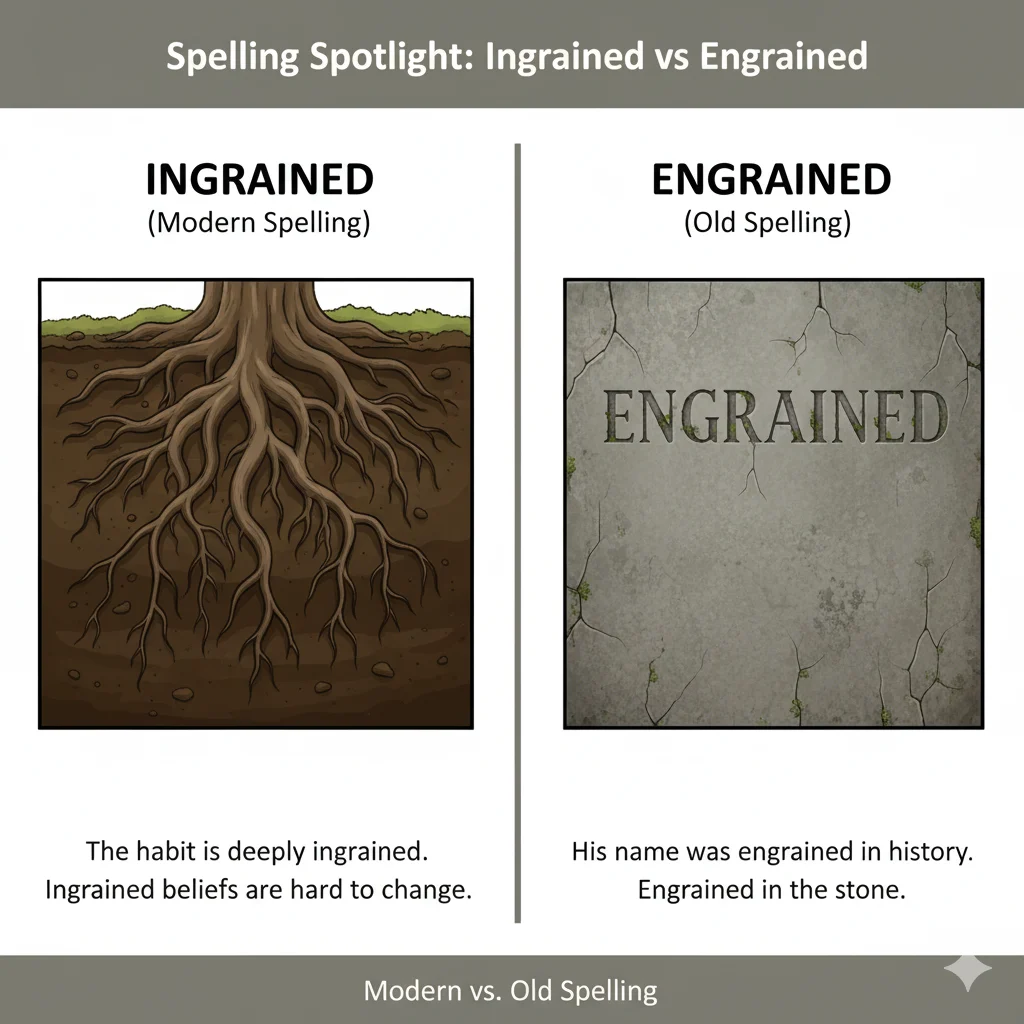
Ingrained (correct and most common spelling)
Meaning: Deeply fixed or established — something that’s a strong part of your thoughts, habits, or nature.
Part of speech: Adjective
Examples:
- Her love for reading is ingrained from childhood.
- Honesty is ingrained in his character.
- The habit of brushing teeth every night is ingrained in most people.
Think of “ingrained” like a stain that goes deep into fabric — it’s not easy to remove. It’s part of the material now!
Engrained (less common spelling)
Meaning: It means the same as ingrained — but it’s an older or alternative spelling. It’s mostly seen in British English or old texts.
Part of speech: Adjective
Examples:
- The values of kindness were engrained in her by her parents.
- The old traditions were engrained in their culture.
- Respect for elders is engrained in many communities.
Although both spellings are correct, “ingrained” is far more common in modern English.
🔍 The Key Difference Between Ingrained and Engrained
| Feature | Ingrained | Engrained |
|---|---|---|
| Meaning | Deeply fixed or firmly rooted | Same meaning (variant spelling) |
| Usage | Common in modern English (US & UK) | Less common, old-fashioned |
| Spelling Type | Standard spelling | Alternative/rare spelling |
| Example | “That belief is ingrained in me.” | “That belief is engrained in me.” |
✅ Quick Tip to Remember
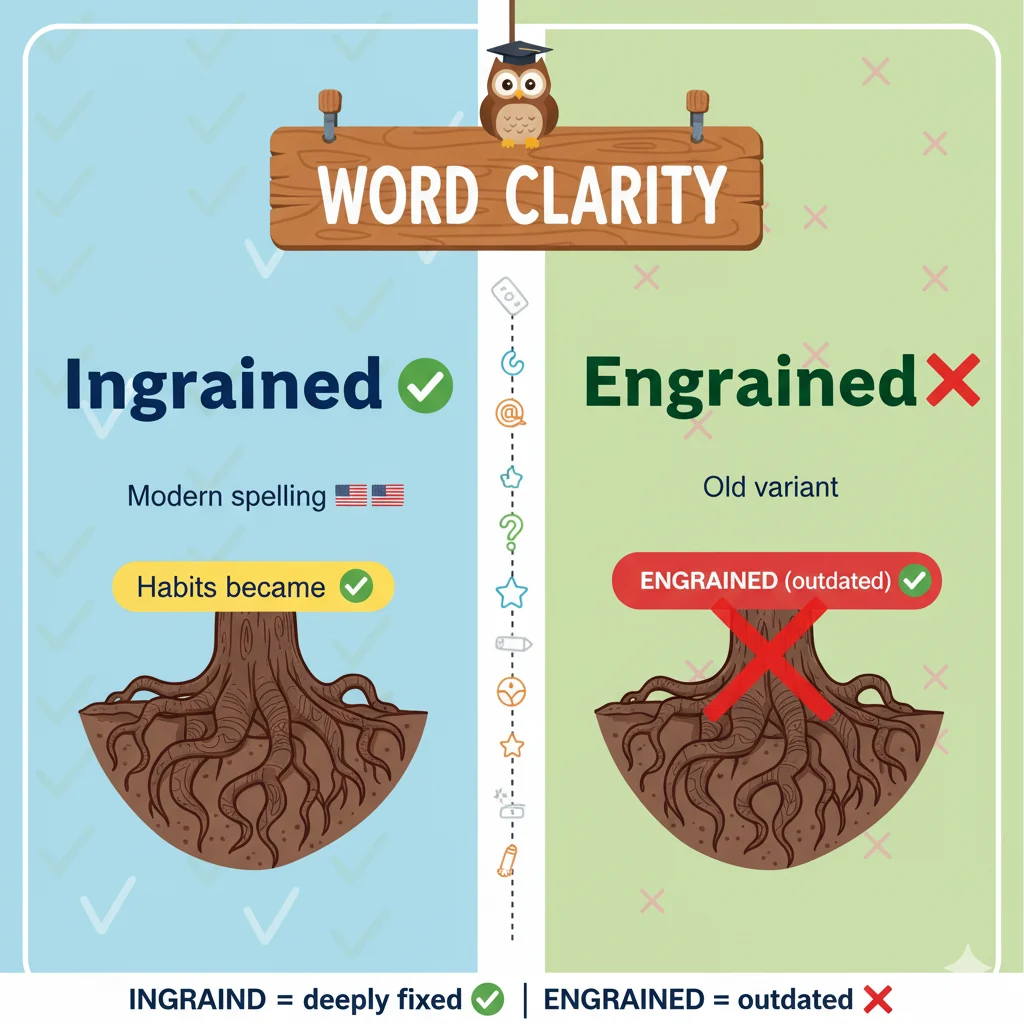
👉 Use “ingrained” for all modern writing — essays, emails, or online content.
👉 Think: “I” for Important — Ingrained is the Important (correct) form!
⚠️ Common Mistakes and How to Avoid Them
❌ Mistake 1:
The tradition is engrained in our society.
✅ Correct:
The tradition is ingrained in our society.
Why? — “Ingrained” is the standard modern spelling.
❌ Mistake 2:
My fear of dogs is engrained since childhood.
✅ Correct:
My fear of dogs is ingrained since childhood.
Why? — “Engrained” looks similar to “engrave,” which can confuse meaning. Stick with “ingrained.”
How to avoid confusion:
Remember that “engrained” is rare. Most dictionaries mark it as a variant of “ingrained.” Always choose the simpler, widely accepted version.
✍️ When to Use “Ingrained”
Use “ingrained” when you want to describe beliefs, habits, emotions, or ideas that are deeply rooted or permanent.
Examples:
- His patience is ingrained in his nature.
- The habit of saving money was ingrained early in life.
- Her confidence is ingrained after years of hard work.
- These traditions are ingrained in the culture.
- Respect for teachers is ingrained in our school.
Real-life tip:
Use “ingrained” for anything that’s built into who someone is or what something stands for.
📚 When to Use “Engrained”
Use “engrained” only if:
- You’re quoting old English literature or historical text.
- You’re using British English where it occasionally appears.
- You want a stylistic effect or old-fashioned tone.
Examples:
- The values were engrained in them by tradition.
- Loyalty was engrained in the knights of old.
- His manners were engrained through generations.
💡 Memory Hack
Think of “engrained” as “engraved” — both start with en- and give an old-fashioned or literary feel.
But for normal use, “ingrained” wins every time!
🧾 Quick Recap: Ingrained vs Engrained
- Ingrained → ✅ The correct, modern, and preferred spelling.
- Engrained → ☑️ An old or less common variant.
- Both mean “deeply rooted” or “firmly established.”
- Always use ingrained in writing, school, and business.
🪄 Quick Summary Table
| Rule | “Ingrained” | “Engrained” |
|---|---|---|
| Correct in modern English? | ✅ Yes | ⚠️ Rare |
| Meaning | Deeply fixed, rooted | Same |
| Best for | Everyday writing, school, exams | Old texts, style choice |
| Memory tip | “I” = Important, Correct | “E” = Extra, not needed |
💡 Advanced Tips: Word Origins and Usage
The word “ingrained” comes from the Latin root “granum,” meaning grain.
It originally referred to color dyed deeply into fabric fibers, not just on the surface. Over time, the meaning expanded to describe ideas or habits fixed deeply into someone’s character.
Engrained appeared later as a variant influenced by “engrave” — but today, it’s seen as less standard.
In Formal Writing or Exams
✅ Use “ingrained” to sound polished and accurate.
Example:
“Cultural values are deeply ingrained in society.”
In Casual Writing or Speech
You’ll almost always hear or see “ingrained.” “Engrained” might confuse readers or seem like a spelling error.
✏️ Mini Quiz — Test Your Understanding
Choose the correct word (ingrained or engrained) for each sentence:
- Good manners are _______ in her behavior.
- The habit of reading was _______ since childhood.
- These customs are _______ in local culture.
- His honesty is _______ in his nature.
- The old spelling “_______” is rarely used today.
(Answers: 1. ingrained, 2. ingrained, 3. ingrained, 4. ingrained, 5. engrained)
❓ FAQs
1. What is the difference between ingrained and engrained?
There’s no difference in meaning. “Ingrained” is the correct and modern spelling, while “engrained” is an older variant.
2. Which is correct: ingrained or engrained?
✅ “Ingrained” is correct in modern English. Most dictionaries and style guides recommend it.
3. Is engrained wrong?
Not exactly wrong, but outdated. It’s rarely used today outside of historical or British contexts.
4. Can I use engrained in formal writing?
You can, but it’s better to use “ingrained” — it’s more accepted in essays, reports, and academic writing.
5. How can I remember the correct form?
Think: “I for Important.” The important, modern word is ingrained!
🏁 Conclusion
Now you know the full difference between ingrained and engrained!
Both words mean the same thing — deeply rooted or firmly established — but “ingrained” is the spelling you should always use in everyday and formal writing.
Keep practicing, keep reading, and soon using the right word will become ingrained in your English skills! 🌱

Isla Merrin is a language and writing expert at Definevs.com, creating simple, engaging guides to help readers master words, grammar, and modern English usage.