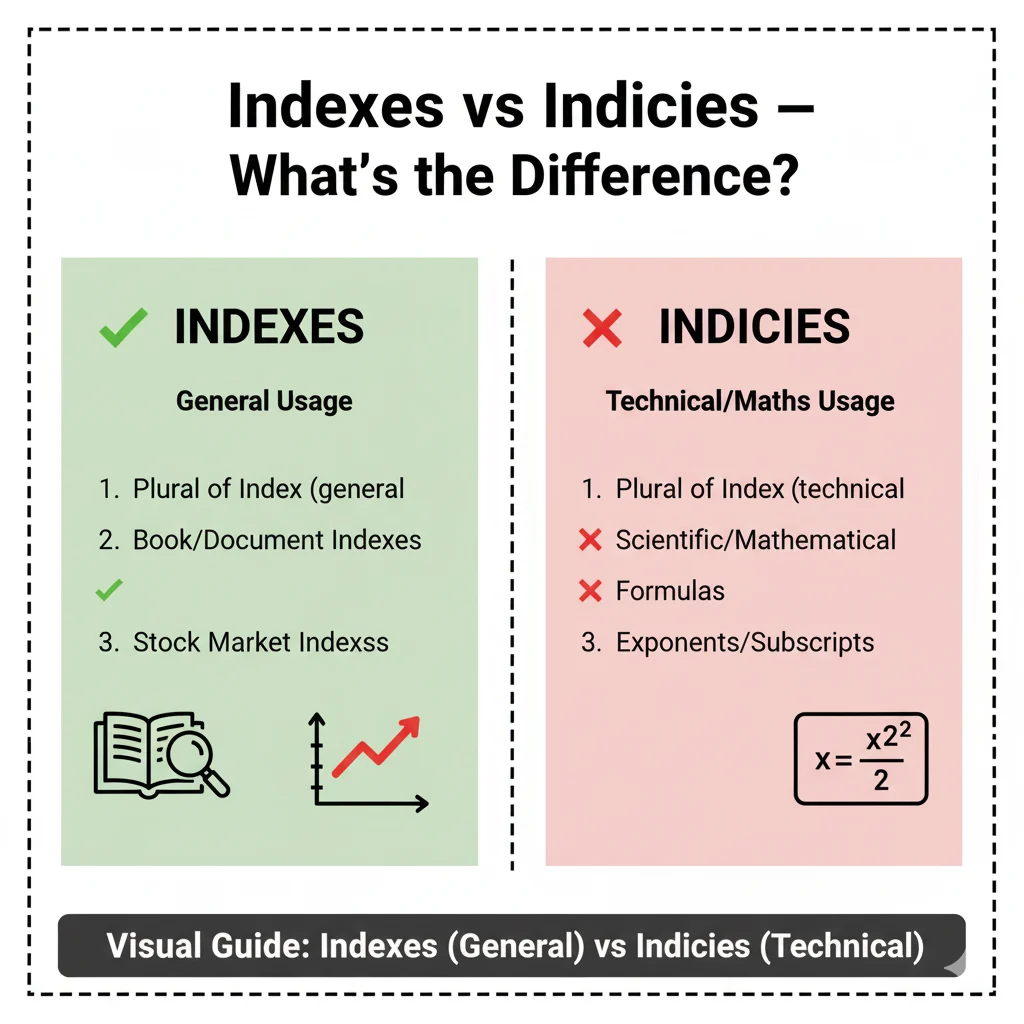
“Indexes” and “indices” both mean plural forms of “index.” “Indexes” is more common in general writing and digital contexts, while “indices” is preferred in mathematics, finance, and science. Both are correct, but their usage depends on the field and tone.
Have you ever paused mid-sentence wondering whether the correct plural is indexes or indices? You’re not alone. This pair is one of the most commonly confused word forms in English—and even native speakers debate which one to use. The confusion gets worse because both are technically correct, but their usage depends on the context, field, and tone of writing.
In this guide, we break down everything you need to know about indexes vs. indices so you never second-guess them again. You’ll learn:
- The exact meaning of both terms
- Where each version is used
- How they evolved over time
- Examples you can apply instantly
- Mistakes to avoid and FAQs
Let’s settle the debate once and for all.
What Does “Indexes / Indices” Mean?
“Indexes” and “indices” are both plural forms of the word “index,” meaning a list, pointer, or measurement used for reference, organization, or comparison.
“Indexes” is more common in everyday English, while “indices” is preferred in technical fields such as math, data science, and finance.
Origin and Popularity
The word index comes from the Latin term index, meaning “forefinger” or “pointer.” In classical Latin, the plural was indices, which carried into early English academic writing.
During the 1800s, as English evolved and became less dependent on Latin endings, many words developed regular plural forms, giving rise to indexes. This version became dominant in general writing, publishing, and technology—especially with the rise of search engines, database indexing, and website navigation.
A brief timeline:
- Pre-1800s: “Indices” was the preferred plural in scholarly texts.
- 1800–1900: English began simplifying Latin plurals → “Indexes” became acceptable.
- 21st century: Tech and data fields widely adopt “indexes”; science and finance still use “indices.”
Today, both forms remain correct, but their popularity varies by domain.
Indexes vs. Indices in Different Contexts
The meaning doesn’t change, but preference does. Here’s how each is used across platforms and fields.
✔ In General Writing (Everyday English)
- Preferred: Indexes
- Used for book indexes, website indexes, search engine indexes.
- Sounds modern, simple, and natural.
✔ In Mathematics
- Preferred: Indices
- Used when discussing exponents, subscripts, or variable positions.
- Example: “The indices of the sequence represent positions in the set.”
✔ In Finance & Economics
- Preferred: Indices
- Refers to market measures like stock indices, inflation indices, and price indices.
- Sounds more formal and industry-standard.
✔ In Technology / Databases
- Preferred: Indexes
- Used for search indexes, database indexes, coding indexes.
✔ In Academic or Scientific Writing
- Often preferred: Indices
- Example: “Researchers analyzed multiple indices of environmental risk.”
📊 Comparison Table
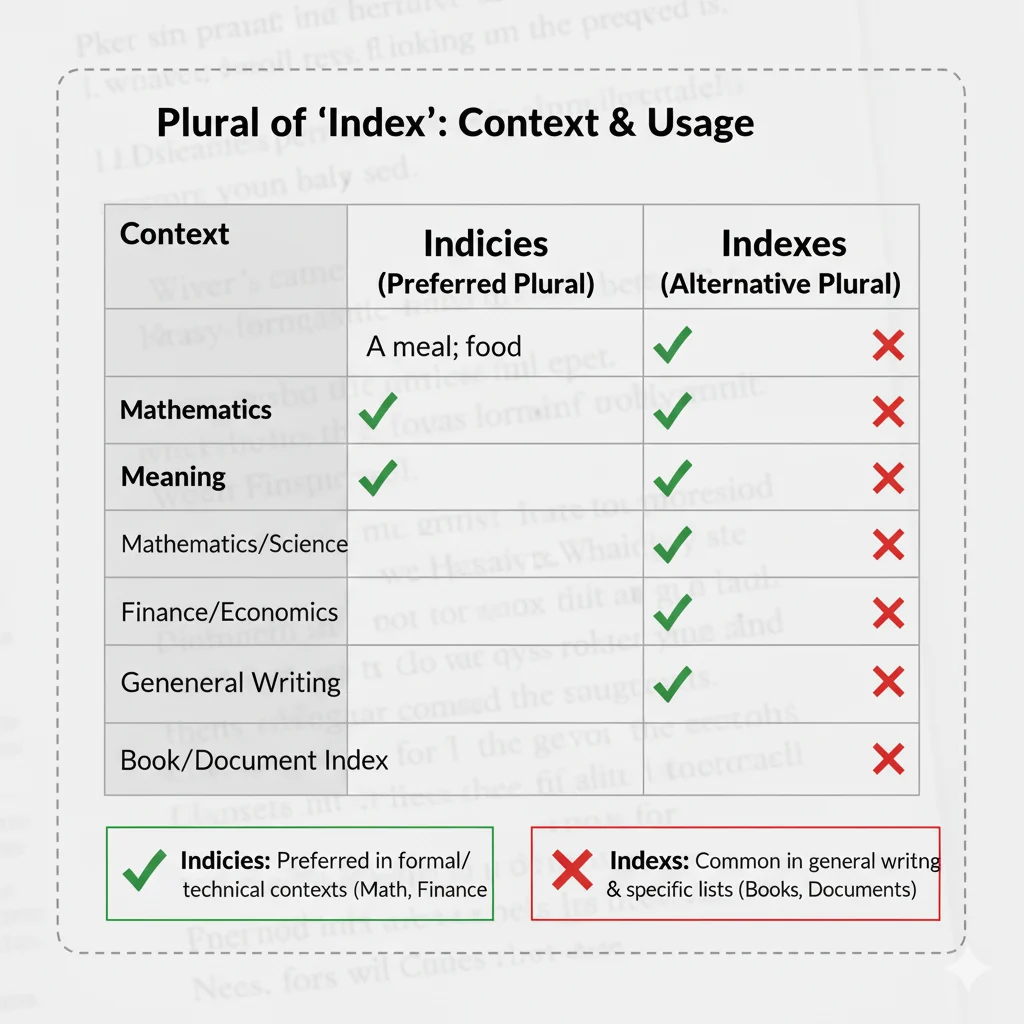
| Context / Field | Preferred Plural | Why |
|---|---|---|
| Everyday English | Indexes | Modern, simplified, widely used |
| Books & Publishing | Indexes | Standard for book back-matter |
| Technology / Coding | Indexes | Common in software and databases |
| Mathematics | Indices | Traditional Latin plural |
| Finance / Economics | Indices | Industry-specific standard |
| Scientific Research | Indices | Sounds formal and academic |
Examples of “Indexes” and “Indices” in Conversations
✔ Everyday Usage (Indexes)
Person A: Did you check the indexes at the back of the book?
Person B: Yes, I found the chapter on climate change easily.
Person A: The website’s indexes aren’t loading.
Person B: Try refreshing—it’s a server issue.
✔ Technical Usage (Indices)
Math Teacher: The indices of the sequence determine its growth rate.
Student: So each index shows the next value?
✔ Business / Finance Example
“Global financial indices rose sharply today following positive economic data.”
Similar or Related Terms
Here are related words that often appear in similar contexts:
- Appendices / Appendixes – similar dual plural forms
- Matrices – plural of matrix
- Data – plural form often used as singular
- Criteria – plural of criterion
Comparison Table
| Term | Singular | Plural Options | Notes |
|---|---|---|---|
| Index | Index | Indexes / Indices | Both correct depending on context |
| Appendix | Appendix | Appendices / Appendixes | Academic vs general use |
| Matrix | Matrix | Matrices | Technical fields |
| Criterion | Criterion | Criteria | Always plural |
How to Use “Indexes / Indices” Correctly
To ensure clarity and professionalism, follow these guidelines:
✔ Do’s
- Use “indexes” in general writing, publishing, websites, and tech.
- Use “indices” in math, finance, and scientific contexts.
- Pick one form and stay consistent in the same document.
- Choose the version your field expects.
❌ Don’ts
- Don’t mix “indexes” and “indices” in the same sentence unless comparing them.
- Don’t use “indices” in casual conversations—it may sound overly formal.
- Don’t assume one is more “correct”—they’re both accepted.
Common Mistakes or Misinterpretations
Here are frequent confusions:
❌ Mistake 1: Thinking one is incorrect
Both are valid English plurals; context decides which is preferable.
❌ Mistake 2: Using “indices” in everyday writing
It may sound unnecessarily technical in casual situations.
❌ Mistake 3: Assuming “indexes” can’t be used in professional fields
Tech, AI, and software engineering often require “indexes,” not “indices.”
❌ Mistake 4: Mixing the two forms randomly
Inconsistent usage can confuse readers or look unprofessional.
FAQ Section
Q1. What does “indexes” mean?
“Indexes” is the plural of index used in general English, publishing, website navigation, and technology. It refers to lists, guides, or reference points that help locate information.
Q2. What does “indices” mean in math or finance?
“Indices” is the Latin plural of index and is widely used in mathematics for exponents and sequences, and in finance for market measures like stock indices.
Q3. Which is more correct: indexes or indices?
Both are correct. “Indexes” is common in general writing and tech, while “indices” is standard in math, academia, and finance.
Q4. Can I use “indexes” in business writing?
Yes—especially in tech-related business writing. For financial reports, however, “indices” is more appropriate.
Q5. Why are there two plurals for the same word?
Because English adopted the Latin plural (“indices”) but later developed its own regular plural (“indexes”), and both forms remained in use.
Q6. When should I avoid using “indices”?
Avoid it in casual conversations, simple explanations, and non-technical writing to keep communication clear.
Conclusion
Understanding the difference between indexes and indices helps you write with clarity, confidence, and professionalism. While indexes fits everyday language, technology, and publishing, indices belongs to the worlds of mathematics, finance, and academic research. Both plurals are correct, but choosing the right one depends on your audience and context.
Now that you know what each term means and when to use it, you’ll never hesitate again—whether you’re writing an email, a report, or a research paper. Keep exploring our site for more simple, helpful guides that decode confusing English terms.

Mira Loxley is a passionate language and writing expert at Definevs.com, turning tricky words and grammar into clear, engaging guides for every reader.