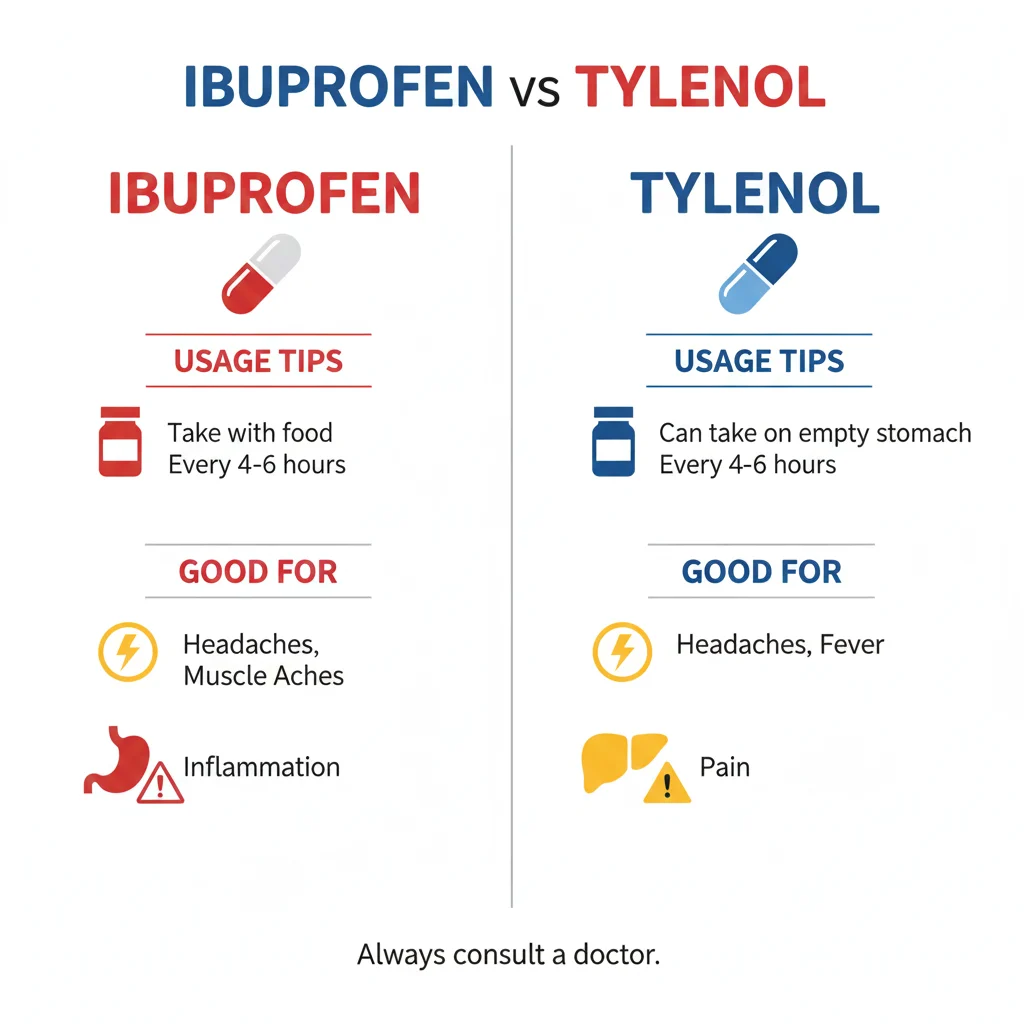
Ibuprofen is better for headaches caused by pressure, swelling, or tension.
Tylenol is better for mild headaches or headaches with fever, and it’s gentler on the stomach.
👉 If your headache feels tight, pounding, or sinus-related → choose Ibuprofen.
👉 If your headache is mild, soft, or you need something gentle → choose Tylenol.
Simple rule:
Inflammation = Ibuprofen
Mild / Fever = Tylenol
When people get a headache, one of the biggest questions they ask is: “Should I take ibuprofen or Tylenol for headaches?” These two medicines are common, easy to find, and widely used—but many people are confused about the difference. They sound similar and are often used for the same problems, which makes it harder to choose the right one.
In this simple, beginner-friendly guide, you’ll learn exactly what ibuprofen means, what Tylenol means, how they work, and which one is better for different types of headaches. You’ll also see examples, easy tips, memory tricks, and a simple comparison table. Even a 4th-grade student will understand everything clearly.
Let’s begin and finally settle the question: Ibuprofen or Tylenol for headaches—what’s the difference?
What Does Each One Mean?
Before deciding whether ibuprofen or Tylenol is better for headaches, we need to understand what each medicine is.
What Is Ibuprofen?
Ibuprofen is a pain reliever and anti-inflammatory medicine.
This means it reduces:
- pain
- swelling
- inflammation
Think of it as a medicine that calms down the body when something is irritated or inflamed.
Easy Examples:
- “I hurt my knee while running. Ibuprofen reduced the swelling.”
- “My headache felt tight, so ibuprofen helped relax the pressure.”
- “Ibuprofen helped when my tooth was throbbing and sore.”

What Is Tylenol?
Tylenol is the brand name for acetaminophen.
It is a pain reliever and fever reducer, but it does NOT reduce inflammation.
Tylenol is gentler on the stomach and usually a safer choice for people who cannot take NSAIDs.
Easy Examples:
- “I had a mild headache. Tylenol worked quickly.”
- “I had a fever, so I took Tylenol to feel better.”
- “Tylenol helped when I had a headache from staying up late.”

The Key Difference Between Ibuprofen and Tylenol for Headaches
Here is the main idea, in the simplest way:
👉 Ibuprofen reduces inflammation. Tylenol does not.
👉 Tylenol is gentler on the stomach than ibuprofen.
Because of this, each medicine works better for different types of headaches.
Comparison Table: Ibuprofen vs Tylenol
| Feature | Ibuprofen | Tylenol |
|---|---|---|
| Helps with pain | ✔️ | ✔️ |
| Reduces inflammation | ✔️ Yes | ❌ No |
| Reduces fever | ✔️ | ✔️ |
| Gentler on stomach | ❌ Not always | ✔️ Yes |
| Best for | Tension headaches, sinus headaches, headaches with pressure | Mild headaches, fever headaches |
| Works faster? | Medium speed | Fast for many people |
| Example use | “My head hurts from sinus pressure.” | “I stayed up late and got a simple headache.” |
Quick Tip to Remember
If your headache feels like pressure or swelling → Ibuprofen.
If your headache is mild or you need something gentle → Tylenol.
Common Mistakes and How to Avoid Them
❌ Mistake 1: Thinking both medicines do the same thing
✔️ Fix: Remember, ibuprofen reduces inflammation, Tylenol does not.
❌ Mistake 2: Taking ibuprofen on an empty stomach
✔️ Fix: Take ibuprofen with food to avoid stomach irritation.
❌ Mistake 3: Using Tylenol for pressure headaches
✔️ Fix: If the headache comes from sinus swelling or tightness, ibuprofen works better.
When to Use Ibuprofen (Easy Guide)
Use ibuprofen for headaches that feel:
- tight
- pounding
- swollen
- caused by sinus pressure
- related to tension or muscle strain
Real-Life Example Sentences:
- “My head feels tight from stress, so I took ibuprofen.”
- “My sinus headache hurts when I bend down. Ibuprofen helps.”
- “I pulled a neck muscle, causing a headache—ibuprofen worked.”
- “I have a headache with swelling around my eyes; ibuprofen reduces the pressure.”
- “After a loud event, my head felt inflamed, so ibuprofen helped calm it down.”
Memory Hack:
Ibuprofen = I for Inflammation.
If inflammation = yes → choose ibuprofen.
When to Use Tylenol (Easy Guide)
Use Tylenol for headaches that are:
- mild
- caused by lack of sleep
- caused by dehydration
- caused by fever
- safe choice when ibuprofen irritates your stomach
Real-Life Example Sentences:
- “I woke up with a simple headache—Tylenol helped.”
- “My head hurts because I have a fever. Tylenol lowered the fever and pain.”
- “I didn’t eat well today, so Tylenol was safer for my stomach.”
- “My headache is light and dull, so Tylenol worked quickly.”
- “I’m sensitive to NSAIDs, so I prefer Tylenol for headaches.”
Memory Hack:
Tylenol = T for Tender (gentle on stomach).
Quick Recap: Ibuprofen vs Tylenol for Headaches
- Ibuprofen = inflammation + pressure + swelling relief
- Tylenol = gentle relief + fever + mild pain
- Ibuprofen is stronger for tension or sinus headaches.
- Tylenol is better for simple or fever-related headaches.
- Both relieve pain but work differently.
Advanced Tips (For Curious Readers)
- Origins: Ibuprofen is an NSAID invented in the 1960s. Tylenol (acetaminophen) has been used since the 1950s.
- Formal usage: Doctors often recommend Tylenol for people with stomach sensitivity.
- Online writing: Saying “ibuprofen or Tylenol for headaches” is a common search phrase because users want quick clarity. Incorrect assumptions can lead to using the wrong medicine.
- Combination: Some doctors allow alternating both for certain headaches, but only under guidance.
Mini Quiz (Test Yourself!)
Fill in the blanks:
- ________ reduces inflammation.
- ________ is gentler on the stomach.
- For a sinus-pressure headache, ________ works better.
- For a mild headache from staying up late, ________ is a good option.
- ________ helps reduce fever.
- If your headache feels swollen, choose ________.
- If your headache is simple and soft, choose ________.
- Ibuprofen
- Tylenol
- Ibuprofen
- Tylenol
- Tylenol
- Ibuprofen
- Tylenol
5 FAQs
1. Which is better for headaches: ibuprofen or Tylenol?
Ibuprofen works better for pressure or inflammation headaches. Tylenol works better for mild or fever headaches.
2. Is Tylenol safer than ibuprofen?
Yes, Tylenol is gentler on the stomach, but it must still be taken as directed.
3. Can I take both ibuprofen and Tylenol together?
Only if a doctor recommends it. Follow medical advice.
4. Does ibuprofen work faster than Tylenol?
Sometimes, but many people feel Tylenol starts working quicker.
5. Which one should I take for sinus headaches?
Ibuprofen is usually better because it reduces inflammation and pressure.
Conclusion
Choosing ibuprofen or Tylenol for headaches becomes easy once you understand how each one works. Ibuprofen helps with swelling and pressure, while Tylenol is better for gentle, mild headaches or fever. Now that you know the difference—plus examples, tips, and memory hacks—you can choose the right medicine with confidence. Practice these rules, and soon you’ll never be confused again.

Mira Loxley is a passionate language and writing expert at Definevs.com, turning tricky words and grammar into clear, engaging guides for every reader.