Have you ever wondered whether to write humor or humour? You’re not alone!
These two words look almost the same but are spelled differently depending on where you live. Many English learners — and even native speakers — get confused about which one to use.
In this easy guide, you’ll learn:
- The difference between humor and humour
- Their meanings and correct usage
- When to use each spelling
- Examples, memory tips, and a quick quiz
By the end, you’ll never mix them up again — for real!
What Does Each Word Mean?
Let’s look at the meanings of both humor and humour.
Spoiler: they mean the same thing, but the spelling changes depending on British or American English.
🟢 Humor
Meaning: The ability to find things funny or to make people laugh.
Part of Speech: Noun
Examples:
- My brother has a great sense of humor.
- That movie was full of humor and laughter.
- Even in tough times, she keeps her humor.
👉 Used in: American English (United States)
🔵 Humour
Meaning: Same as humor — the quality of being funny or making others laugh.
Part of Speech: Noun
Examples:
- British people are known for their dry humour.
- His jokes show a clever sense of humour.
- The teacher’s humour makes the class enjoyable.
👉 Used in: British English (UK, Canada, Australia, etc.)
The Key Difference Between Humor and Humour
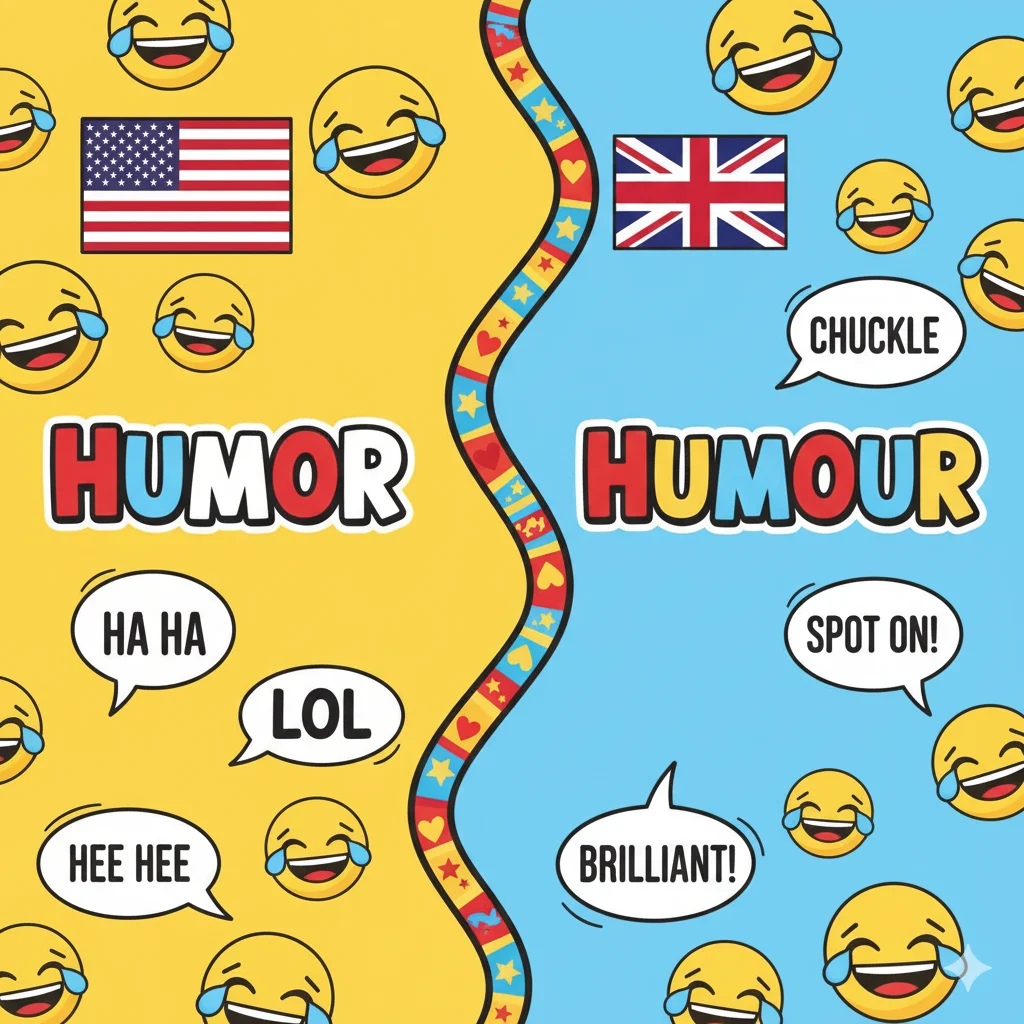
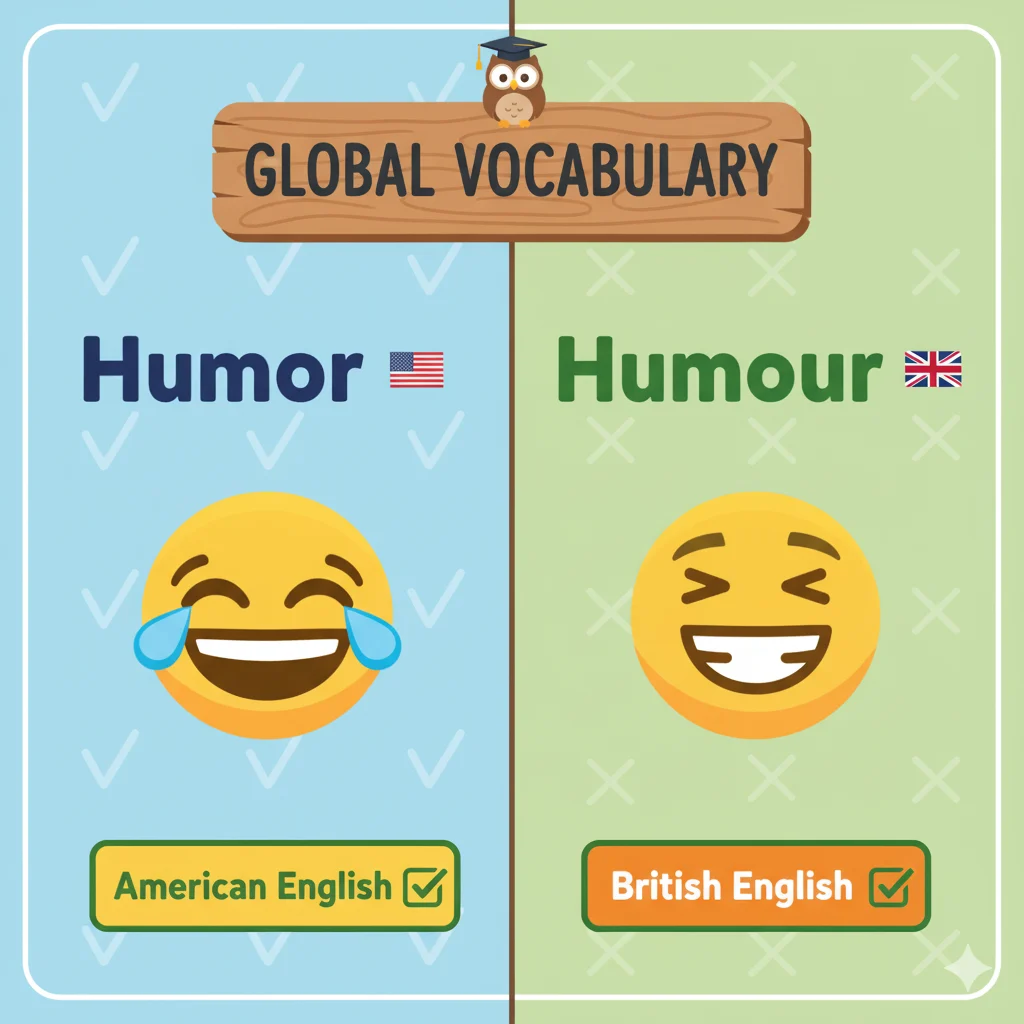
Both words have identical meanings, but differ in spelling based on region.
| Feature | Humor | Humour |
|---|---|---|
| Meaning | The ability to find things funny | Same meaning |
| Spelling Used In | American English | British English |
| Example Sentence | “I love your sense of humor.” | “I love your sense of humour.” |
| Pronunciation | /ˈhjuː.mɚ/ | /ˈhjuː.mə/ |
| Origin | Simplified American spelling | Original British spelling |
💡 Quick Tip to Remember:
If you’re writing for an American audience, drop the “u” → humor.
If your readers are in the UK or Commonwealth countries, keep the “u” → humour.
Common Mistakes and How to Avoid Them
Here are a few mistakes learners make when using these words:
❌ Incorrect: I like British humor shows.
✅ Correct (British): I like British humour shows.
❌ Incorrect: His humour makes me laugh (in U.S. writing).
✅ Correct (American): His humor makes me laugh.
Why this happens:
Both spellings look correct! But remember — it’s not about meaning; it’s about where you’re writing. Always match your spelling style to your audience.
🏷️ Labeling vs Labelling: What’s the Difference and Which One Is Correct?
When to Use “Humor”
Use humor when you are:
- Writing in American English
- Publishing for U.S. audiences (like blogs, school essays, or books)
- Following APA or U.S. spelling rules
Examples:
- The comedian’s humor made everyone laugh.
- I enjoy lighthearted humor in movies.
- Her dry humor often surprises people.
- He used humor to make a serious point.
- American humor can be very expressive.
🧠 Memory Hack:
Think “U leave out the U in the U.S.” → HUMOR (no “u”).
When to Use “Humour”
Use humour when you are:
- Writing in British English
- Addressing readers from the UK, Canada, or Australia
- Following Oxford or Cambridge English standards
Examples:
- British humour is often subtle and clever.
- She always adds a touch of humour to her stories.
- That TV show’s humour is loved around the world.
- The author’s dark humour makes his books unique.
- We need more humour in our daily lives.
🧠 Visual Trick:
Imagine the “U” in humour stands for UK — where this spelling is used.
Quick Recap: Humor vs Humour
Here’s a quick summary to lock it in 🔒
- ✅ Both mean the same thing.
- 🇺🇸 Humor = American English spelling.
- 🇬🇧 Humour = British English spelling.
- Always match your audience (U.S. or U.K.).
- Same pronunciation, same meaning — only the spelling changes.
Advanced Tips: Origins and Formal Use
The word “humour” comes from the Old French term humor, meaning “fluid” or “mood.” In the Middle Ages, it referred to the body’s fluids that influenced emotions — like “good humour” or “bad humour.”
Later, it evolved to mean “funny or amusing behavior.”
When Noah Webster simplified American English in the early 1800s, he removed unnecessary letters like the “u” in “colour,” “flavour,” and “humour.” That’s how the U.S. spelling “humor” was born.
In formal writing, both are correct — just stay consistent! Don’t mix both spellings in one document.
Mini Quiz: Test Your Understanding
Fill in the blanks with the correct word — humor or humour.
- I enjoy British __________ because it’s so witty.
- His sense of __________ made everyone smile.
- Americans spell it as __________.
- Dark __________ can make serious topics easier to discuss.
- She added a bit of __________ to lighten the mood.
(Answers: 1. humour, 2. humor, 3. humor, 4. humor, 5. humour)
FAQs
1. What is the main difference between humor and humour?
They have the same meaning, but “humor” is used in American English, while “humour” is used in British English.
2. Which one should I use — humor or humour?
Use “humor” if you’re writing for the U.S., and “humour” for the U.K. or other Commonwealth countries.
3. Do humor and humour have the same pronunciation?
Yes, both are pronounced the same: /ˈhjuː.mər/.
4. Can I mix both spellings in my writing?
No, it’s best to stay consistent — choose one version based on your reader’s region.
5. Is humor/humour only used as a noun?
Mostly, yes. But it can also be used as a verb, meaning “to entertain” or “to go along with someone’s mood.”
Example: She humored her little brother by laughing at his joke.
Conclusion
So now you know — humor and humour mean the same thing but belong to different forms of English.
Use humor for American writing and humour for British or Commonwealth writing.
It’s a small difference that shows big attention to detail!
Keep practicing, stay consistent, and soon your English spelling will be — no joke — perfect. 😄

Arwen Blythe is a passionate language and culture enthusiast, crafting clear, engaging guides on words, phrases, and modern English for Definevs.com readers.